
Prepared for Takeoff: Two Trailblazing Aviation Leaders Share Lessons With Eagles

 Michaela Jarvis
Michaela Jarvis
/
Michaela Jarvis
Mar 06, 2026, 12:07 PM
Tammie Jo Shults was at the controls of Southwest Airlines Flight 1380 from New York’s La Guardia Airport when a fan blade in the left engine flew off, causing a destructive sequence in which the engine exploded and debris struck the side of the plane, shattering a window. The plane skidded sideways, rolled sharply to the left and started a deep dive as it lost air pressure.
Luckily, on the day of the engine explosion, Shults, a Navy veteran who had flown supersonic F/A-18 Hornets, and her crew worked quickly and calmly.
“Darren Ellisor was my first officer, and when our engine exploded, within two seconds, we regained control of the aircraft. Within six seconds, we had the engine secured that had exploded. Within 11 seconds, we turned back toward Philadelphia,” she said. “All of these things were not natural for Darren and me. But we had trained and made those things habits.”
Shults recounted details of the 2018 incident in a “Safer Skies” event hosted by the Boeing Center for Aviation and Aerospace Safety at Embry-Riddle Aeronautical University on Feb. 18. At the event, Shults joined forces with Maj. Gen. Jeannie Leavitt, dean of the College of Aviation at Embry-Riddle’s Prescott, Arizona, campus, presenting on Personal Resource Management (PRM) to an audience of about 230 people.
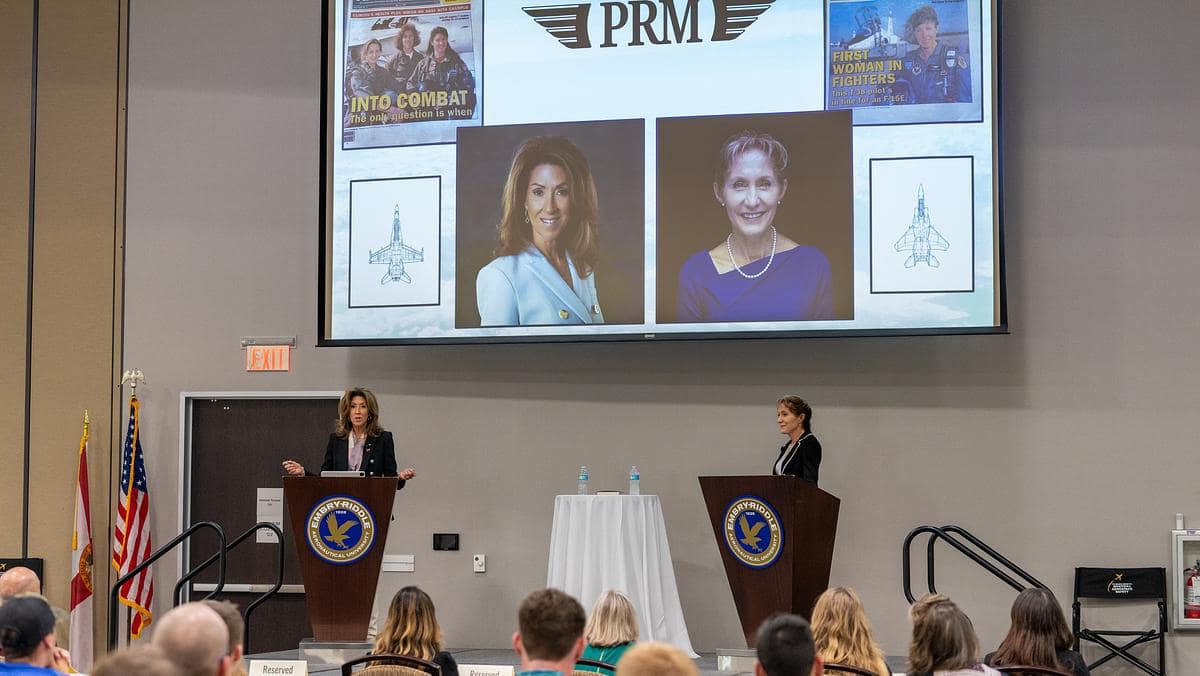
More than 200 people listened to Shults and Leavitt present on Personal Resource Management (PRM). (Photo: Embry-Riddle/David Massey)
Shults and Leavitt discussed their experiences for lessons in readiness, resilience and leadership.
Leavitt, who began her tenure as dean last month, was the first U.S. Air Force female fighter pilot and the first woman to command an Air Force combat fighter wing. She has flown more than 3,000 flight hours, including 300 combat hours in the F-15E Strike Eagle, in Iraq and Afghanistan and has served as the chief of safety for the Air Force and Space Force.
“To be the best possible crew member or team member, you need to not only bring your A game, but to have lived your A game every day,” Leavitt said. “So the question is: ‘how do we optimize that performance?’”
Leavitt advised students to be open to feedback — and to weigh it carefully.
“You need to ask for feedback. And be willing to hear it,” Leavitt said. “If we filter out positive comments, we think we need to fix everything, which can seem overwhelming. If we filter out negative comments, then we miss opportunities to learn and grow.”
When Shults started her Navy pilot training, she was the only woman in her squadron and became one of the first female fighter pilots to qualify to fly the F/A-18 Hornet. Although women were not allowed in combat roles at the time, she flew aircraft in aggressor missions in which she simulated the enemy. She also taught out-of-control flight — in which pilot trainees practice recovery from dramatic flight upsets such as spins and stalls — and other expert maneuvers.
Answering a question about how students should handle stress, Shults encouraged them not to lose perspective, explaining that she was 23 before she joined the Navy and was at first overwhelmed with the amount of information and the number of manuals she was supposed to commit to memory.
One year later, she said, she was learning to fly her second aircraft and had landed a jet on an aircraft carrier.
“You’re not going to be stressed or pressed like this your whole life. I wish I’d known that in college,” Shults said, adding that students should reset by setting aside time once a week. "Just 30 minutes, no distractions, no electronics," she said. "Just find a place out in nature to sit still and realize what a privilege it is to be studying at this incredible university.”
Shults is the author of the 2019 book Nerves of Steel: How I followed my dreams, earned my wings, and faced my greatest challenge.