
Record Number of Embry-Riddle Students Present Research at Campus Forums and at National Conference

Embry-Riddle Aeronautical University student researchers set a record in the number of projects presented at the university’s spring research forums and also showcased their work on a national stage.
Many projects focused on space, including studies of microgravity on bacteria, materials for lunar construction and models to better predict spacecraft trajectories. Other projects explored a range of topics, from immersive education to aerospace cybersecurity.
At Discovery Day 2026 on the Daytona Beach Campus, a total of 371 projects were presented, a record for the annual symposium. More than 950 undergraduate, graduate and doctoral students participated in the event. Ten projects came from Worldwide Campus students.
“Discovery Day highlights the incredible work our students are doing — from applied research and industry collaborations to innovative ideas and creative scholarship,” said Dr. Mihhail Berezovski, director of the Office of Undergraduate Research and associate professor of Mathematics. “It is a powerful reflection of Embry-Riddle’s commitment to experiential learning and student success.”
Undergraduate innovation was also on display at the Undergraduate Research Institute Discovery 2026 event on the Prescott Campus. It featured more than 90 projects, over half of which were supported through internal grants, industry partnerships and programs, such as the Arizona Space Grant.
“It has been an exciting year for our Embry-Riddle Prescott undergraduates, as is reflected in the breadth and depth of the presentations and demonstrations,” said Dr. Anne Boettcher, assistant dean of Research.
Embry-Riddle undergraduate researchers also recently presented at the National Conference on Undergraduate Research held April 13-15 in Richmond, Virginia. Berezovski said 51 students from the Daytona Beach Campus presented 35 projects. Embry-Riddle’s Prescott Campus also had six presentations.
Senior Vice President of Academic Affairs and Provost Dr. Kelly Austin said that he was inspired by the quality of work produced by Embry-Riddle students.
“Both events reflect the curiosity, determination, creativity and growing expertise of our Eagles as they engage in hands‑on discovery at the university,” he said. “Our faculty plays a vital role in cultivating that spirit and they encourage students to pursue innovative ideas and develop the real-world skills and knowledge that will define their future careers.”
Daytona Beach Discovery Days Recognize Top Researchers
Andrew Murphy was chosen as Overall Student Researcher of the Year, while Dr. Cagri Kilic was selected as Research Faculty Mentor of the Year at Daytona Beach’s Discovery Day 2026.
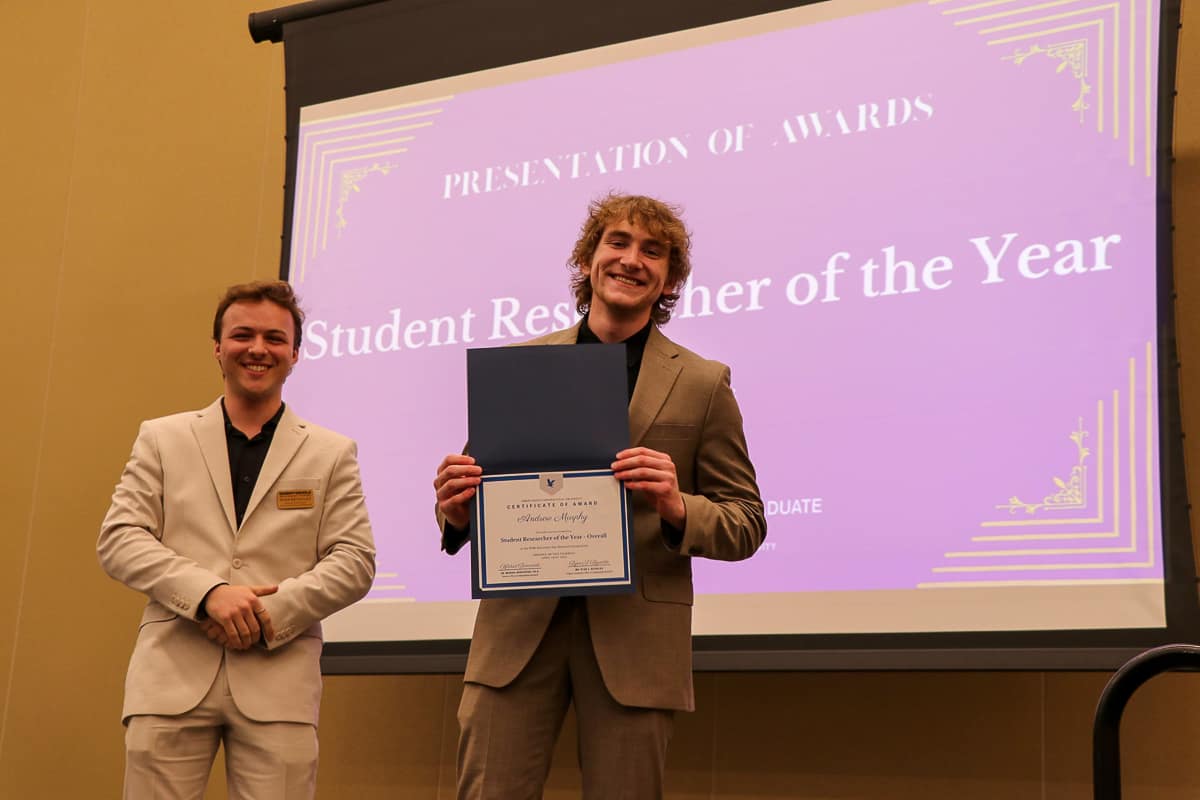
Andrew Murphy is a sophomore Aerospace Engineering student in the Honors Program. (Photo: Embry-Riddle/OUR)
Murphy, a sophomore Aerospace Engineering student in the Honors Program, is working on research projects in Embry‑Riddle’s Space Technologies Lab, the Space and Atmospheric Instrumentation Lab and the Department of Mathematics.
“I view research as a cornerstone of my identity, so this award is an especially prestigious honor for me,” said Murphy, who will be interning at the Lockheed Martin Corporation this summer. “As a sophomore, it reflects the impact I’ve been able to make in just two years through my involvement in research projects across the university."
Kilic, assistant professor in the College of Engineering and director of the university’s Space Robotics and Generative Estimation Lab, was named Faculty Mentor of the Year.
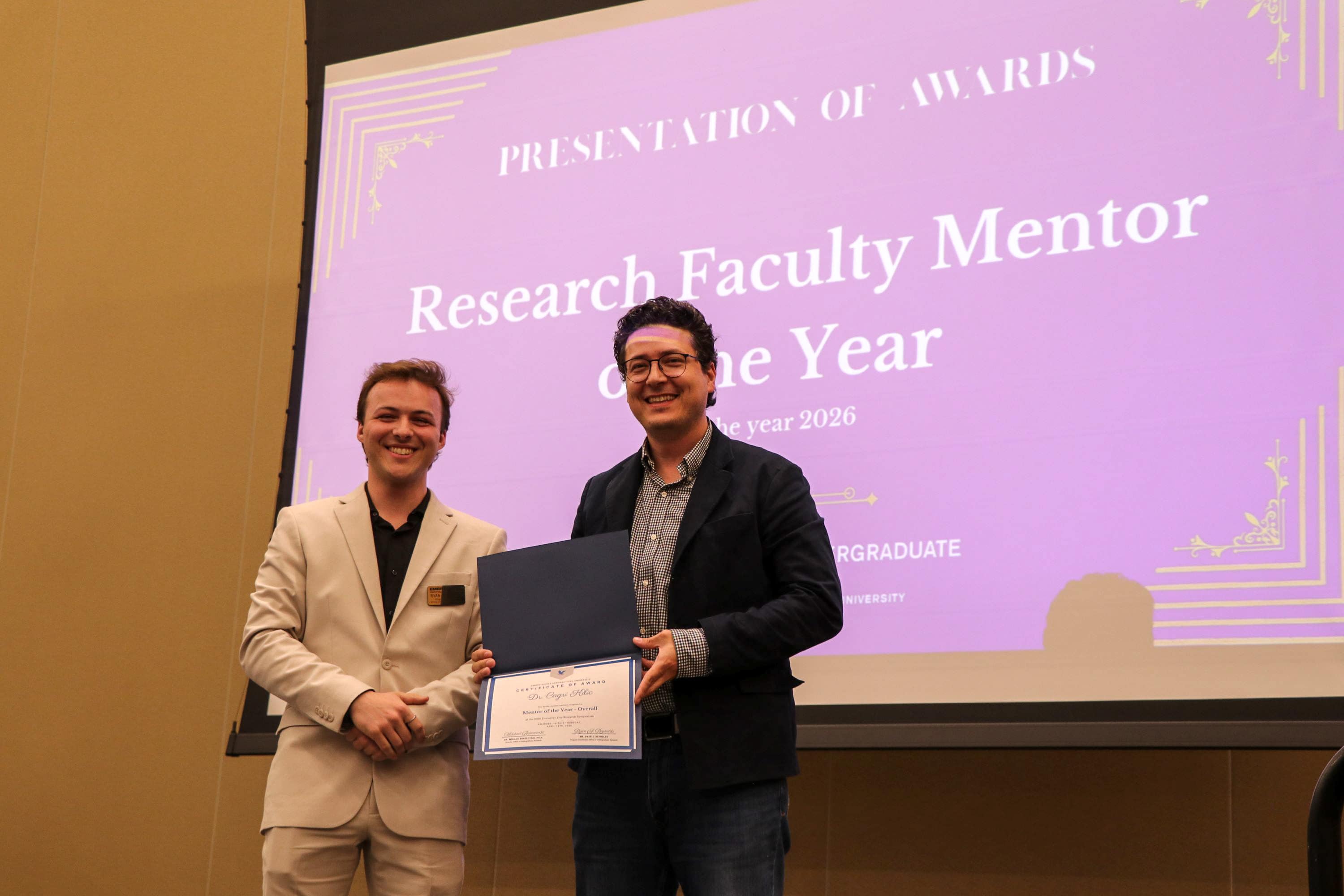
Dr. Cagri Kilic is an assistant professor in the College of Engineering and director of the university’s Space Robotics and Generative Estimation Lab. (Photo: Embry-Riddle/ OUR)
“First, we have excellent students,” said Kilic. “Working with them and getting this recognition is truly an honor.”
Additionally, the College of Arts and Sciences, College of Aviation, College of Engineering and David B. O'Maley College of Business at the Daytona Beach Campus recognized their top student and faculty researchers of the year.
Awards for the best undergraduate, master’s and Ph.D. posters were also given at the event.
Mechanical Engineering student Owen Maute and Aerospace Physiology student Tyler Jenkins tied for first place in the Best Overall Undergraduate Poster competition. Maute, who was also named the College of Engineering’s Student Researcher of the Year, is conducting research on designing a hybrid microturbine power and propulsion system for unmanned aerial vehicles. Jenkins is researching antibiotic resistance in bacteria under simulated microgravity.
Sarath Murarisetty and Arjun Myadam, who are both studying Aerospace Engineering, tied for first place in the Best Overall Graduate Poster for master’s degree students. Murarisetty’s research focuses on combining numerical methods with neural networks to develop a framework for more accurately predicting spacecraft trajectories in the region between the Earth and the moon. Myadam’s project develops a simulation to study and improve the properties of carbon fiber, thereby increasing strength and multi-functionality.
Human Factors student Sabrina Ehrenfort and Mechanical Engineering student Poorendra Ramlall tied for first place in the Best Overall Graduate Poster for Ph.D. students. Ehrenfort’s research investigates the impact of acute nitrate supplementation on inspiratory muscles, offering a viable, noninvasive intervention for patients recovering from mechanical ventilation. Ramlall’s project explores how driver interactions shape traffic dynamics and introduces a data-driven, human-in-the-loop framework for the next generation of transportation systems.
Additionally, each of the four colleges gave awards for the best undergraduate, master’s posters and Ph.D. posters.
The Office of Undergraduate Research also awarded 17 Ignite grants, given to undergraduate-led groups conducting long-term research projects, as well as 32 Summer Undergraduate Research Fellows (SURF) grants, which provide students with a stipend and additional funding to support their research over the summer. Each of the four colleges at the Daytona Beach Campus also awarded SURF grants.
Undergraduate Research Takes Center Stage at Prescott Campus
The projects presented at the Discovery 2026 event at the Prescott Campus showcased students working to solve a broad spectrum of challenges.
A first-year team developed a proposal for what they call “lunarcrete,” where fibers from cotton and polyethylene plastic bags are mixed with lunar regolith, the rock material that covers the moon. The team plans to present the project at NASA’s LunaRecycle Challenge, which seeks ways to reduce waste on long-term moon missions.
Samuel Yang, an Aerospace Engineering student, described how the team’s work could support future lunar habitats and infrastructure. He added that the level of responsibility given to a first-year team was unexpected.
“The thing that excites me the most about this project is being able to contribute to research that will have a tangible impact on humanity,” Yang said. “If this project works, it very well could be the mixture and process used to create lunar concrete directly on the moon.”
In the College of Arts and Sciences, students reimagined how complex physics concepts can be taught through virtual environments. The project, described as a “Virtual Reality Physics Museum,” features immersive simulations, such as a scaled solar system and a dynamic Foucault pendulum, that let users interact with physics in ways not possible in traditional classrooms.
“Our goal is for the user to learn a little bit more about how the world works by being able to interact with difficult concepts first-hand,” said Paige Dahman, who is pursuing a bachelor’s degree in Simulation Science, Games and Animation.
In another College of Arts and Sciences project, Applied Biology students Kailey Ellison and Hannah Palmer investigated one of the most debated events in Earth’s history: the Younger Dryas, a sudden cooling period about 12,800 years ago. The team analyzed soil and mineral samples for evidence of a potential cosmic impact, comparing them to known high-energy events, such as the 1908 Tunguska airburst. Their findings identified microscopic features consistent with extreme heat and pressure, including shocked quartz and microscopic spherical particles.
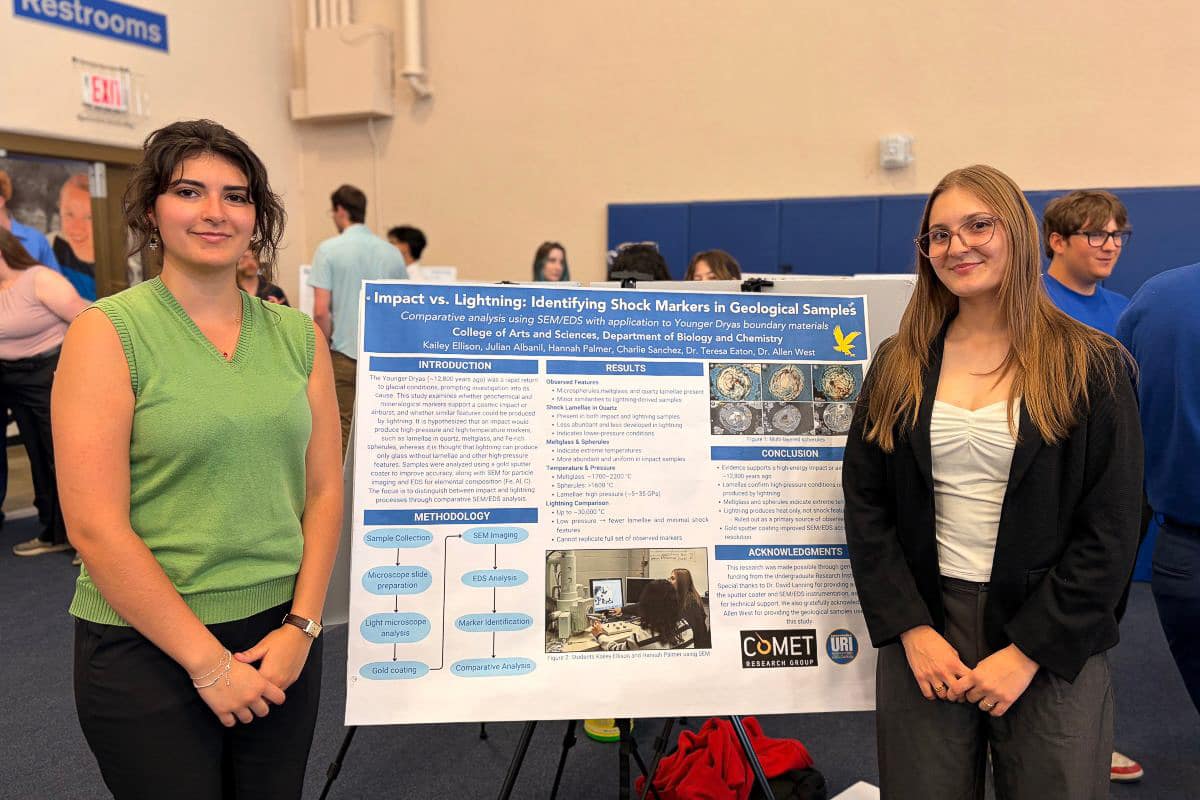
Students Hannah Palmer (left) and Kailey Ellison present their “Younger Dryas Impact Hypothesis” research during Embry-Riddle’s Undergraduate Research Institute Discovery 2026 event. (Photo: Embry-Riddle/URI)
The project earned first place in the Central Arizona American Chemical Society poster competition. While the results suggest an impact-related origin, the team noted that current evidence remains inconclusive in definitively linking the event to a comet or airburst.
“After putting so much time and effort into this project, it was incredibly rewarding to see our work recognized,” Ellison said. “Winning best poster made all the hard work feel truly worth it.”
In the College of Business, Security and Intelligence, a Honeywell-sponsored team addressed cybersecurity challenges in advanced air mobility systems. The project focused on securing communication between aircraft systems, mobile devices and cloud infrastructure. The team developed secure communication frameworks to ensure only authorized users could access sensitive systems, helping protect next-generation aerospace platforms.
“Cybersecurity is critical to the future of advanced air mobility, as these systems rely heavily on software, connectivity and increasing levels of automation,” said Nicholas Oakley, a senior who is pursuing a bachelor’s degree in Cyber Intelligence and Security. “What might begin as a system disruption could quickly escalate into a safety issue.”
Dr. Jeremy Ernst, vice president for Research and Doctoral Programs at Embry-Riddle, said that studies have shown that students who engage in undergraduate research are better prepared for professional careers in their chosen industries.
“Embry-Riddle faculty do an outstanding job of helping students acquire skills that they can use beyond the academic environment, and students from our three campuses continue to inspire excellence as they prepare for a knowledge-driven world beyond Embry-Riddle," he said.