
New Honeywell Radar Installed at Embry-Riddle’s Prescott Campus Provides Advanced Weather Tracking

 Keaton S. Ziem
Keaton S. Ziem
/
Keaton S. Ziem
Dec 03, 2025, 4:40 PM
A high-tech Honeywell radar now crowns Embry-Riddle Aeronautical University’s Prescott Campus, offering new real-time weather analysis that will benefit both students and the region.
The Honeywell IntuVue RDR-7000 — a radar system originally designed for commercial aircraft — was installed last month on the rooftop of the Academic Complex building.
Featuring a larger antenna and an integrated weather camera system, the RDR-7000 performs automated scans of a 120-degree sector across central Yavapai County in Arizona. Its elevated vantage point provides live surveillance of precipitation and storm patterns visible through the university’s nowcasting website.
“This state-of-the-art radar and camera show Embry-Riddle’s commitment — and that of industry partners like Honeywell — to giving students hands-on experiences that better prepare future professionals,” said Dr. Curtis James, professor of Meteorology in the Department of Applied Aviation Sciences. “By bringing live radar imagery out of the cockpit and into the classroom, students can learn to interpret what pilots see in real time and compare it with National Weather Service data to improve their understanding of weather radar.”
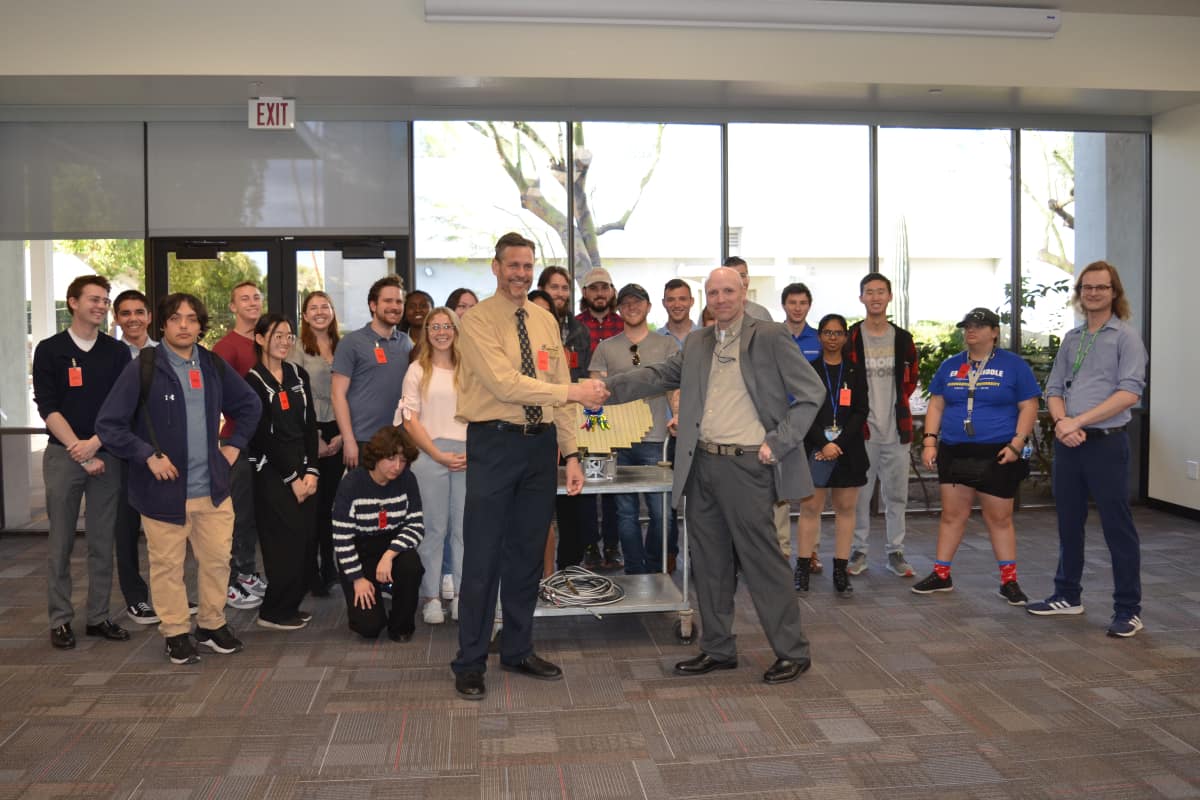
James and his students meet with Honeywell Senior Engineering Manager Levi Brown to celebrate the IntuVue RDR-7000 radar partnership between Embry-Riddle and Honeywell. (Photo: Embry-Riddle/Curtis James)
Because the RDR-7000 was never intended to operate from a stationary platform, the project required extensive reengineering and planning between Honeywell’s technical team and Embry-Riddle’s faculty and students. This included mounting it on an aluminum base in a custom housing designed by Embry-Riddle Engineering Lab Specialist Joseph Chandler and student assistant Jacob Homberger.
Computer Engineering student Sawyer Curless and Electrical Engineering student Allayna Allman helped wire and test the radar system and built the software interface that displays live imagery.
“We’re giving pilots the power to compare what the radar sees with actual conditions right here in Prescott,” said Curless. “That’s a huge advantage over relying on general weather reports.”
James described the radar system as “a work in progress” that continues to evolve as new software capabilities come online. Honeywell engineers also continue to access the system for “live-fire” testing — verifying radar signal accuracy in atmospheric conditions that can’t be replicated in a lab.
“Being able to work directly with the radar and knowing that, in the end, what we’re building will allow students and pilots to access better, real-time weather data is so valuable to me,” said Allman, who had an extended internship with Honeywell following the project. “The experience allowed me to explore the processing, testing and development that go into radar systems with Honeywell, and how we can improve the future of weather detection for generations to come.”
James and his students are developing machine-learning tools that will eventually generate thunderstorm forecasts accessible to the public. Such forecasts would be particularly valuable during Arizona’s monsoon season.
While the radar is not intended for weather prediction, James noted that it provides valuable insight into local atmospheric conditions. The radar supports local weather awareness and flight safety across the Prescott region.
“This project is of public interest since we now have a weather radar that produces scans at low altitudes over the Prescott area,” James said.
Philanthropist Rudy R. Miller, alumnus Marc Collins and Dean of Student Success Dr. Jennah Perry were also instrumental in helping secure the radar.