
Internships Hosted by Embry-Riddle’s Center for Aerospace Resilient Systems Provide Hands-on Experience

 Michaela Jarvis
Michaela Jarvis
/
Michaela Jarvis
Dec 11, 2025, 8:54 AM
Last summer, Embry-Riddle’s Center for Aerospace Resilient Systems (CARS) provided an exciting opportunity for three interns to develop an advanced interactive flight simulator that captivated aviation enthusiasts at the 2025 DEF CON cybersecurity conference’s Aerospace Village.
“We were invited to be a part of and support DEF CON’s Aerospace Village,” said Dan Diessner, CARS executive director. “The great showing by our CARS interns, led by research scholar Jayson Clifford, had the Aerospace Village leadership begging us to bring our team back next summer.”
During the internship program, the three students worked with a virtual aircraft system, adapting it not only to have interactive controls like a real plane but also to be able to run simulated cyberattacks requiring responses.
This year, CARS is offering another summer internship opportunity, scheduled for May 10 to August 10. The 2026 program, which will also include participating in DEF CON, will welcome four students.
Last year’s interns started with a system that was a follow-up to work conducted by CARS, one of the university’s Centers of Excellence, with the Federal Aviation Administration’s Cyber Security Data Science program. That system simulated aircraft system data to train AI machine learning and analyze the impacts of cyberattacks on aviation systems in controlled environments. While emulating the operation of an aircraft, the system did not include a user interface and was more of a background data source.
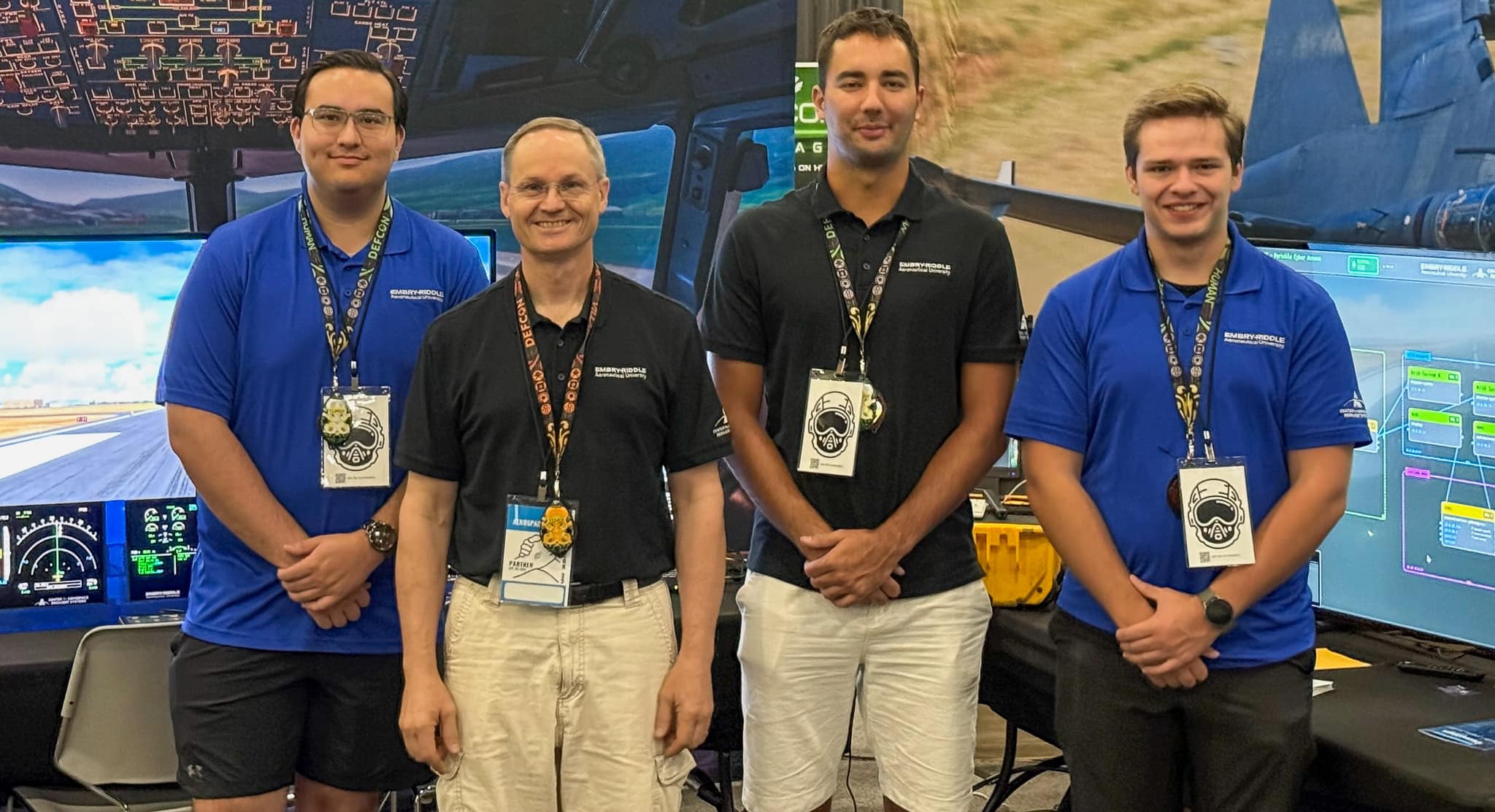
Intern Payton Macias, CARS executive director Dan Diessner, intern Samuil Nikolov and intern Sean McConoughey brought a flight simulator that could run mock cybersecurity attacks to the Aerospace Village at DEF CON.“There was no pilot control, no yoke or stick or throttle or instruments,” said Clifford, who supervised the summer interns. “We wanted to make it more interactive and be able to have a crew there doing things with it, so we wanted to hook it up to a flight simulator and then also have all these back-end systems hooked up.”
Intern Payton Macias, a junior majoring in Cyber Intelligence and Security at Embry-Riddle’s Prescott Campus, took on the role of making the system more interactive. He said he benefited greatly from the experience.
“Getting a real hands-on experience with a fast, evolving work environment was invaluable,” Macias said.
Because the flight simulator equipment needed to be transported to DEF CON in Las Vegas, it had to be portable enough to fit into specialized suitcases and be shipped by plane. The many dials, switches and knobs that make up the controls and displays in a plane’s cockpit needed to be translated onto transportable iPads that could be manipulated by the users of the simulator.
“We had to take that user experience and then turn it into a flat, multitouch iPad application and still make it feel like an airplane,” Clifford said.
The intern who took on that role, Samuil Nikolov, a junior majoring in Space Operations, wrote all of the code for the controls to be translated onto the iPads.
Nikolov said he benefited from his involvement because “it wasn’t just an academic exercise – the work had a clear purpose. Being part of team that trusted interns with meaningful responsibility really helped me grow.”
Intern Sean McConoughey, a sophomore in Aerospace Engineering, implemented a system to take flight logs generated by the simulator, process and analyze them in real time and then communicate information back to the simulator’s “flight crew” that they could use to respond to cyber events and make adjustments to how they flew the simulated aircraft. Generally, such logs are processed to detect anomalies after a flight, which can take a month or more.
“We wanted to do it in real time, and that was a project that Sean was really interested in doing,” Clifford said.
“There were a lot of challenges to face. The logs we were generating were noisy, sporadic and inconsistent,” McConoughey said. “Getting a large language model to extract anomalies from that mess wasn’t a guarantee. But once the pipeline started coming together, the output we were able to pull out was real, repeatable and actionable.”
McConoughey said that outcome was important because it showed that large language models — a form of AI — can operate in environments where data quality is not ideal, which is “exactly the situation you face with aviation systems.”
With the three interns’ systems in place, the simulator was a huge success at DEF CON, Diessner said.
“During the three days at DEF CON, there was not a time when the simulator was not occupied by attendees, often with long wait times,” he said.
The “pilots” who tried the simulator ranged from high school students, some who were thinking about applying to Embry-Riddle, to retired airline captains, Clifford said. He added that the airline captains would point out any discrepancies between the simulator and real aircraft, but they were wowed by the simulated cyber threats and response capabilities.
Regarding the ongoing summer internship, Diessner said the real value is that students get to work in a high-capacity research environment on campus over the summer, and they receive class credit, as well as traveling to “the world’s premier cyber venue to show off their accomplishments at the DEF CON Aerospace Village.”
This fall, after DEF CON and his last internship ended, Nikolov said he would readily recommend the program to other students.
“You’re surrounded by knowledgeable mentors, you get exposure to real research and flight-test operations, and you’re trusted to contribute in ways that matter,” he said. “Anyone who’s passionate about aerospace, systems engineering or mission operations would get a tremendous amount out of it.”
Students interested in applying to be part of the CARS 2026 internship cohort can find more information here.