
Historical Planes Capture the Pioneering Spirit of Aviation at Embry-Riddle Event

Justin Westbrooks, who earned a bachelor’s degree in Aeronautical Science in 2009, flies an AT-6 Texan, a World War II-era trainer once known as the “pilot maker.”
When he takes the plane’s controls, aviation history comes to life.
“You can hear it. You can feel it,” said Westbrooks, who flies the AT-6 Texan several times a month. “It’s a functioning museum. That makes it much more interesting than just reading a plaque.”
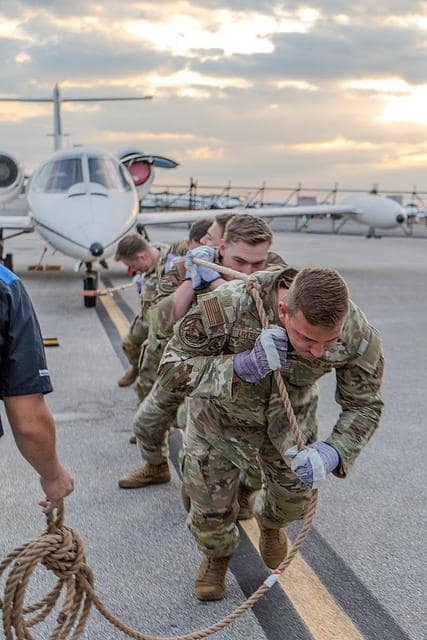
A plane pull held during Aviation Week honored alumnus Costas Sivyllis and supported the scholarship fund established in his name. (Photo: Embry-Riddle/Clayton Laughary)
The AT-6 Texan was among several legendary aircraft on display at Embry-Riddle Aeronautical University during Aviation Week, held from Feb. 17 to 20, on the Daytona Beach Campus. The week also featured informative aviation maintenance sessions, simulator challenges, and a plane pull in benefit of the Costas Sivyllis Endowed Memorial Scholarship.
Students, faculty, staff and other aviation enthusiasts toured the lineup of aircraft, posed for photos and climbed into flight decks.
Michael Beckerman, who graduated with a bachelor’s degree in Aeronautical Science in 2023, helped students into a T-34A “Mentor” from the historical fleet maintained by the Florida Wing of the Commemorative Air Force. With tandem seating for a student and an instructor, the T-34 trained thousands of U.S. Air Force pilots in the 1950s and early 1960s.
“I hope after this event that everyone has a little more understanding of what these aircraft were used for and their significance to our history,” Beckerman said.
Steven Warmath, who earned a bachelor’s degree in Professional Aeronautics in 2010 and an MBA in Aviation in 2022, provided a brief history of the smallest plane to serve as Air Force One. Nicknamed Ike’s Bird, the L-26 Aero Commander shuttled President Dwight D. Eisenhower between Washington, D.C., and his family farm in Gettysburg, Pennsylvania.
“They would use Marine One for that now,” he said. “But in 1955, helicopters weren’t considered a reliable form of transportation for the president.”
A fire-engine-red 1941 Boeing Stearman carried students back to an earlier age of aviation. Seated in the biplane, they marveled at the lack of a roof.
“There’s a romantic aspect to open-cockpit flying,” said Jeffrey Thornton, who brought the plane to the event. “You are one with the air.”
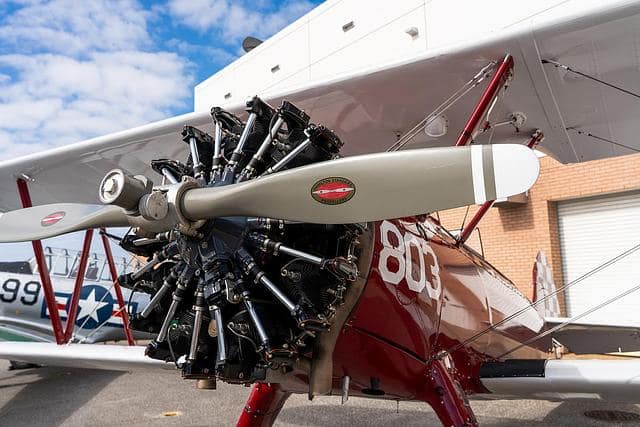
A 1941 Boeing Stearman PT-17 on display. This type of plane was the primary training aircraft for U.S. Army Air Corps pilots in World War II. (Photo: Embry-Riddle/Johnny Stipancich)
However, the inability to see over the plane’s nose and its tailwheel construction complicate takeoffs and landings.
“Flying taildraggers these days has become kind of a lost art,” Thornton said. “We don’t build a lot of new airplanes this way, and for good reason. They’re unstable and finicky.”
Thornton, who earned a bachelor’s degree in Aviation Business Administration in 2009, noted that the Stearman would have looked at home when the Daytona Beach airport served as a Naval Air Station during World War II. The plane was the primary trainer for the U.S. Army Air Corps and the Navy.
“This very type of airplane flew out of this airport doing proficiency training for pilots,” he said.
The plane’s legacy of training aspiring aviators evoked Embry-Riddle’s mission to lead in aviation and aerospace higher education. The university, which is celebrating its 100th anniversary, displayed a centennial-branded Cessna 172 Skyhawk, the type of aircraft current students in the aviation program first fly.
“Look at all the flight training we still do here now,” Thornton said. “The tradition continues.”