
Generations of Pilots: The Enduring Legacy of the Cessna 172 Skyhawk at Embry-Riddle


With a sparkling gold finish and bold lettering reading “100 Years,” a custom-painted Cessna 172 Skyhawk has landed at Embry-Riddle Aeronautical University to mark its centennial.
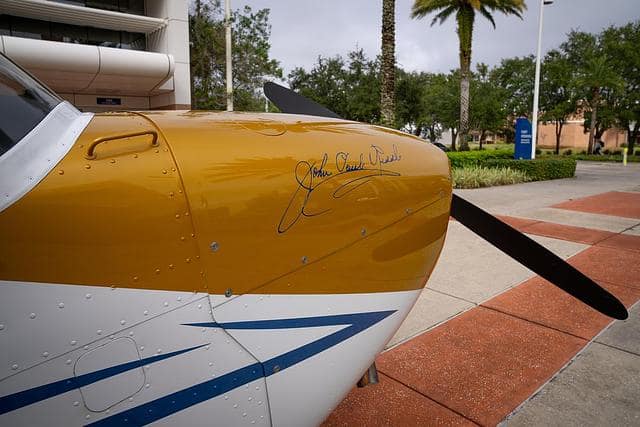
Founder John Paul Riddle’s signature is painted on the nose of the centennial-themed Cessna 172. (Photo: Embry-Riddle/Kristel Knowles)
Subtle details on the plane’s livery include university founder John Paul Riddle’s signature on the nose. The tail number — N1926R — is a nod to Embry-Riddle’s founding year.
The plane is a fitting tribute; all Embry-Riddle flight students first learn to fly the single-engine Cessna 172, whose centennial edition would look familiar to nearly anyone who trained at Embry-Riddle’s Daytona Beach or Prescott campuses.
“The airframe, the fuselage, the wings, the tail — all of that’s going to be the same,” said Dr. Mike Wiggins, a professor of Aeronautical Science who started as a student at Embry-Riddle in 1973 and joined its faculty in 1977.
Today’s flight students, however, first encounter the Cessna 172 in a far different way than their predecessors of decades ago — through the power of virtual reality.
A Training Workhorse
Cessna Aircraft Company first produced the Cessna 172 in 1956. The aircraft came to dominate the fleet at Embry-Riddle’s Daytona Beach Campus in 1968, three years after its opening.
According to an article in the student newspaper at that time, 20 new Cessna 172 Skyhawks replaced a fleet of Cessna 150s. “The Cessna 172s are larger and more powerful,” the newspaper reported.
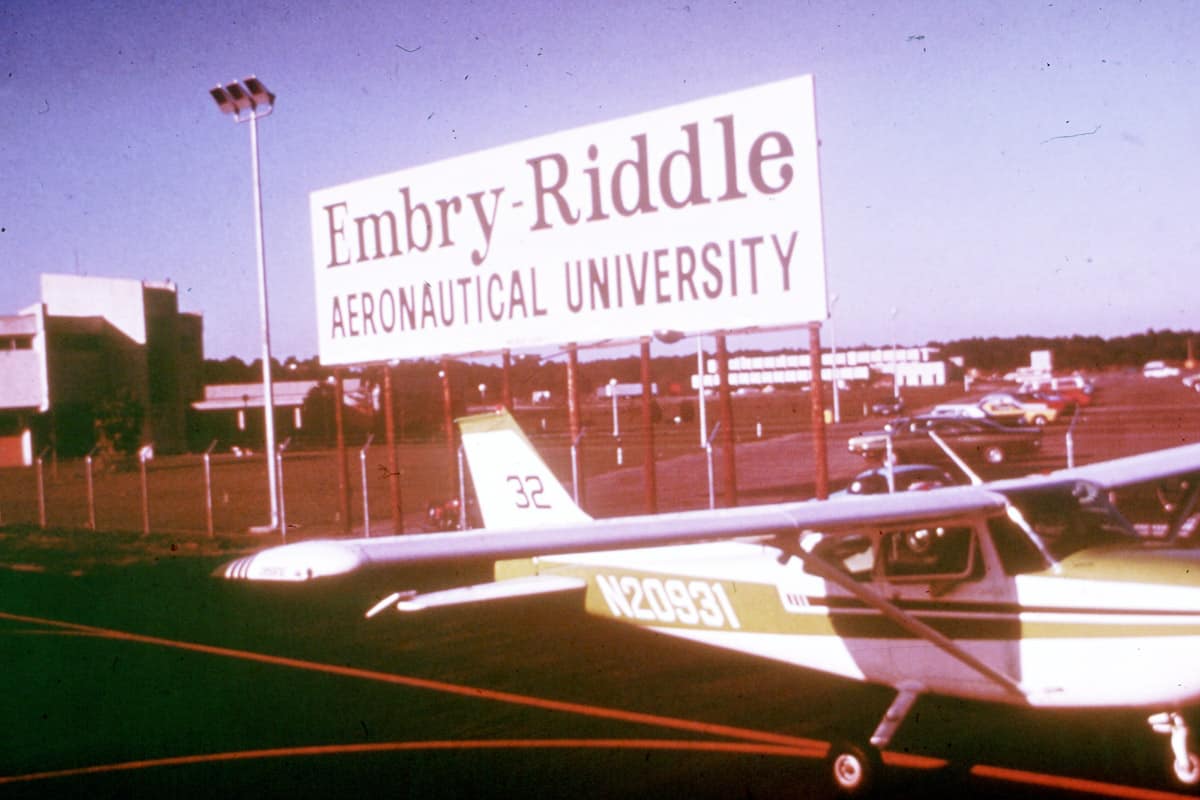
Cessna 172 Skyhawks on the flight line in the 1970s. (Photo: Embry-Riddle/Archives)
Wiggins said one of the main advantages of the Cessna as a training plane was its four-seat configuration, which allowed the instructor to work with one student in front while another rode in the back. That student “could observe what’s going on and learn that way to reduce overall training time,” he said.
When Cessna halted production in 1986 because of financial losses and liability lawsuits, Embry-Riddle added other single-engine aircraft to its fleet. The university returned to using the Cessna 172 exclusively as its primary training plane when production resumed a decade later.
“Embry-Riddle became one of the key early fleet customers for the newly produced Skyhawk,” said Dr. Ken Byrnes, associate dean in the College of Aviation and chair of the Flight Department on the Daytona Beach Campus. “The university helped support Cessna’s return to piston aircraft production and contributed to establishing the modern Cessna 172 as the benchmark training platform.”
Embry-Riddle’s fleet now consists of 174 Cessna 172s: 78 in Prescott and 96 in Daytona Beach.
“It’s got very strong landing gear, and it’s a forgiving airplane to teach in,” Wiggins said. “They are very dependable and sturdy, and they can take the kind of use we put on them.”
The most significant changes over the years have been under the cowling and to the navigation and communication systems on the flight deck. The newer engines have increased horsepower and a fuel-injection system.
In the early 2000s, Embry-Riddle worked with Cessna to bring Garmin’s G1000 avionics system to its training aircraft. “We had a firsthand experience in the transition going from the old analog round dials to the glass systems,” Wiggins said.
The legacy of the Cessna 172 Skyhawk can be seen in the many images of the aircraft across the College of Aviation on the Daytona Beach Campus. Some date back to the 1970s.
“I would say the proof that it’s a good training airplane is that it has been used here for 60 years,” Wiggins said. “Its purpose is to be a safe training airplane, and it accomplishes that mission exceptionally well.”
New Frontiers for Flight Training
Aeronautical Science students now get their first experiences with the Cessna 172 before ever entering the flight deck. They strap on virtual reality headsets that transport them to a three-dimensional, 360-degree model of the Cessna 172 on Embry-Riddle’s flight line.
Students can walk around, look under and manipulate the aircraft to practice pre-flight inspections and checklists.
“It’s an exact match for the aircraft that they will be flying,” said Flight Simulation Programs Manager James Hanover, standing next to a student wearing a headset. “You’ll see every component, including the rivets that attach the skin to the aircraft.”
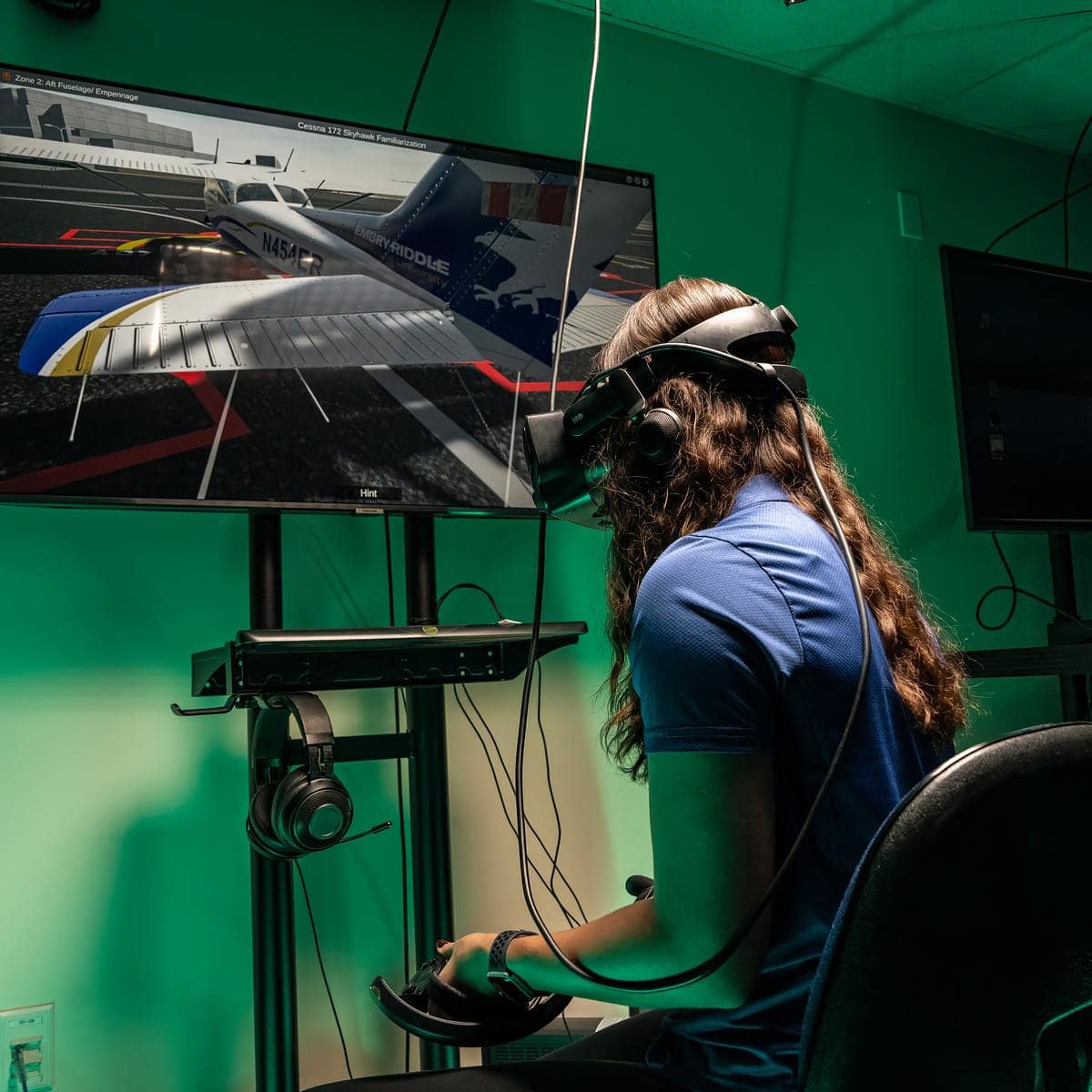
A student uses a virtual reality headset and controls to move around a three-dimensional model of the Cessna 172 on Embry-Riddle’s flight line. (Photo: Embry-Riddle/Bill Fredette-Huffman)
To create the VR experience, Embry-Riddle worked with industry partner Cole Engineering Solutions on a technology called CAART (Commercial Aviation Augmented Reality Toolkit).
Using joysticks, students can methodically work through scenarios, seeing instruction cards and triggering actions. Animations simulate pressing a button, switching a toggle and moving the flight controls. Abnormal and emergency procedures are also integrated.
“She is performing parts of the cabin checklist right now, removing the control wheel lock and checking the airworthiness and the registration for validity to make sure it's within date,” said Hanover of the student. “They can perform any checklist item that we have and that a student would normally do on a Cessna 172 on the flight line.”
A separate setup includes yoke, throttle, mixture control and pedals. This allows students to “hop in and focus on performing maneuvers without oversaturating their workload,” Hanover said.
The most advanced simulators put a student and a flight instructor into a fully functional, exact replica of Embry-Riddle’s Cessna 172 flight deck. During a recent exercise, a student steadily proceeded toward a runway. “They are fully immersed visually and tactilely, and train exactly as they would in an aircraft but in a safer way,” Hanover said.
An Aviation Icon
The most-produced aircraft in history — with more than 45,000 built and counting, according to Textron Aviation, which now designs and produces the plane — the Cessna 172 is ubiquitous on runways.
"Students may not remember the plane itself as anything unusual. What they’ll probably remember most are the experiences they had with their instructor in it or the first solo they had with it,” Wiggins said.
Embry-Riddle flight instructor Rafael Dubena flew Embry-Riddle’s centennial-branded plane from the Cessna factory in Independence, Kansas, to the Daytona Beach Campus.
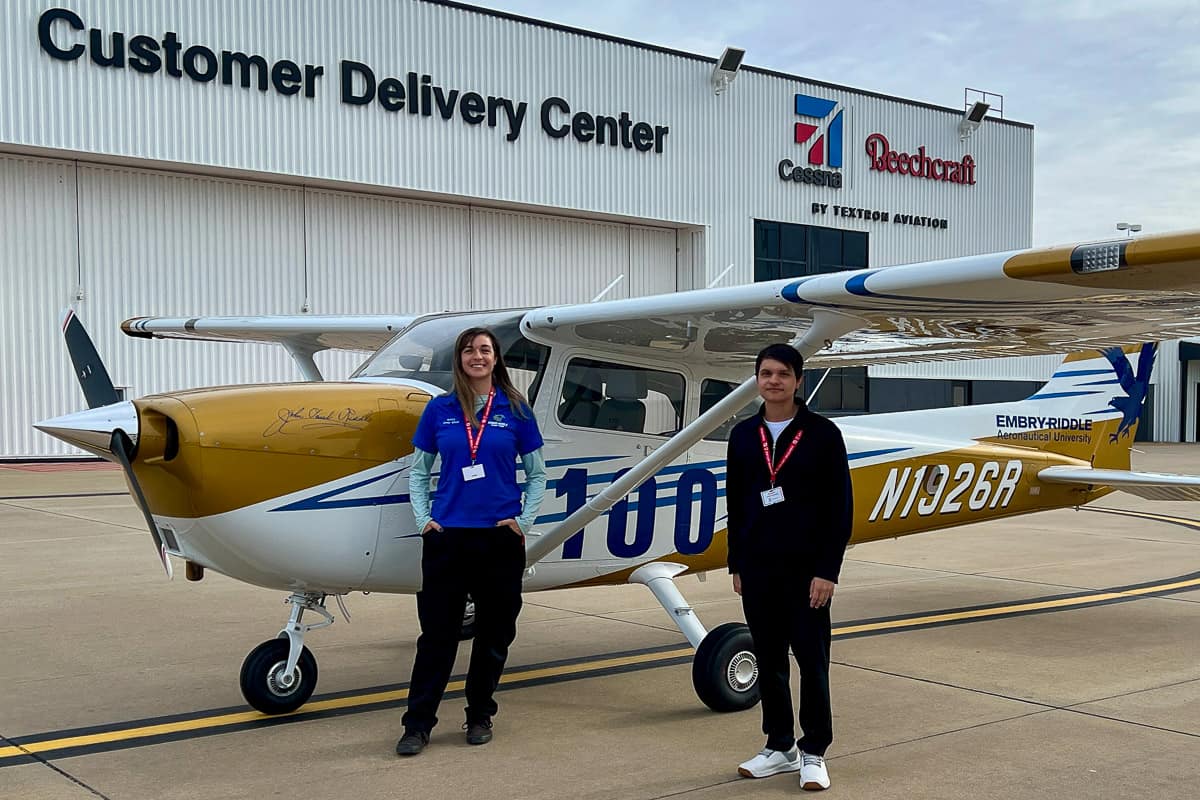
Aircraft Technician Korry Noyes and Flight Instructor Rafael Dubena at the Cessna factory in Kansas. (Photo: Rafael Dubena)
A Brazilian native, Dubena has earned his master’s degree in Aviation and bachelor’s degrees in Aeronautics and Air Traffic Management from Embry-Riddle. Dubena said the university has molded his goals, safety values and character as a pilot.
“It was an honor,” he said, “that I was entrusted to bring this little piece of history to Embry-Riddle.”