
From Carnival Games to Elevator Controls: Embry-Riddle Students Build Automated Future in New Lab

 Keaton S. Ziem
Keaton S. Ziem
/
Keaton S. Ziem
Mar 17, 2026, 8:02 AM
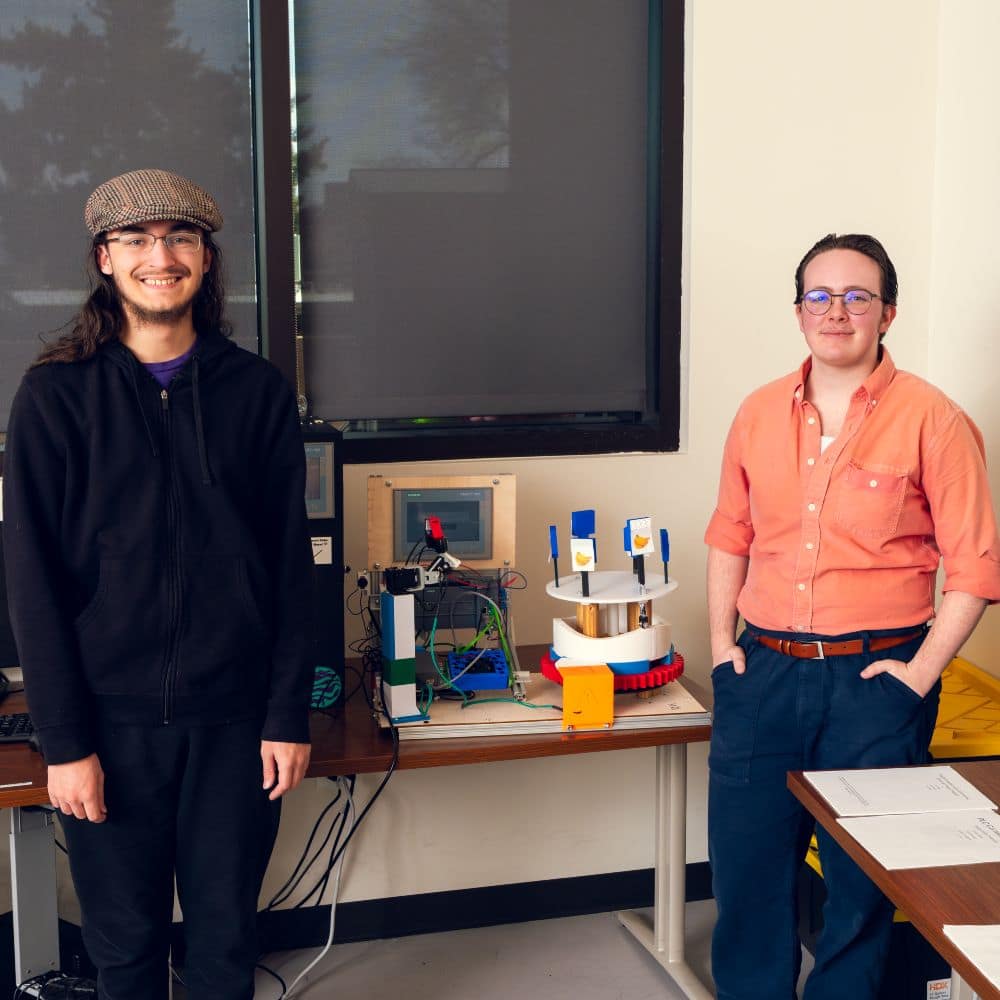 Students Austin Palahnuk and Wrin Monger stand beside their carnival game that uses artificial intelligence to automatically track and shoot rotating banana targets. (Photo: Embry-Riddle/Wilson Van Ness)A laser mechanism tracks bright yellow bananas, rising and dipping as they spin on a carousel. The setup resembles an old-time carnival shooting game — only much smaller and far more high-tech.
A camera identifies the banana targets, and the laser fires. At the same time, the system evaluates whether the laser has remained on target long enough to count as a hit, adjusts difficulty parameters and maintains score. It all happens within fractions of a second and without any human control, said Wrin Monger, a senior Mechanical Engineering student at Embry-Riddle Aeronautical University.
The carnival game is one of six automation projects at Embry-Riddle’s new Automation Lab, where students are designing and building industry-grade control systems. The lab was made possible through a donation from the James Family Trust.
“These are not toy projects. They are real systems built with real industrial controllers,” said Dr. Mehran Andalibi, associate professor of Mechanical Engineering and the lab’s director.
Automation refers to the design of systems capable of operating with minimal human intervention. From manufacturing lines and transportation systems to fluid processing and robotics, automated systems rely on tightly integrated hardware, sensors and control logic to function safely and efficiently. The lab centers on programmable logic controllers — small computers widely used to control machinery in manufacturing, transportation and other industrial sectors.
“Most of the hardware in industry, from robots to automated systems, runs on programmable logic controllers,” Andalibi said.
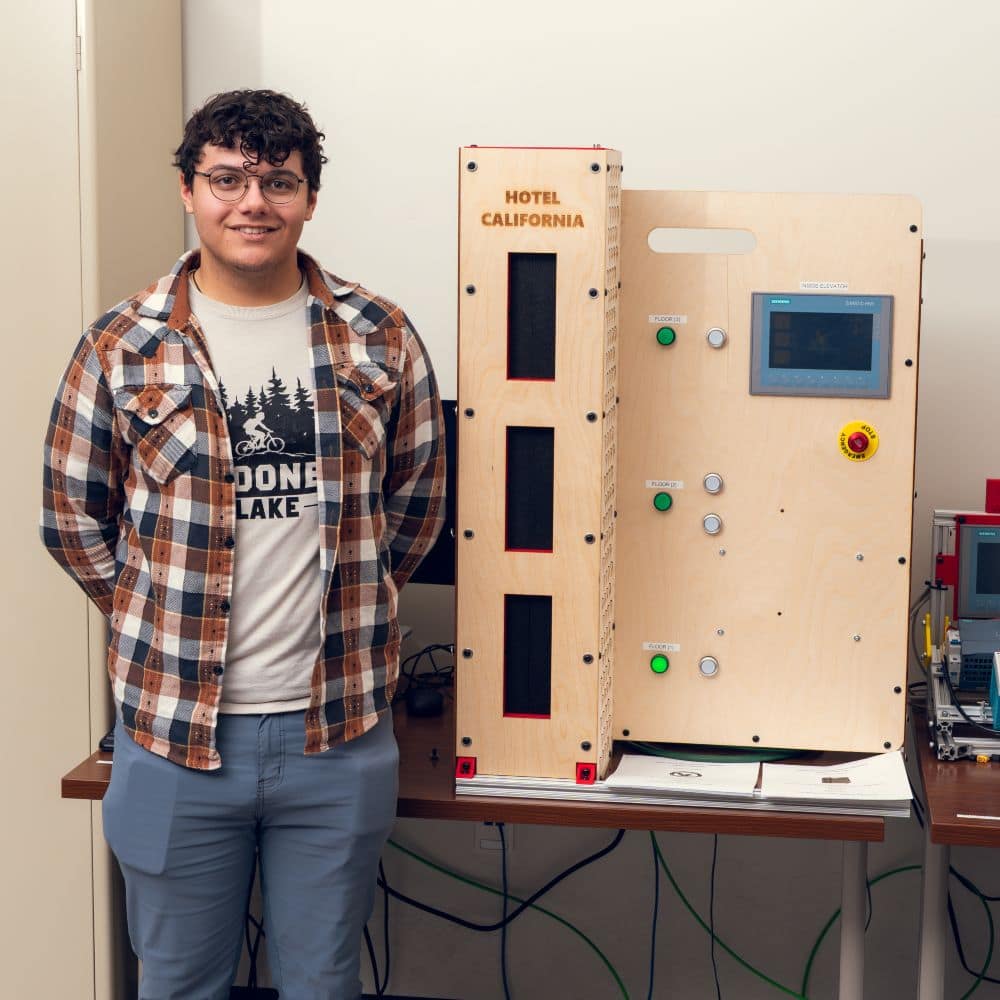 Noah Temprendola developed an elevator system nicknamed “Hotel California,” inspired by the rock band The Eagles. (Photo: Embry-Riddle/Wilson Van Ness)Small teams of Mechanical Engineering students developed each project, often over a single semester. One student team built a fully functional elevator model with call buttons, safety features and a programmed priority queue to manage multiple requests efficiently.
“An elevator is complicated, and the control algorithm is intricate. We decided this would be a really good test of our skills that we’re learning in this class,” said Mechanical Engineering student Noah Temprendola.
Mechanical Engineering student Alexis Hall worked on a vending machine. Small mechanical tolerances had a large impact on performance, she said.
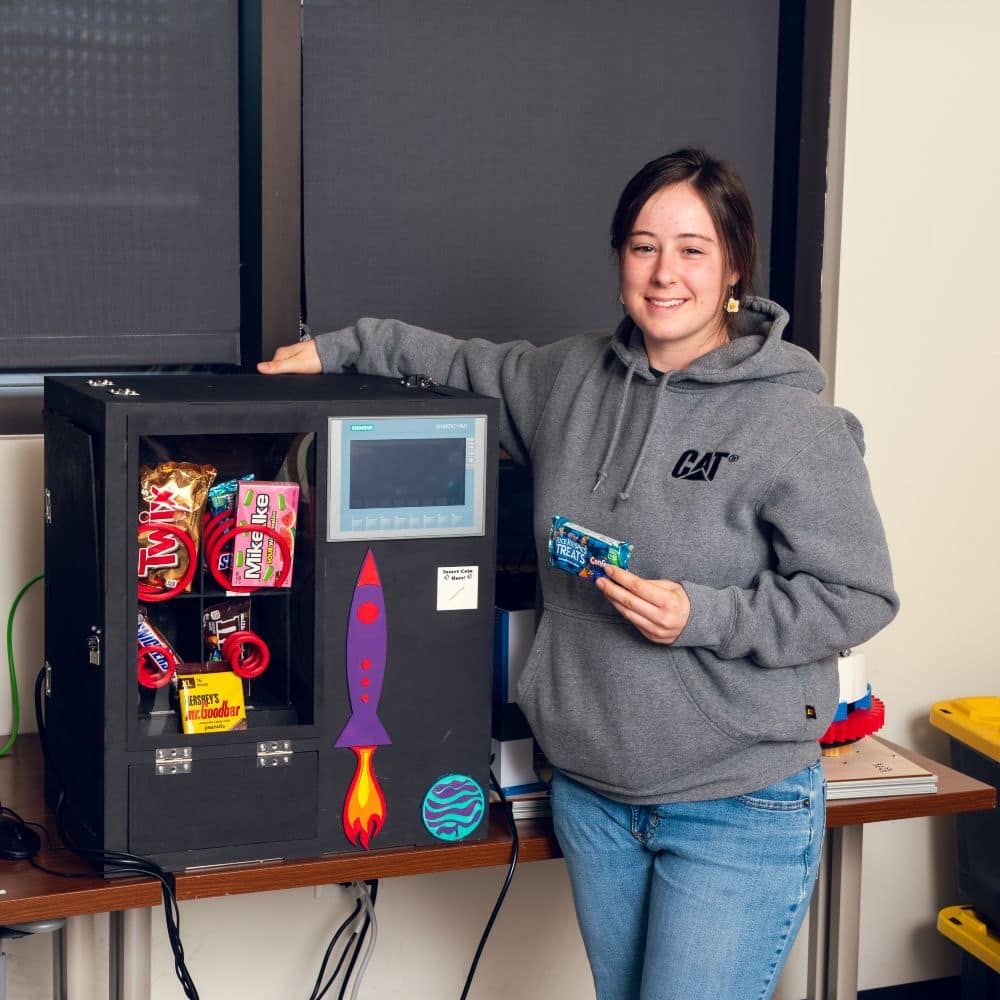 It may look like a model, but Alexis Hall’s vending machine dispenses candy. (Photo: Embry-Riddle/Wilson Van Ness)“The motors were complicated, and we had to get them to turn the exact amount to get the candy to dispense,” Hall said. “If it doesn’t turn enough, the candy doesn’t come out. If it turns too much, too much candy comes out.”
According to Andalibi, similar commercial training systems can cost tens of thousands of dollars each, but the students were able to build the lab’s hardware at a fraction of that cost while gaining deeper technical experience.
The Automation Lab now also supports a robotics capstone project in which students are integrating a robotic arm, vision system and artificial intelligence to create a fully autonomous sorting system capable of identifying objects by shape, color and material.
With the lab in place, Andalibi said the Prescott Campus plans to introduce a formal automation course beginning next spring. Automation is widely used across industry but is not commonly taught at the engineering level.
Monger said working with the controllers on the carousel game provided a level of realism that stood apart from more traditional classroom projects.
“If I go into anything that includes autonomous systems, like robotics, I absolutely expect to encounter programmable logic controllers,” Monger said. “I’m glad that I learned how they work so that I can design around them.”