
High School Students Explore Future Careers Through Embry-Riddle’s Immersive Summer Programs

 Keaton S. Ziem
Keaton S. Ziem
/
Keaton S. Ziem
Feb 04, 2026, 3:10 PM
This summer, high school students from across the country will have the opportunity to explore future careers through hands-on, immersive learning experiences at Embry-Riddle Aeronautical University’s Prescott Campus.
Designed to go beyond a traditional summer camp experience, Embry-Riddle’s Summer Programs place students in college-level labs, classrooms and simulations where they can test-drive potential paths in science, engineering, technology and aviation.
Beginning in June, participants in residential programs will live on campus, work alongside expert faculty and gain practical experience using the same tools and techniques employed by Embry-Riddle undergraduates. New offerings for 2026 include camps in genetic engineering; storm science; artificial intelligence and robotics; and intelligence and cybersecurity.
“Our summer programs are designed to help students explore what truly excites them — and just as importantly, what a career in that field actually looks like day to day,” said Jenn Downing, summer programs manager at Embry-Riddle Prescott. “Participants don’t just learn concepts. They apply them, collaborate with peers and experience college life in a meaningful way.”
For many students, that experience provides a first glimpse of independence and academic confidence.
“Being on campus for a full week lets students picture themselves as college students,” said Megan Cramer, an Embry-Riddle forensic biology major and student coordinator for summer programs. “They start the week unsure, but by the end, they’re asking questions, engaging with professors and realizing they can handle challenging material. It helps them make more confident decisions about their future.”
New Experiences in 2026
One of the newest offerings this summer is Genetic Engineering, which introduces students to the molecular techniques driving advances in medicine, biotechnology and agriculture. Through hands-on lab work, participants extract and analyze DNA, perform polymerase chain reaction experiments, clone genes and express proteins in bacterial systems.
“The goal is to expose students to authentic laboratory techniques they would normally encounter for the first time in college,” said Dr. Zafer Hatahet, dean of the College of Arts and Sciences. “Early experience like this helps students understand both the scientific rigor and the collaborative nature of work in biotechnology and medical research.”
The new Storm Science camp will explore Arizona’s monsoon season. Participants analyze real-time radar and satellite data, launch a weather balloon, create customized weather maps and produce their own forecast videos.
“Meteorology is an applied science that affects countless industries,” said Jeremy Mazon, assistant professor of Meteorology. “By working with live data and operational tools, students gain a realistic understanding of how weather impacts aviation, transportation, energy and forecasting.”
In VibeCode: AI & Robotics, students explore coding and artificial intelligence through an accessible, creative approach. Beginning with visual programming and robotics, participants are introduced to introductory Python-based projects such as chatbots and data analysis applications, learning how machines process information and make decisions.
Another new program is Spy Camp, which blends intelligence studies, cybersecurity and investigative techniques. Students explore cryptography, digital forensics, fraud investigation, surveillance methods and simulated security challenges, providing insight into modern intelligence and cyber defense careers.
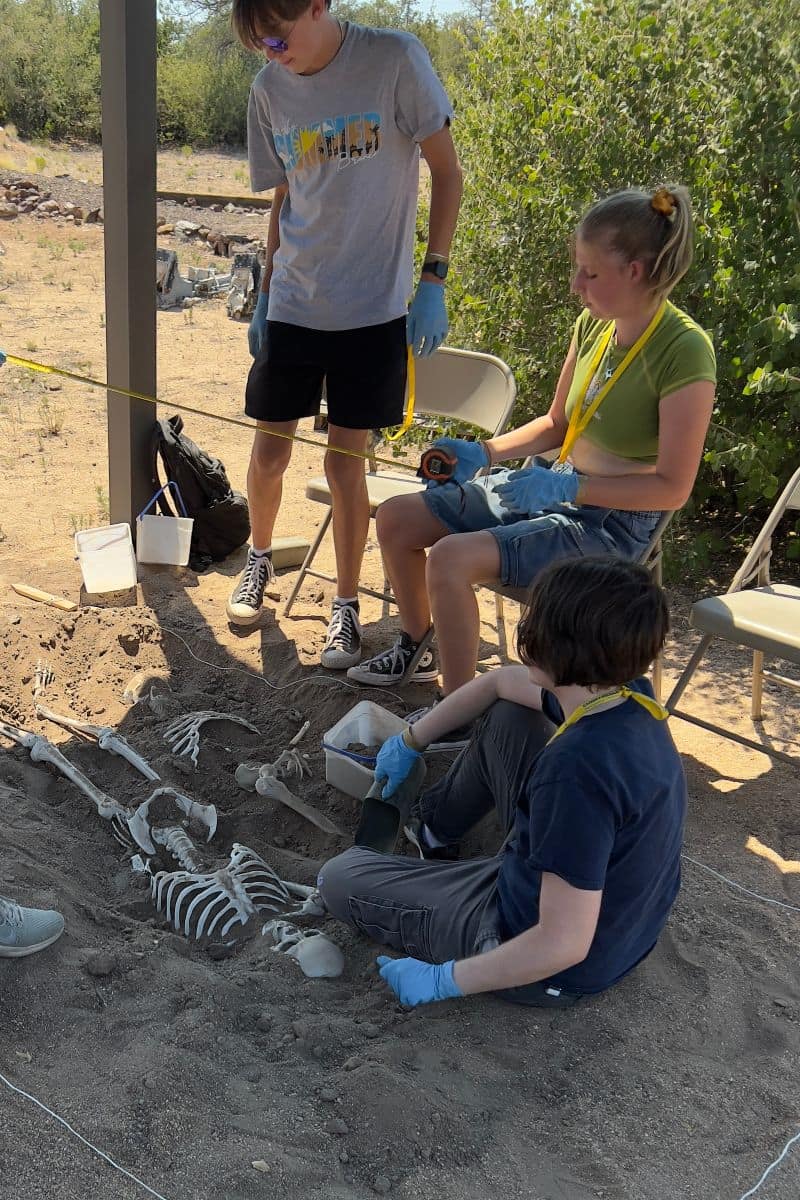 High school students participate in a simulated excavation during a forensic science summer camp at Embry-Riddle Aeronautical University’s Prescott Campus. (Photo: Embry-Riddle Aeronautical University)
Learning That Builds Over Time
Several Embry-Riddle summer programs are intentionally designed to build skills across multiple sessions. Forensic Science camp, for example, allows students to progress from crime scene investigation to laboratory analysis and, finally, to investigative and courtroom applications.
“Students experience the full forensic process, from evidence collection to how that evidence is ultimately used,” said Kelly Crockett, instructor of Forensic Science. “It helps correct common misconceptions and shows how science, investigation and law intersect in real cases.”
Students may enroll in individual sessions or return for additional weeks to deepen their understanding and continue building skills.
Discoveries Across STEM and Aviation
In addition to new programs, Embry-Riddle’s summer offerings include camps in aerospace engineering, astronomy, data science, game design and simulation, uncrewed aircraft systems and aviation-focused flight experiences. Each program emphasizes hands-on learning, problem solving and collaboration while giving students exposure to college-level expectations.
“Even if a student isn’t completely sure what they want to pursue, the experience is valuable,” Cramer said. “You gain real skills, meet people with similar interests and walk away feeling more prepared for college.”
Enrollment for Embry-Riddle’s 2026 Summer Programs is now open, with sessions beginning in June on the Prescott Campus. More information is available at Embry-Riddle’s Summer Programs website.