
Embry-Riddle Team Navigates to 6th-Place Finish, Earns Top Awards at 2026 RoboBoat Competition

 Melanie Stawicki Azam
Melanie Stawicki Azam
/
Melanie Stawicki Azam
Apr 08, 2026, 9:07 AM
Embry-Riddle Aeronautical University's Team Minion joined forces with senior Mechanical Engineering students for an international autonomous robotic boat competition, where they came home with several top awards.
Team Minion, part of the Robotics Association at Embry‑Riddle, competed against 37 teams from around the world at the 2026 RoboBoat competition held in Sarasota, Florida, and hosted by RoboNation.
The team placed 6th in the dynamic portion of the competition, which requires students to navigate their autonomous vessels through a challenge course. The Embry-Riddle team also won best team video, tied for first place in design documentation and won an excellence in sportsmanship award for assisting other teams throughout the week.
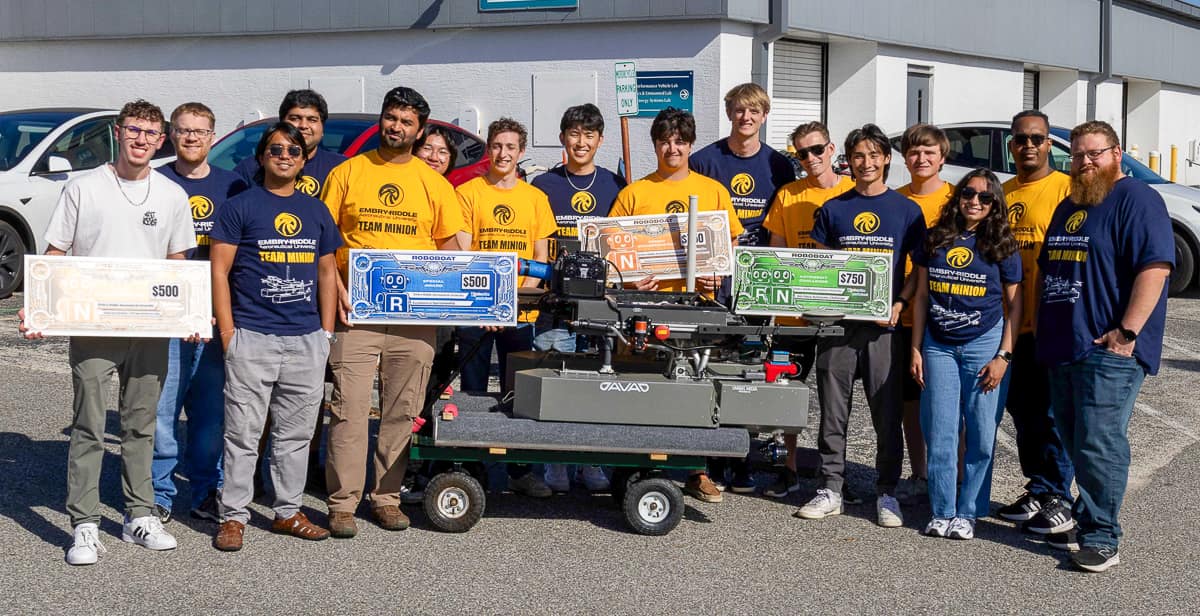
Team Minion, part of the Robotics Association at Embry-Riddle, won several top awards at the 2026 international RoboBoat competition. (Photo: Embry-Riddle/Eric Coyle)
“Uncrewed surface vessels are the future of the maritime commercial and defense industries,” said Dr. Eric Coyle, the team’s faculty advisor and a professor of Mechanical Engineering. “Team Minion showed that Embry-Riddle will be at the forefront of this new wave of technology. I am extremely proud of what our students were able to accomplish technically, and even more proud of the professional way they represented Embry-Riddle”
Team Minion’s leaders and Coyle met last summer to develop a plan to design a new vehicle for the 2026 RoboBoat competition. In the fall, they met with 11 senior Mechanical Engineering design students to collaborate on building it.
“I had worked with robots before, but none were as complex or sophisticated as this project,” said Bharat Jagwani, the team’s lead and a graduate Mechanical Engineering student. “It was a great opportunity to learn new things at a more advanced level and apply the theory we learn in classes to real-life scenarios. It also gave me valuable experience managing a team.”
To sharpen their focus and meet the tight deadline, the students were divided into several smaller teams. Their work involved everything from designing the hull to integrating the vehicle’s sensing, propulsion, computing and communications systems. The team also developed software for the vehicle to complete the RoboBoat competition’s specific tasks and tested the new system.
“This project helped me bridge the gap between school and industry and gave me the opportunity to apply engineering in a real, hands-on way through design, fabrication, testing and teamwork,” said Michael Saravis, the project’s testing lead and a senior design Mechanical Engineering student. “I’ve always enjoyed projects that combine mechanical systems, problem-solving and building something tangible, so RoboBoat became a perfect fit for me.”
Luke Coblentz, the project’s tasking lead and a senior design Mechanical Engineering student, said Team Minion’s seasoned veterans mentored less experienced students and set them up for success. The competition also allowed students to hone their presentation and networking skills.
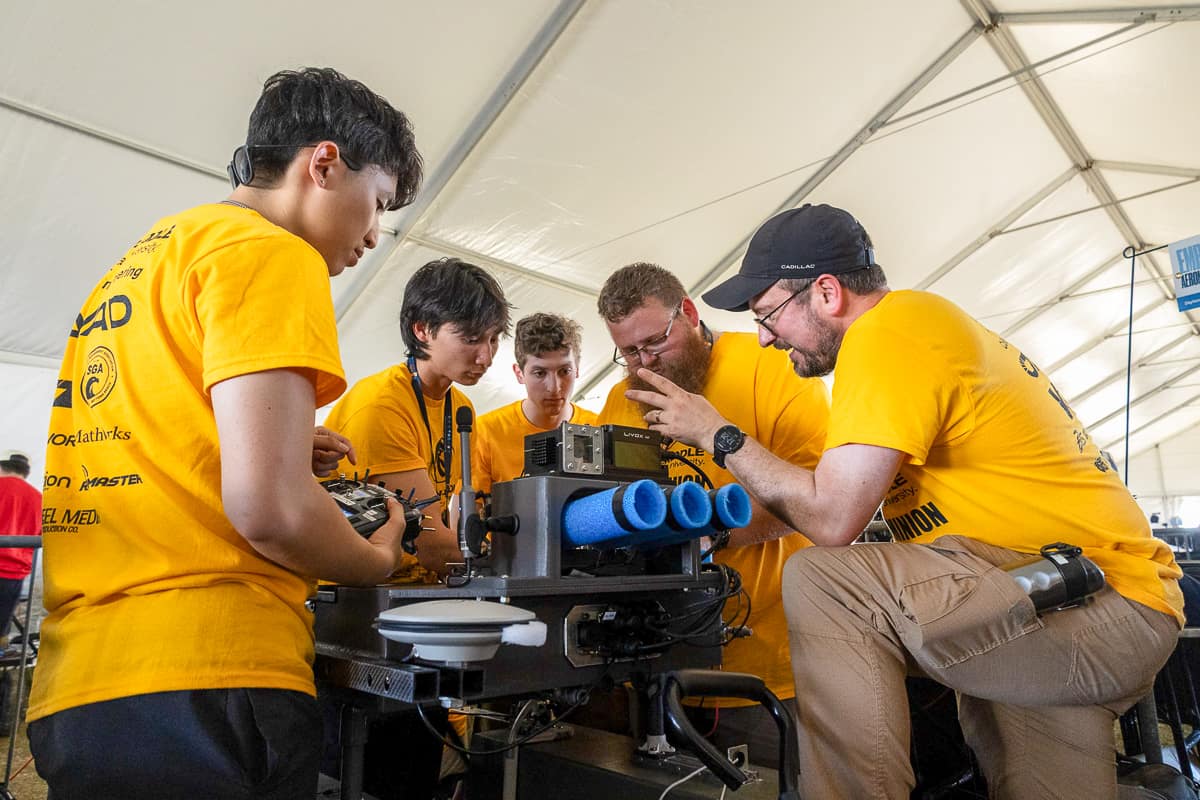
Team Minion members prepare their autonomous boat for the water. Pictured left to right are Sena Nitta, Kamanakai Natividad, Joshua Matthews, Michael Saravis, and Dr. Patrick Currier. (Photo: Embry-Riddle/Nam Tran)
“Attending the RoboBoat competition was an excellent opportunity to interact with engineers from all over the world,” Coblentz said. “We discussed how we designed the hulls, what safety mechanisms exist on our vessel, what composite materials or sensors comprise the instrument deck, or even what simulation software was used.”
Communication and collaboration were key to the team’s success working in the lab and presenting at the competition, Saravis said. The excellence in sportsmanship award the Embry-Riddle team received reflects the culture of both the team and the university, he added.
“Every Embry-Riddle team member was supportive, respectful and willing to help each other and other teams,” he said. “We were competitive, but we also understood that competitions like this are meant to advance the field, build connections and inspire the next generation of engineers.“
In addition to Jagwani, Saravis and Coblentz, other students on Embry-Riddle’s RoboBoat team include: Sarthak Aggarwal; Sagar Sarkar; Kamanakai Natividad; Ethan Shephard; Nam Tran; Joshua Matthews; Caleb Henning; Jaylene Santiago; Andrew Lumsden; Orlando Bailey; and Sena Nitta. Clayton Loughary, a member of Embry-Riddle’s UnReel Media Filmmaking Club, assisted with the team video.