
Innovation on Display: Embry-Riddle Students Showcase Research at Florida Capitol

 Melanie Stawicki Azam
Melanie Stawicki Azam
/
Melanie Stawicki Azam
Feb 09, 2026, 9:48 AM
No one likes flight delays. That frustration is one of the reasons Embry-Riddle Aeronautical University student John Preiss is researching ways to strengthen airline networks and reduce schedule disturbances.
Preiss was among three Embry-Riddle students who recently presented their research to legislators and their staff at the Florida State Capitol in Tallahassee.
“We've all experienced a flight delay for whatever reason,” said Preiss, a sophomore Aviation Business Administration major. “The aim of the project is to curb these delays by nullifying network disruptions efficiently.”
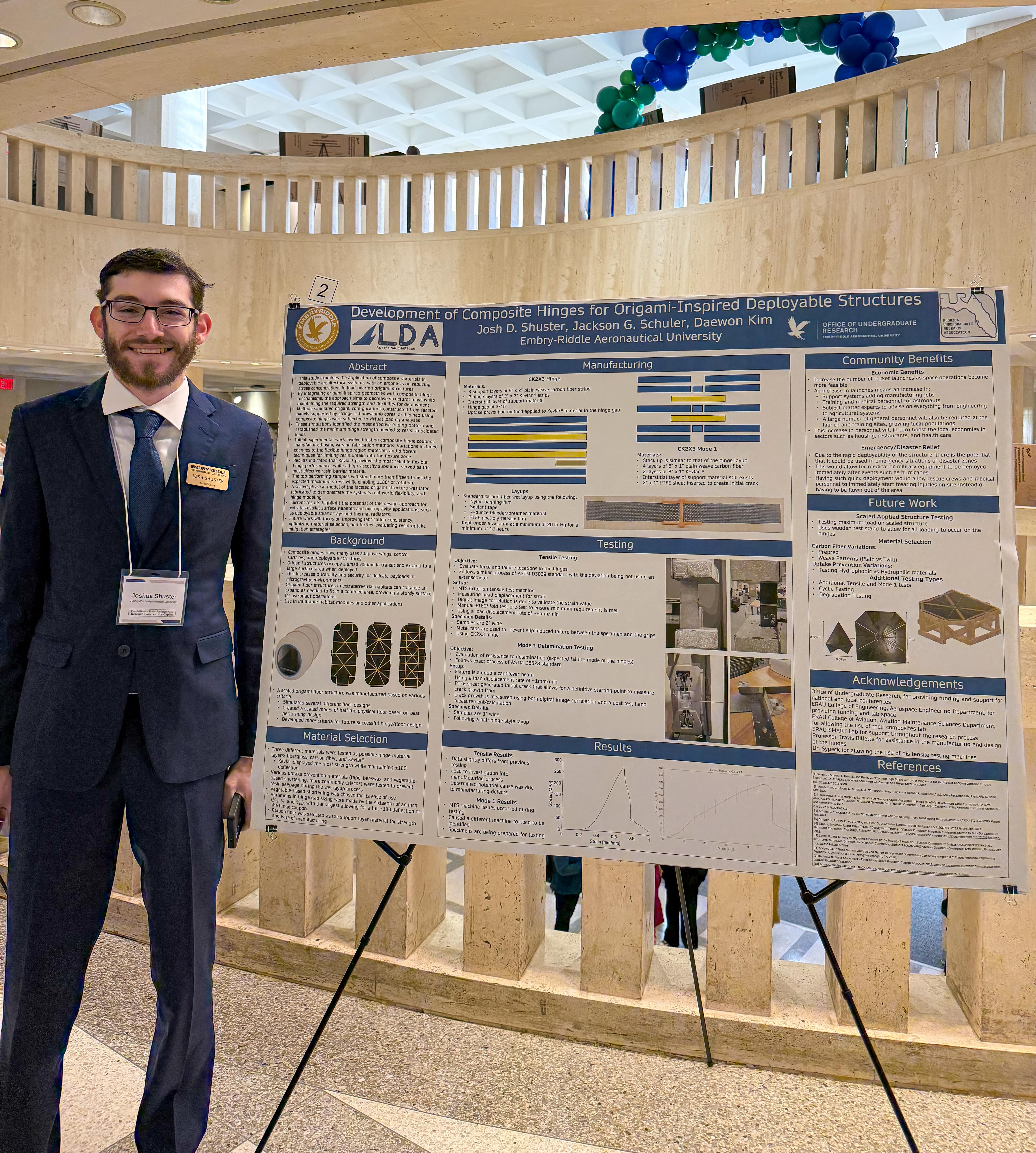 Joshua Shuster, a senior Aerospace Engineering student, shares his research on deployable origami-inspired structures for space habitats. (Photo: Embry-Riddle)
Preiss was joined by fellow students Joshua Shuster and Tyler Johnson, who showcased their work at Florida Undergraduate Research Association’s (FURA) Posters at the Capitol 2026 event. Held late last month, the biennial program also allowed students to tour the Senate and House Chambers and meet state officials.
“Overall, the students had a great time presenting their research at the Capitol and networking with other undergraduate researchers from across the state,” said Dr. Mihhail Berezovski, director of the university’s Office of Undergraduate Research and associate professor of Mathematics.
Preiss’ project focuses on modeling airline systems as multilayer networks to detect single-carrier vulnerabilities and build more resilient air links. The research analyzes millions of public flight records to identify cities dependent on single carriers, quantify network robustness and design algorithms that suggest the minimum route additions needed to maintain connectivity during disruptions. Preiss is collaborating with Dr. Archie Dong, an assistant professor in the David B. O’Maley College of Business, on the work.
“Working with Dr. Dong, I gained great foundational skills in Python and some advanced Excel experience,” said Preiss, who wants to work in airline supply chain management. “This project focuses on the logistical problems I hope to one day tackle as a career.”
Shuster, a senior Aerospace Engineering student, also showed his research at the Capitol. For the past four years, he has studied deployable origami-inspired structures for space habitats.
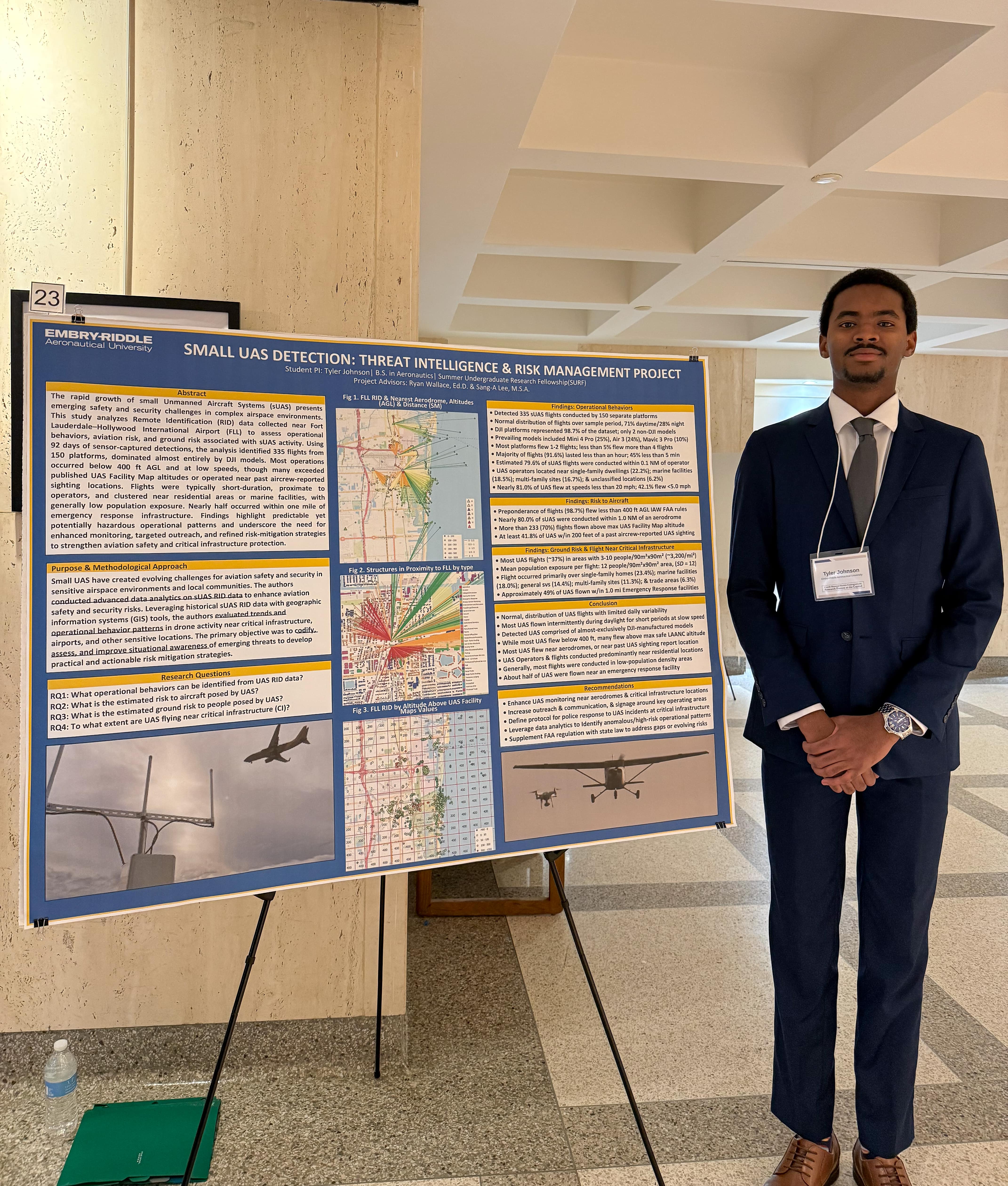
Tyler Johnson, a senior majoring in Aeronautics, presents his research focused on addressing aviation safety and security challenges posed by the growing number of drones in the airspace. (Photo: Embry-Riddle)
“The project involves designing the physical hinges that allow our origami structure to fold while maintaining its required strength,” said Shuster. “This ensures that when the habitats are inflated on different planets or moons, the origami floor we have designed can expand out with it, allowing astronauts to immediately start working instead of first having to assemble a floor in the habitat.”
Shuster is collaborating with Dr. Daewon Kim, professor of Aerospace Engineering and director of the Structures & Materials through Additive & Reconfigurable Technology (SMART) Lab.
“Working as a researcher for Dr. Kim has taught me not just how to complete educational research, but also how it corresponds to industry research,” said Shuster, who has completed multiple internships at Gulfstream Aerospace Corporation and plans to earn his master’s degree in Aerospace Engineering.
Johnson, a senior majoring in Aeronautics, exhibited his research addressing aviation safety and security challenges posed by the growing number of small unmanned aircraft systems (sUAS) in the airspace. He is working with Dr. Ryan Wallace, a professor in the Aeronautical Science Department, to develop a threat intelligence and risk management framework to improve the detection and assessment of drones in sensitive airspace. The research, conducted in partnership with the Transportation Security Administration and the Federal Air Marshal Service, uses advanced data analytics on sUAS detection and telemetry data to enhance aviation safety.
“This work is important because it directly impacts the security of the national airspace system and the critical infrastructure we rely on every day,” said Johnson.
Johnson credited Wallace with deepening his technical expertise and strengthening his ability to communicate research.
“Working with Dr. Wallace has been phenomenal,” said Johnson. “Presenting at the Florida Capitol was an amazing opportunity, and much of that credit goes to Dr. Wallace. He has been a true mentor.”