
Embry-Riddle Students Share Extreme Fluid Dynamics Discovery at National Conference

 Melanie Stawicki Azam
Melanie Stawicki Azam
/
Melanie Stawicki Azam
May 20, 2026, 8:59 AM
A multidisciplinary team of Embry-Riddle Aeronautical University undergraduate students recently presented on a national stage their novel research into a phenomenon in which liquid nitrogen bridges split into filaments and then regroup spontaneously for many cycles
Their work, which combined hands-on experiments with mathematical modeling, revealed a new physical phenomenon in ultra-cold liquids, said Dr. Andrei Ludu, a Mathematics professor and director of the university’s Nonlinear Waves Laboratory who mentored the students.
“The discovery may inform future advances in aerospace thermal management, microfluidics and even biological processes such as cell division,” he added.
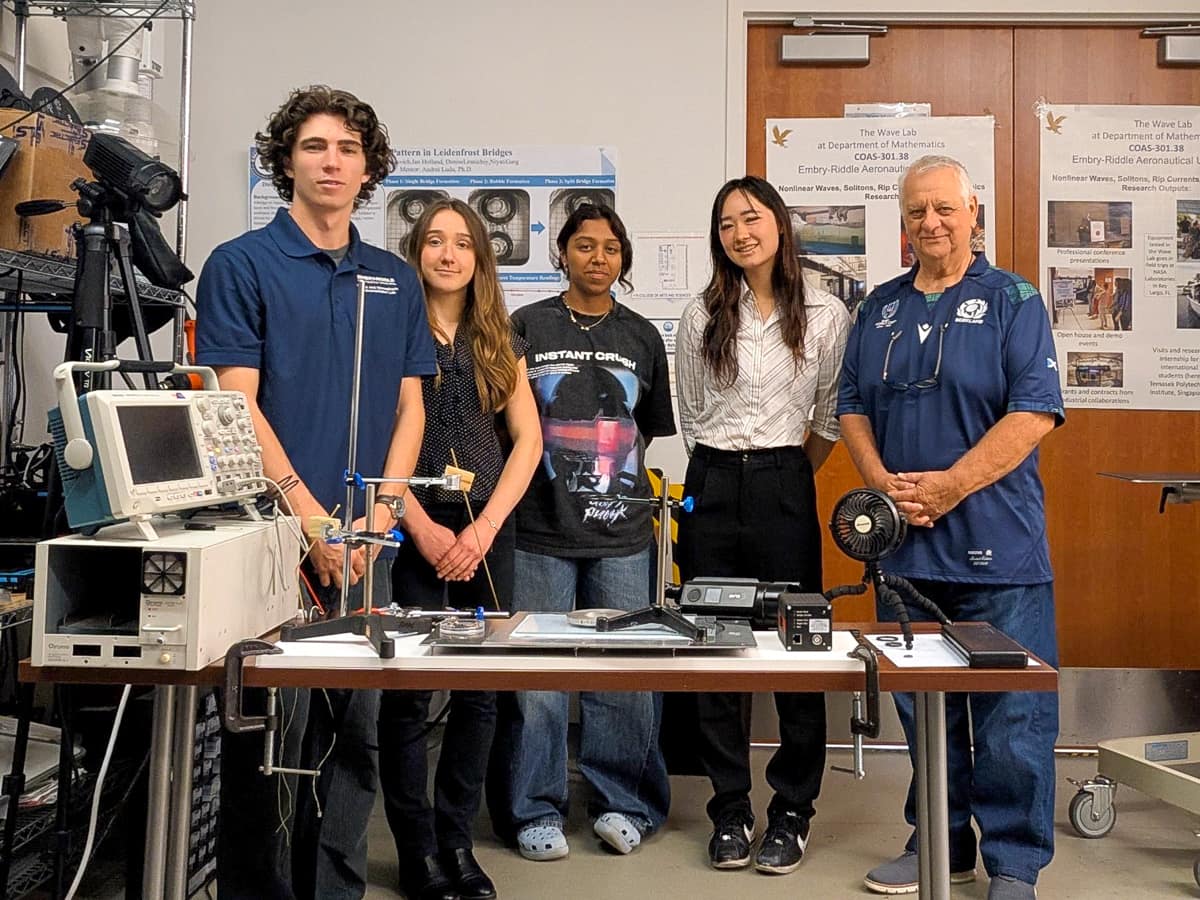
Students (from left) Ian Holland, Diana Slavich, Niyati Garg and Denise Lesnichiy with Dr. Andrei Ludu in the university’s Nonlinear Waves Laboratory. (Photo: Embry-Riddle)
Three of the four-member team — Engineering Physics students Ian Holland and Denise Lesnichiy and Aerospace Engineering student Diana Slavich — shared their findings at the 2026 National Conference on Undergraduate Research, held in Richmond, Virginia.
They were among 51 students from Embry-Riddle’s Daytona Beach Campus at the conference who presented 35 projects. The projects that engaged 94 students in total, said Dr. Mihhail Berezovski, associate professor of Mathematics and director of Undergraduate Research at the university’s Office of Undergraduate Research.
Under Ludu’s guidance, the students studied the behavior of liquid nitrogen when it is placed on a hot surface between specially designed circular boundaries. The super-cold liquid floats on a thin cushion of its own vapors, a phenomenon called the Leidenfrost Effect. They then discovered that a part of the floating liquid became trapped between the boundaries and formed liquid bridges that “breathe” by opening and closing a hole.
“This self-organized motion had not been observed before in cryogenic liquid systems,” said Ludu.
Holland, a senior from California who is the team’s lead, said the research allowed him to delve further into his interests in theoretical physics and mathematics.
“This was an opportunity to develop equations and modeling from the ground up,” said Holland, who plans to pursue a master’s degree in Engineering Physics.
He said Ludu provided support when the team needed it.
“Dr. Ludu had really good ideas that he shared with us, but he let this be our project and supported our research,” said Holland.
Slavich, a sophomore from New Jersey, said the research drove home engineering concepts in a real-world way and made her more interested in propulsion, which uses a lot of liquid fuels.
“It completely changed my whole viewpoint of the world, and it add so much depth to what I am learning in class,” she said. “It gave me hands-on experience in how liquids work.”
Aerospace Engineering student Niyati Garg, who also worked on the project but did not attend the national conference, presented the research at the 2026 Florida Undergraduate Research Conference, held in March at the University of North Florida in Jacksonville. She said sharing her work has boosted her communications skills and confidence, plus connected her with other researchers in the field.
“I feel like the experience has made me better able to express myself and more comfortable with talking to people,” said Garg, who is from India and also a flight student.
Lesnichiy, a junior from Oregon, credited the research with helping her land a National Science Foundation Research Experiences for Undergraduates position this summer at the National High Magnetic Field Laboratory housed at Florida State University in Tallahassee. The NSF support will allow her to work on an in-depth research project with scientists at the lab, the world’s largest and highest-powered magnet laboratory.
“I’m interested in fluid dynamics, so this research has definitely helped me,” said Lesnichiy.
Holland said the team plans to publish a paper on their research later this year.