
Embry-Riddle Undergrad Publishes Research on How Stars Shed Their Disks

 Keaton S. Ziem
Keaton S. Ziem
/
Keaton S. Ziem
Feb 10, 2026, 8:22 AM
Before she even finishes her undergraduate degree — a semester ahead of schedule — Embry-Riddle Aeronautical University Astronomy student Sola Nova has led a research project uncovering how massive, rapidly spinning stars shed their disks of gas.
Recently accepted for publication in The Astrophysical Journal, Nova’s paper offers new insights into Lambda Pavonis, a Be star located about 1,000 light-years away.
Nova said that she’s still a little surprised by how quickly her academic journey took off under the mentorship of Dr. Noel Richardson, associate professor of Physics and Astronomy.
“I first got involved when Dr. Richardson asked me to stay after his class,” Nova said. “I thought we were going to talk about test scores, but he asked me to join his research team. This is when I first learned about Be stars — large, hot stars that spin so fast they’re misshapen and can eject material into orbit. I was hooked.”
To 'Be' or Not to Be?
In the summer of 2023, astronomers captured a full cycle of Lambda Pavonis’ disk formation and dissipation using nearly 700 spectra from ground-based telescopes and high-cadence data from NASA’s Transiting Exoplanet Survey Satellite (TESS) — a complete event never before observed in such detail.
“The last three days that the NASA satellite was pointed in that direction, the star began building a disk,” Richardson said. “We watched the disk build, peak and dissipate. The beautiful thing about Sola’s data set is that she was able to put it all together in a coherent story about how the disk grows and is lost.”
Her analysis revealed that the star’s disk built up in just a few days and disappeared within weeks, demonstrating that the inner parts of the disk dissipate faster than the outer regions. The findings offer astronomers new clues about how these ephemeral structures evolve.
Discovery Through Perseverance
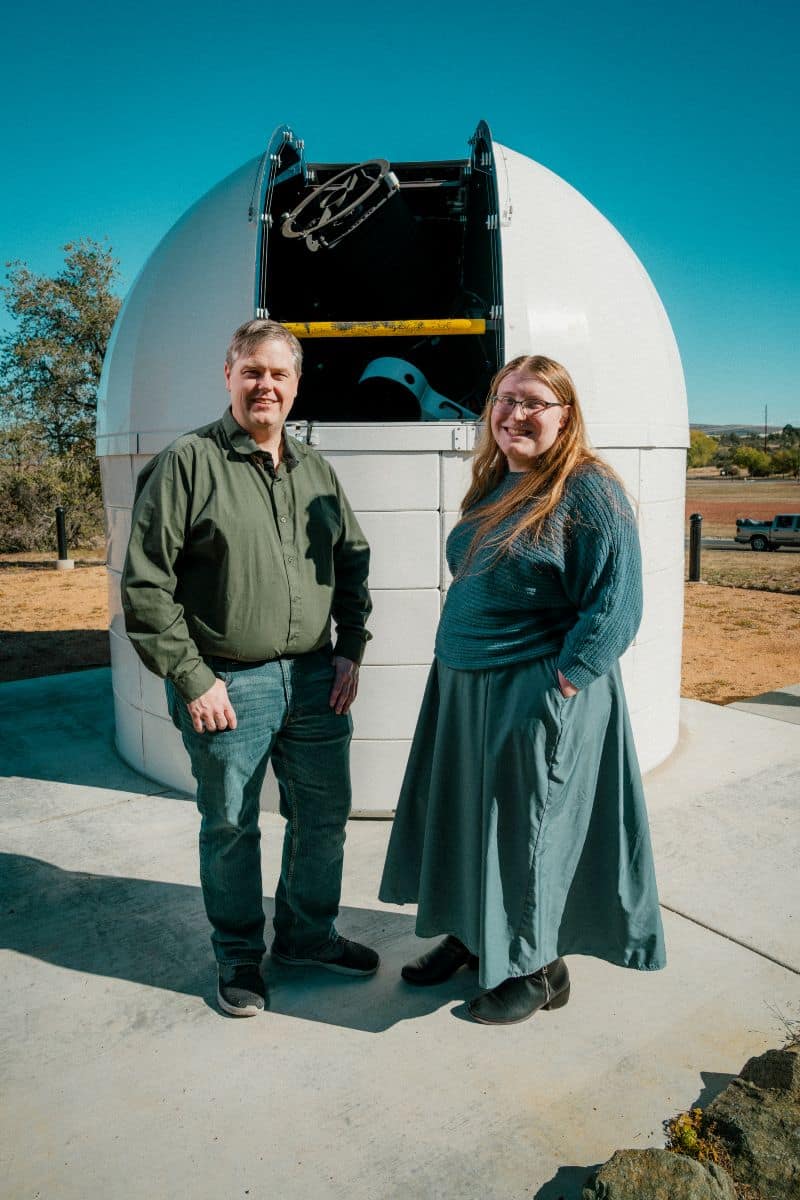 Astronomy student Sola Nova studied Be star disk formation under the mentorship of Dr. Noel Richardson. (Photo: Embry-Riddle/Connor McShane)As the lead student researcher, Nova handled the complex coding and data analysis that turned thousands of raw observations into publishable science.
“I analyzed the data, organized them into figures and wrote most of the original manuscript for submission,” she said. “The most difficult part was processing data from two different instruments to produce a clear graph. It took over a year, mostly because I was in school, but enough small tweaks finally got good results.”
Her persistence paid off. The resulting dataset not only captured the disk’s rapid formation but also revealed how the star’s internal pulsations might be tied to those outbursts — a key question in understanding Be stars.
The project connected Nova with collaborators from Denmark and France. Just a year ago, she had been studying the papers of these scientists, she said.
“When I started working with international collaborators, it felt a little more surreal,” she said. “Something about working with more people from around the world, and especially people whose work I had read, it made me feel like I was truly entering the astronomical community.”
Richardson called the accomplishment “exceptional,” adding that few students reach the finish line of a professional research paper while still undergraduates.
“I’m always proud to see my students get a project completed and into publication,” he said. “But to see them also be able to do it quickly while still in that undergraduate curriculum is something exceptional.”
A Legacy of Exploration
Understanding how Be stars form and shed their disks helps researchers learn more about how stars — and even planetary systems — evolve.
“Be stars can reveal quite a few things about other stars. They’re worth looking into to understand more about how the interiors of stars work,” Nova said. “We still don’t know which mechanism is responsible for forming the disk. Now that I’m on this path, I want to keep going until I figure out what exactly causes the disk to form around these stars.”
The culmination of her work comes as Embry-Riddle celebrates its century-long mission to push the boundaries of aerospace and space science. Nova’s success underscores the power of undergraduate research conducted at the university.
Now in her final semester, Nova plans to pursue graduate studies in astronomy.