
Embry-Riddle Ph.D. Student Mines Insect Behaviors for Engineering Insights

 Michaela Jarvis
Michaela Jarvis
/
Michaela Jarvis
Apr 06, 2026, 8:27 AM
James Hand is a Ph.D. candidate at Embry-Riddle Aeronautical University, a Department of Defense SMART scholarship awardee and, most recently, the recipient of the International Council on Systems Engineering (INCOSE)/Stevens Institute Doctoral Award. The award is presented annually to just two Ph.D. students worldwide, recognizing their research for its innovation and its potential to advance systems engineering.
Hand’s research focus? The behaviors and strategies of insects – and how those behaviors could translate into engineering designs for drones and robotics.
Hand says he particularly enjoys studying insect behavior because it is completely outside of his field of engineering.
“That makes it even more interesting to read and learn about these strange but unique behaviors,” he said.
From a Small Town to Big Accomplishments
Hand grew up in Flippin, a town of 1,345 people in north central Arkansas. His mother worked at the post office, and his father was a mechanic. For a few years, the family owned a dirt racetrack, and Hand would sometimes help his dad with the race cars and go-karts. Even as a kid, Hand liked to build things and tear them down.
He says he always loved engineering, but he also loved science in general. He also had interests beyond STEM subjects while growing up and was selected to attend the Arkansas Governor School during a summer in high school to study acting.
It was in his senior year of high school that his career path started to solidify. Hand took a computer science class, and it fit perfectly with what he described as an ideal scenario: “having a problem laid out before me and building something to address that problem.”
“With computer science, that is generally what you are out to do, take a problem and build a solution for it,” he said. “The challenges in implementation and tweaking the design to work better are part of the fun.”
Intro to Robotics, Biologically Inspired Design
As an undergraduate at the University of Arkansas, Hand did a lot of work in robotics, including on the university’s NASA Lunabotics competition team, but he wanted more expertise. He entered the master’s program in Unmanned and Autonomous Systems Engineering at Embry-Riddle, where he began the work that has won him accolades, awards and recognition as an innovative researcher.
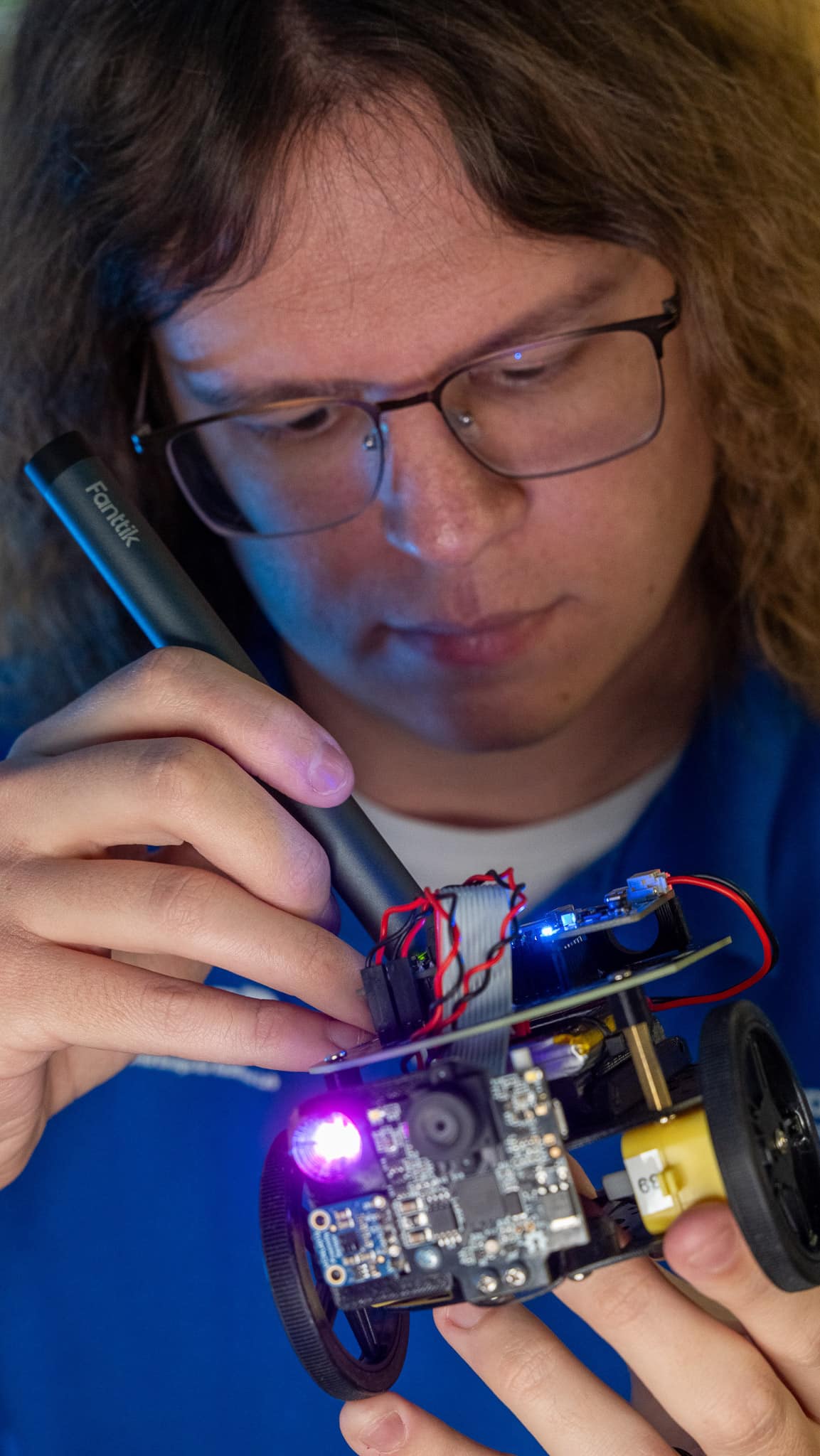
Hand checks one of the robotic vehicles in the Biologically Inspired Design-for-Resilience lab’s robotic swarm. (Photo: Embry-Riddle/David Massey)
Hand became intrigued by the biologically inspired engineering research of Dr. Bryan Watson, assistant professor in the Department of Electrical Engineering and Computer Science (EECS) and principal investigator of the Biologically Inspired Design-for-Resilience (BID4R) lab. Watson explores animal behaviors and strategies — such as how insects detect colony invasions — for their potential application in designing systems such as drone and robot swarms.
Hand credits Watson as “the one who really led me down the path of working with insects and insect behaviors. Before meeting him, I had only the vaguest of notions you could even use insect behaviors for something as complex as robotics.”
Hand said Watson – who was named the 2025 Tej Gupta ERAU Teacher of the Year, Embry-Riddle’s 2024 College of Engineering Teacher of the Year and the university’s 2024 Research Mentor of the Year – “taught me pretty much everything I know about how to do proper research, how to manage and advise undergraduate students, and more.”
For his part, Watson said Hand has been instrumental to the BID4R lab.
“James was the first student to join the BID4R Lab and was foundational to the lab's progress over the last three years,” said Watson. “He proposed our Swarm Test Arena for Resilient Systems (STARS) robot swarm, has presented at multiple conferences, and is well recognized in the systems engineering community. I am very grateful that he chose to spend his Ph.D. with EECS at Embry-Riddle.”
Learning From Insects, Millipedes
For his Ph.D., Hand continues to focus on engineering design inspired by nature. Building on research by Watson, Hand worked to develop systems to resist cyberattacks on drone swarms and other networks by imitating the way swarm insects protect themselves.
Hand says his work focuses on a growing problem that affects multi-agent systems such as drone swarms, warehouse robots and computer networks. Considering that faults in such networks can spread between interconnected agents in the same way that a disease can spread in a population, harming the group’s performance or even damaging or destroying the group, Hand has turned to examining how swarm insects fight off disease.
“I look at a group in nature that has millions of years of experience fighting off disease and fungal infections while also being some of the smallest and least intelligent species on the planet,” Hand said.
Exploring the ways that swarm insects organize their nests, adjust their genetics and use other strategies to resist disease, Hand then helped develop mathematical models of those strategies that could be applied to robot swarms. His research showed that the strategies, which are scalable and low-complexity, provided “noticeable resilience” against the spreading of faults.
In a paper published in October in the proceedings of the INCOSE International Symposium, Hand and Watson concluded that they were able “to greatly improve system resilience,” mitigating the need for previously tested methods such as centralized control, which had faltered in larger multi-agent swarms or systems."
Hand has also done research on other types of insects. He has considered studying how a type of cricket changed the way it communicates to avoid a parasite that had recognized the crickets’ communication pattern, a strategy that could provide insights into how computer networks could improve the security of their communication. He is also investigating how millipedes climb on top of each other as they move as a swarm, providing security and speed to the swarm, and demonstrating energy-saving potential.
Explaining the energy-saving potential of millipede movement, Hand uses the analogy of a train, explaining that if a passenger walks inside the train in the same direction it’s traveling, the speed of the passenger equals both the speed of the train plus the walking speed. Similarly, millipedes that climb on top of the swarm are arriving at their destinations with less energy output per distance traveled.
When it comes to continuing his research, Hand is definitely playing the long game. Asked which of his discoveries he thinks could have the greatest effect on the world, he said, “Honestly, I think the ones I haven’t made yet.”