
Embry-Riddle Leads National Effort to Strengthen Aerospace Cybersecurity Workforce Through Government, Industry Collaboration

 Keaton S. Ziem
Keaton S. Ziem
/
Keaton S. Ziem
Apr 29, 2026, 8:23 AM
Aerospace leaders, cybersecurity experts and students gathered at Embry-Riddle Aeronautical University to address a pressing aerospace challenge: securing increasingly interconnected, AI-enabled flight and space systems.
In an opening message to participants at the third annual ERAU-NASA-NSF Aerospace Cybersecurity Workshop at the Prescott Campus, U.S. Sen. Mark Kelly, a former Navy test pilot and astronaut, said that “the stakes continue to grow” for aerospace cybersecurity.
“As our aerospace systems become more connected and more complex, cybersecurity is no longer a standalone issue,” he said in the recorded message. “It is fundamental to safety, reliability and mission success.”
Supported by the National Science Foundation (NSF) CyberAICorps Scholarship for Service (SFS) program, the Embry-Riddle event brought together more than 75 professionals from over 50 organizations, as well as students from more than 25 universities.
The two-day workshop addressed challenges ranging from securing aircraft systems, airline operations and air traffic control infrastructure to emerging issues related to advanced air mobility (AAM) and space-based technologies.
Participants emphasized that aerospace cybersecurity is interdisciplinary, requiring coordination among engineers, operators, policymakers and cybersecurity specialists.
“This workshop is about more than sharing ideas — it’s about bringing the right people into the same room to tackle challenges that no single sector can solve alone,” said Dr. Krishna Sampigethaya, chair of the Department of Cyber Intelligence and Security and NSF SFS principal investigator for the Prescott Campus. “By connecting students from across the nation with leaders from industry, government and academia, we are not only advancing solutions but also building the workforce needed to secure the future of aviation and space systems.”
That reality was evident during a panel focused on aerospace cybersecurity careers, where four Embry-Riddle students moderated a discussion with professionals from NASA, Boeing, airlines and other industry groups.
Panelists described careers that span disciplines.
“It can’t just be cyber, and it can’t just be aerospace,” said Nina Vajda, who now works at Lancium, an energy technology and infrastructure company, after decades of experience in aerospace cybersecurity. “There has to be communication and collaboration.”
For students, the session offered both practical guidance and a clearer view of how to enter a field facing growing demand for talent. Panelists encouraged students and recent graduates to seek hands-on experience, remain flexible in their career paths and take advantage of opportunities to build connections across the industry.
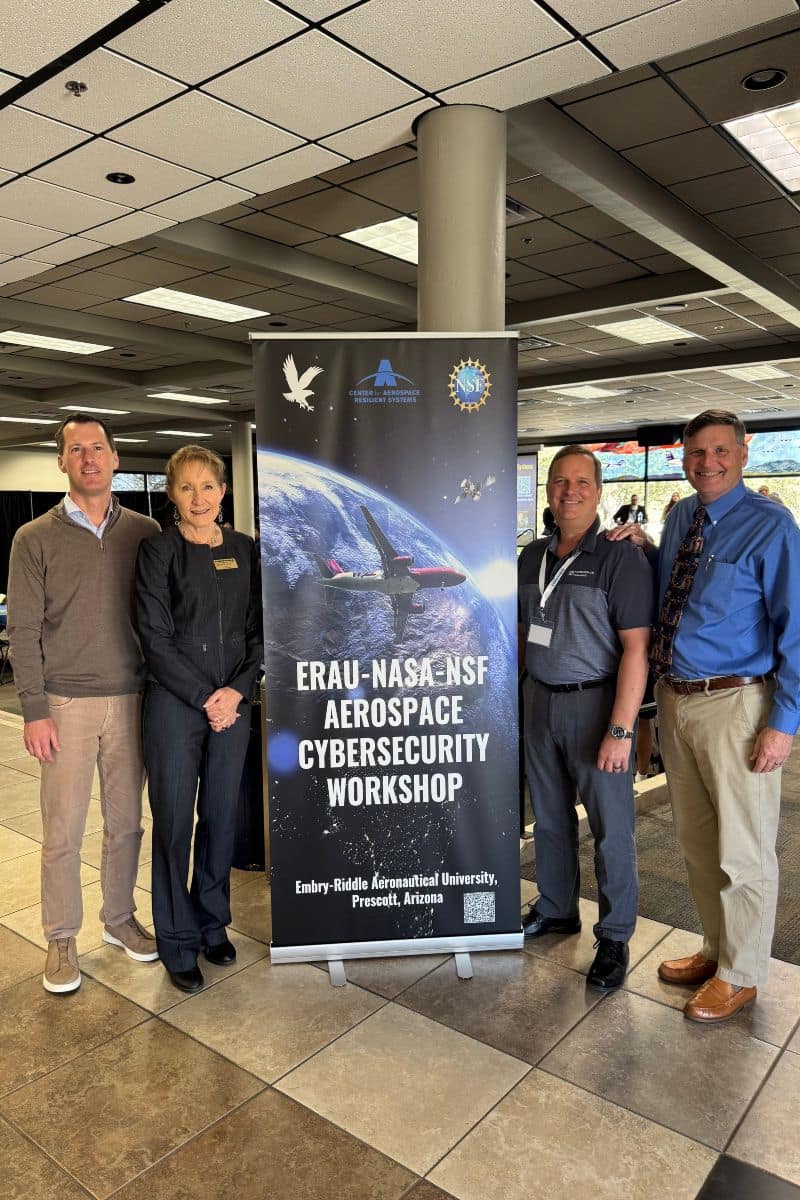 Leaders from across aviation and cybersecurity gather for a special session at the ERAU-NASA-NSF Aerospace Cybersecurity Workshop, highlighting cross-sector collaboration on trust, data and decision-making in modern aerospace systems. (Photo: Embry-Riddle)
Securing the Aviation, Space Domains
Discussions throughout the workshop highlighted that cybersecurity is becoming inseparable from aviation safety. Modern aircraft and aviation systems are increasingly reliant on data — from real-time weather and navigation inputs to software updates and connected operational tools.
“We’ve been lulled into this comfort; we tend to trust but not verify,” said Maj. Gen. Jeannie Leavitt, dean of the College of Aviation on the Prescott Campus. “We need to recognize when something isn’t right, confirm with other instruments and ensure it’s checked.”
Leavitt was part of a panel discussion on how trust and decision-making are evolving in modern aviation. She was joined by Daniel Baker, founder of FlightAware, a flight-tracking platform; Stephen Taylor, former Boeing chief pilot and president of Boeing Business Jets; and Steve Luczynski, board chair of Aerospace Village, a cybersecurity nonprofit.
The industry leaders agreed that security challenges extend to existing vulnerabilities.
“When new technology comes out, security-conscious people focus on those one or two risks — but not the 700 things wrong with the technology we’re currently using,” Baker said.
The workshop also explored the latest frontier in cyber defense: space. Dr. Andrew Aldrin, associate professor and executive director of space programs at Embry-Riddle Worldwide, highlighted how technological shifts and expanding commercial activity are creating new opportunities — and new challenges.
“Now is the time to find your place in space,” Aldrin said. “We’re in a transition, and that’s when opportunities emerge.”
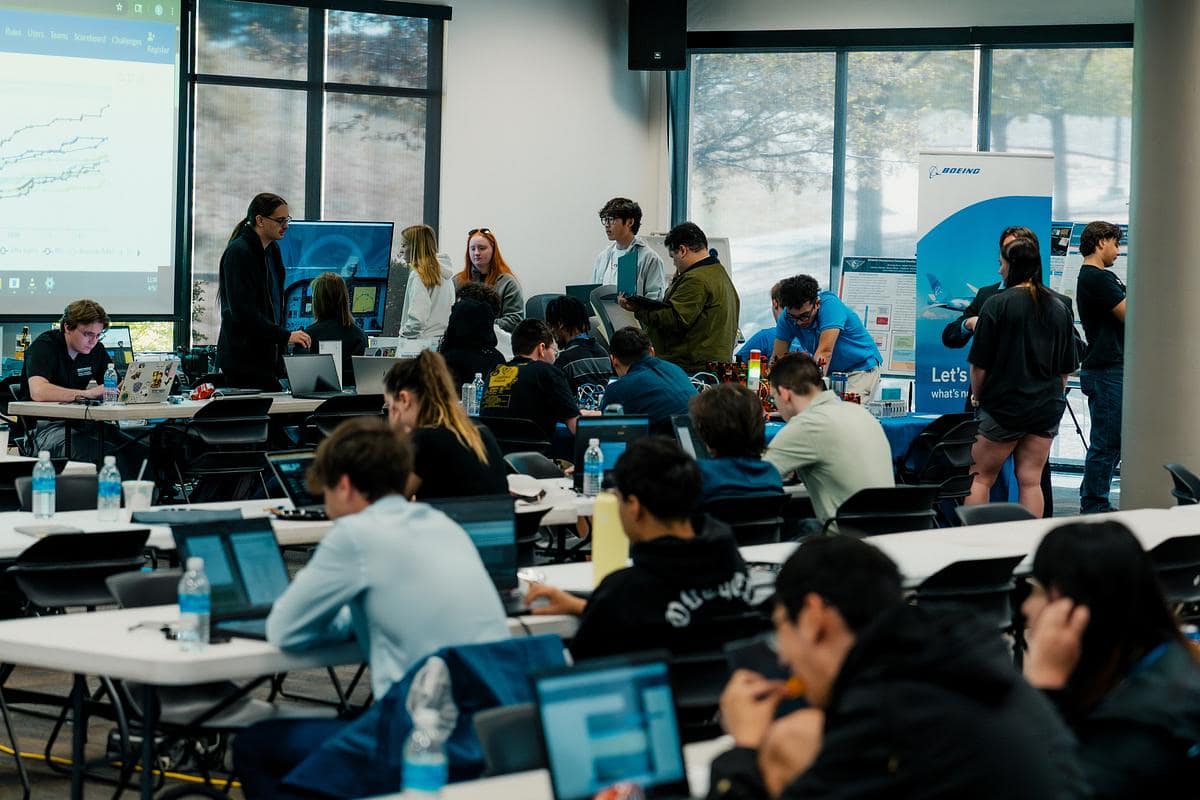
Students compete in an aerospace cybersecurity capture-the-flag competition developed by students at Embry-Riddle’s Prescott Campus. (Photo: Embry-Riddle)
Teams Compete in Aerospace Capture-the-Flag Challenge
In addition to expert panels, the workshop featured an aerospace cybersecurity capture-the-flag competition developed by Embry-Riddle Prescott students.
The competition called on teams to solve realistic aviation cyber scenarios, with awards recognizing the top three teams from outside the university. A joint team from Ohio State University and the University of South Florida earned top honors and a $2,100 prize.
“The CTF was one of the most engaging competitions I’ve been a part of. The aviation-specific scenarios pushed us to think beyond textbook cybersecurity and apply our skills to real-world aerospace contexts, which made it both challenging and exciting,” said Haskell Cappers, a Computer Science graduate student at Embry-Riddle’s Daytona Beach Campus and a member of the top-scoring Embry-Riddle team. “Coming in first place was a huge honor.”
Student research was also showcased during a poster session. Top awards were shared by two Embry-Riddle Prescott teams focusing on pilot cyber readiness and AAM security, including a project sponsored by Honeywell Aerospace.