
Embry-Riddle Speaker Series Explores International Collaborations in Space

 Emily Berger
Emily Berger
/
Emily Berger
May 21, 2026, 8:08 AM
Embry-Riddle Aeronautical University recently hosted a series of policy experts and officials to discuss U.S.-Japan cooperation in space security.
The seven-part series — held throughout the spring semester — concluded in late April with a lecture by Keiichi Wada, director of the Washington, D.C. office for the Japan Aerospace Exploration Agency (JAXA). In that role, Wada is responsible for fostering collaborations with U.S. agencies, including NASA and the National Oceanic and Atmospheric Administration (NOAA), as well as other space programs in North and South America.
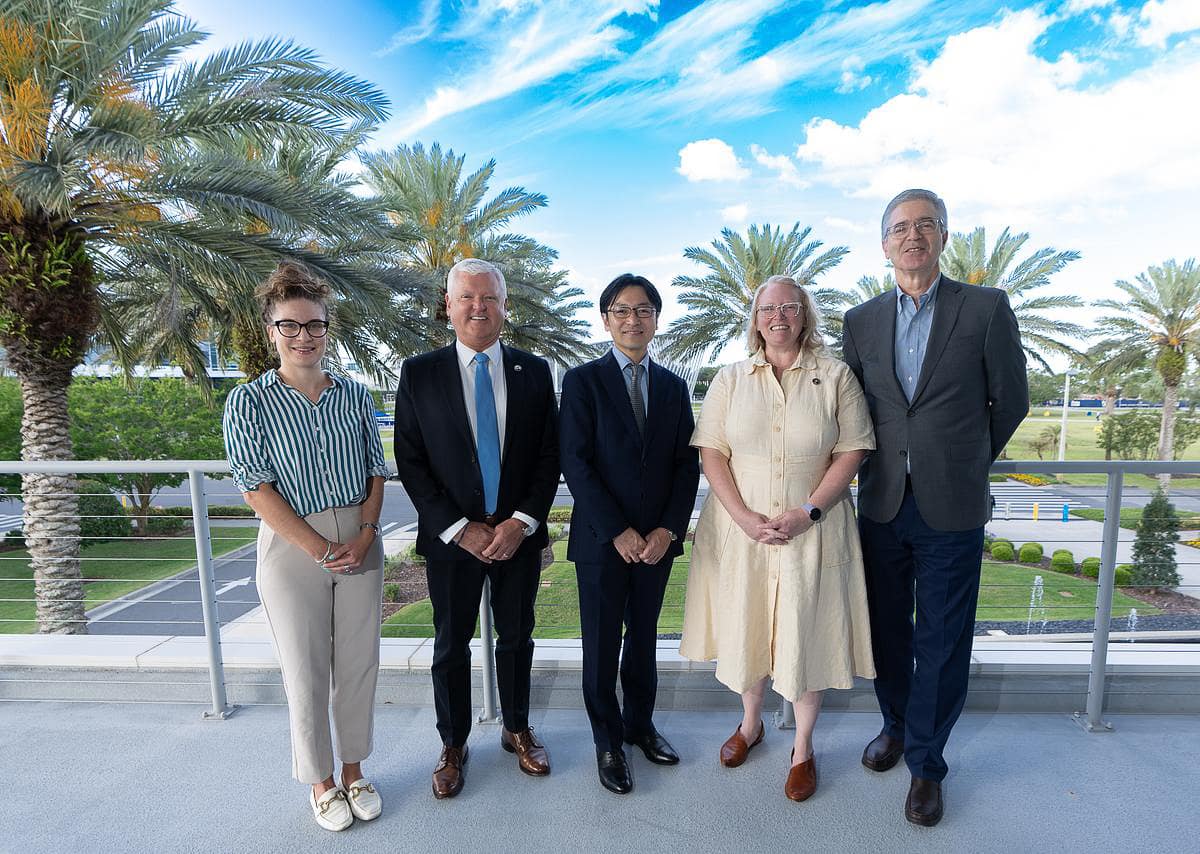
Wada on a tour of Embry-Riddle's Daytona Beach Campus. Here, he is with (from left) Dr. Alice Dell'Era; Worldwide Campus Chancellor Dr. John Watret; Dr. Elisabeth Hope Murray; and Embry-Riddle President P. Barry Butler, Ph.D. (Photo: Embry-Riddle/David Massey)
"It was a wonderful opportunity for me and JAXA to share our mission,” Wada said of his experience at Embry-Riddle. “International cooperation and partnerships are vital for JAXA to achieve its wide range of space missions.”
The program was supported by Embry-Riddle's first grant from the Japan Foundation, a Japanese cultural exchange institution. The grant was awarded to Dr. Alice Dell’Era, principal investigator and an assistant professor in the Security and International Affairs Department. Dr. Elisabeth Hope Murray, associate professor in the same department and Dr. Teha Cooks, associate director of the Center for Teaching and Learning Excellence at Embry-Riddle’s Daytona Beach Campus, also supported the project.
"This series created a valuable opportunity for students and the Embry-Riddle community to engage in meaningful dialogue with leading experts on the space-related challenges facing both Japan and the U.S.,” said Dell’Era.
Across the series, speakers emphasized the growing importance of international cooperation in addressing space security.
Dr. Kazuto Suzuki, a professor of science and technology policy at the Graduate School of Public Policy at the University of Tokyo, highlighted the evolution of Japan’s space policy and explored the role of space within Tokyo’s national security strategy, noting that collaboration is essential to maintaining stability in an increasingly complex space environment.
Dr. Saadia Pekkanen, founding director of the Space Law, Data and Policy Program at the University of Washington in Seattle, further examined the role of governance and long-term strategic coordination in space, emphasizing the contribution of the U.S.-Japan alliance in the space domain.
Speakers also focused on the technological dimensions of space security, particularly the growing reliance on satellite systems and the need to protect them. Robert S. Wilson, systems director for the Center for Space Policy and Strategy at the Aerospace Corporation, an organization that advances U.S. space capabilities, discussed how the proliferation of satellites can enhance resilience, noting that integrating capabilities across systems could reduce vulnerabilities and strengthen national security.
Michael Fletcher, president of MJF Consulting, a firm that provides services to U.S. and Japanese companies in the space sector, highlighted the role of the commercial and civil space sectors in supporting space security needs. Sean Wilson, founder and CEO of the Mirai Group, which provides support to clients interested in international partnerships in the aerospace and emerging technologies sectors, emphasized future pathways for bilateral cooperation in the space domain.
Legal and governance structures were another central theme throughout the series. Dr. Setsuko Aoki, professor at the Chiba Institute of Technology in Japan, discussed U.S.-Japan space security cooperation within international and regional governance initiatives, noting the existence of ambiguous legal frameworks. Her lecture highlighted the need to balance security considerations with norm creation, reinforcing the role of law and policy in shaping the future of space security.
Throughout the speaker series, students engaged directly with the speakers through Q&A sessions and networking opportunities.
“Students and attendees gained a deeper appreciation for the importance of international collaboration, and the vital role global partnerships play not only in strengthening space security, but also in shaping their academic journeys and opening doors to future careers in the space industry,” Dell’Era said.