
Embry-Riddle Sees Record Student Participation at Fall 2025 Research Symposium

 Melanie Stawicki Azam
Melanie Stawicki Azam
/
Melanie Stawicki Azam
Dec 05, 2025, 8:59 AM
Embry-Riddle Aeronautical University set a record for student research engagement at the Fall 2025 Student Research Symposium, which featured more than 240 posters and 600 student presenters from across the university.
The symposium, held Nov. 19 in the Mori Hosseini Student Union on Embry‑Riddle’s Daytona Beach Campus, included research on a range of topics, from aviation safety and uncrewed and autonomous systems to engineering design and AI-supported modeling. Other studies focused on space and atmospheric science, human factors and business analytics.
“In just a few years we have tripled participation in undergraduate research at Embry-Riddle,” said Dr. Mihhail Berezovski, director of the Office of Undergraduate Research and associate professor of Mathematics. “One of Embry-Riddle’s greatest strengths is the opportunity for undergraduate students to engage in world-class research alongside exceptional faculty and industry partners.”
The best overall undergraduate and graduate posters received awards. Additionally, first, second and third place awards went to undergraduate projects in each college, and one graduate student from each college was chosen for a best poster award.
“Research is no longer a niche activity for a select few — it is becoming an essential part of Embry-Riddle’s academic culture and identity,” said Berezovski.
Investigating the Behavior of Bacteria in Microgravity
Tyler Jenkins, a sophomore Aerospace Physiology student, won the Best Overall Undergraduate Poster award for his research investigating how a specific strain of E. coli bacteria responds when exposed to microgravity.
He worked in the Space Microbiology Lab, directed by Dr. Hugo Castillo, associate professor of Human Factors and Behavioral Neurobiology. The lab tests different strains in a simulated space environment to see how human health could be affected. The research is significant because bacteria play a role in how humans digest food, fight off infections and process information in their brains.
“When people go into space, they are exposed to a completely different environment, and something that changes is the behavior of these bacteria,” said Jenkins. “With this research, we can see, based on how the bacteria change, whether people are at a higher risk of digestion, immunization and brain signaling issues, and develop some strategies to mitigate them.”
Jenkins, who wants to pursue a career in emergency medicine, said that this was his first major project in the Space Microbiology Lab.
“Dr. Castillo taught me all the concepts and techniques I needed to do my job well,” said Jenkins. “I have become much more well-rounded as a research scientist, thanks to his mentorship.
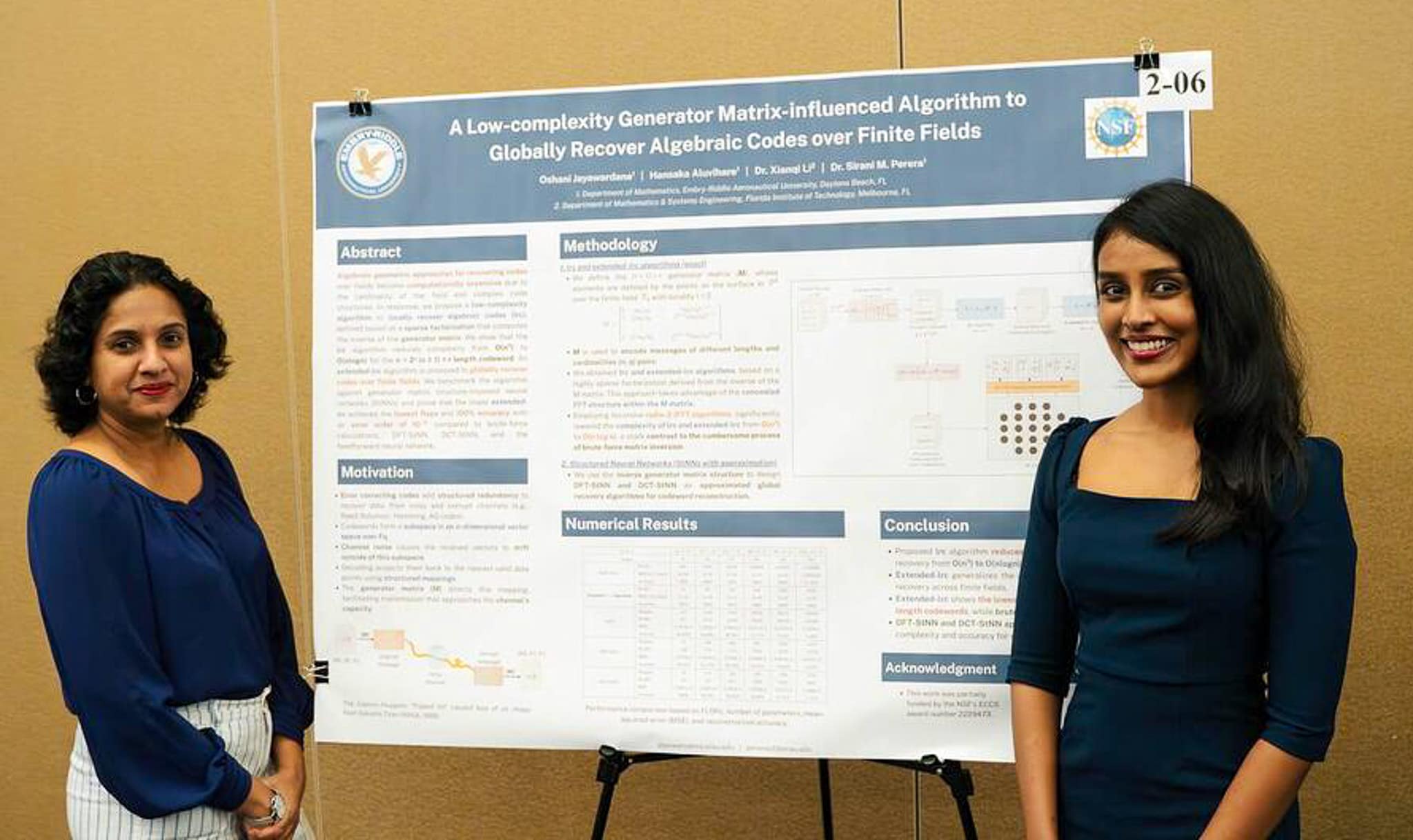
Data Science graduate student Oshani Vimansa Jayawardane (right), who tied for the Best Overall Graduate Poster award, and her faculty mentor, Dr. Sirani Perera, associate professor in the Mathematics Department. (Photo: Embry-Riddle/Smirkae McLean)
Using Advanced Math to Improve Communication
Graduate students Oshani Vimansa Jayawardane and Timothy Mascal tied for the Best Overall Graduate Poster award.
Jayawardane, who is pursuing a master’s degree in Data Science, is working with Dr. Sirani Perera, an associate professor in the Mathematics Department, on research to improve data transmission and recovery using a low-complexity algorithm for more resilient digital data in the context the network of connected objects that have sensors and software, allowing them to share data via the Internet, known broadly as the Internet of Things.
“Today's 5G communication systems, including Wi-Fi, digital TV, and satellite communication, use error correcting codes to recover data,” said Jayawardane, who has a bachelor’s degree in Electrical and Electronic Engineering. “But the conventional methods for recovering these algebraic codes over finite fields are computationally intensive.”
With Perera as her mentor, Jayawardane said she has learned how applied linear algebra can be used to reduce the complexity of problems and improve performance across a variety of fields, from wireless communications to spacecraft trajectory predictions.
“While working with her on this project, I was able to see how advanced math concepts can be used effectively to solve real-world problems,” said Jayawardane.
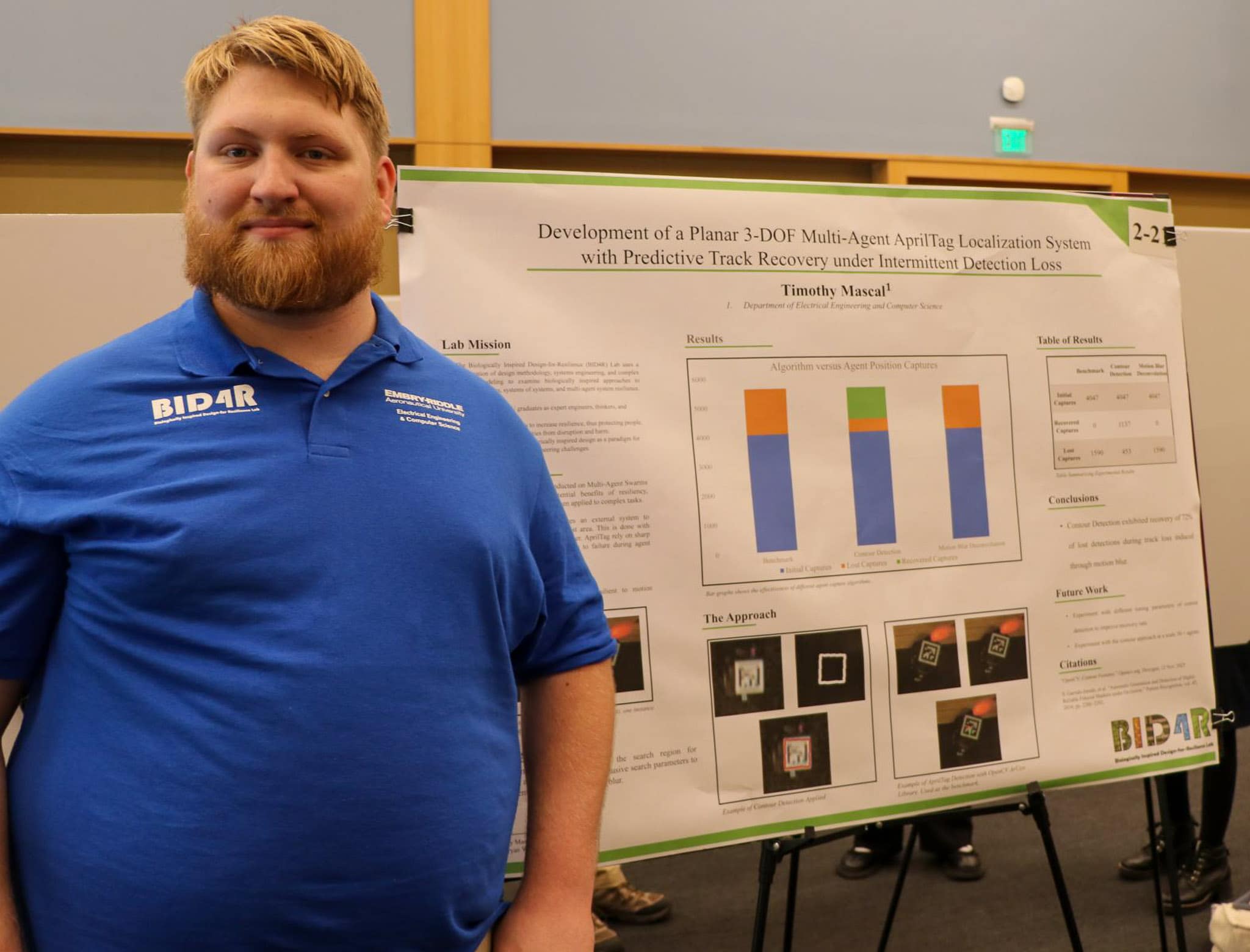
Systems Engineering graduate student Timothy Mascal tied for the Best Overall Graduate Poster award. (Photo: Embry-Riddle/Office of Undergraduate Research)
Researching Multi-Agent Swarms for Cyberattacks
Timothy Mascal, who is pursuing a master’s degree in Systems Engineering, is conducting research using detection history to better track multi-agent swarms, which can identify cyberattacks on networks.
“Tim's work focuses on enabling better performance of our STARS Robot Swarm, which is used to validate many of the algorithms used in the research,” said Dr. Bryan Watson, an assistant professor in the Department of Electrical Engineering and Computer Science and director of Biologically Inspired Design-for-Resilience (BID4R) Lab.
Resembling the collective behavior of ants or bees in nature, multi-agent swarms are systems that use many autonomous agents to collaborate on solving complex problems. Using systems engineering and modeling to examine biologically inspired approaches, the BID4R Lab is researching multi-agent swarms for complicated tasks, because of their resiliency, adaptability and scalability
“In the experimental setup for testing swarms using small robots, it was difficult to locate where the robots were while they were moving, which is important for the multi-agent swarm research,” said Mascal, who earned his B.S. in Mechanical Engineering and completed two Naval Research Enterprise internships. “I was interested in this problem because of my experience with computer vision, which is the process of extracting useful information from an image using a variety of techniques.”
He said he has spent the past semester working closely with Watson and learning more about conducting research.
“Dr. Watson has provided consistent mentorship by answering questions, providing direction and holding one-on-one meetings with me to ensure everything is going well,” said Mascal, a Defense Department SMART Scholarship recipient. “It has been an excellent experience and by far the best mentorship I’ve had.”