
Embry-Riddle Researchers Develop Drone Tech to Study Harmful Blue-Green Algae on Lake Okeechobee

During the summer months, mats of blue-green algae float across Florida’s Lake Okeechobee, choking the ecosystem and releasing toxins that can be irritating to people and fatal to fish and other wildlife.
Water testing could help better detect the blue-green algae — which are actually a primitive type of bacteria called cyanobacteria — and help predict where blooms are most likely to erupt. But collecting samples across Lake Okeechobee’s 730-square-mile surface presents major logistical challenges.
For this reason, researchers at Embry-Riddle Aeronautical University are exploring the use of uncrewed aerial systems, or drones, to capture water samples and test the air across the lake. The team has begun developing water- and particle-sampling sensors to deploy on the drones. The aircraft will also carry advanced cameras that can detect wavelengths beyond what human eyes can perceive to assess the concentrations of cyanobacteria and the health of aquatic vegetation.
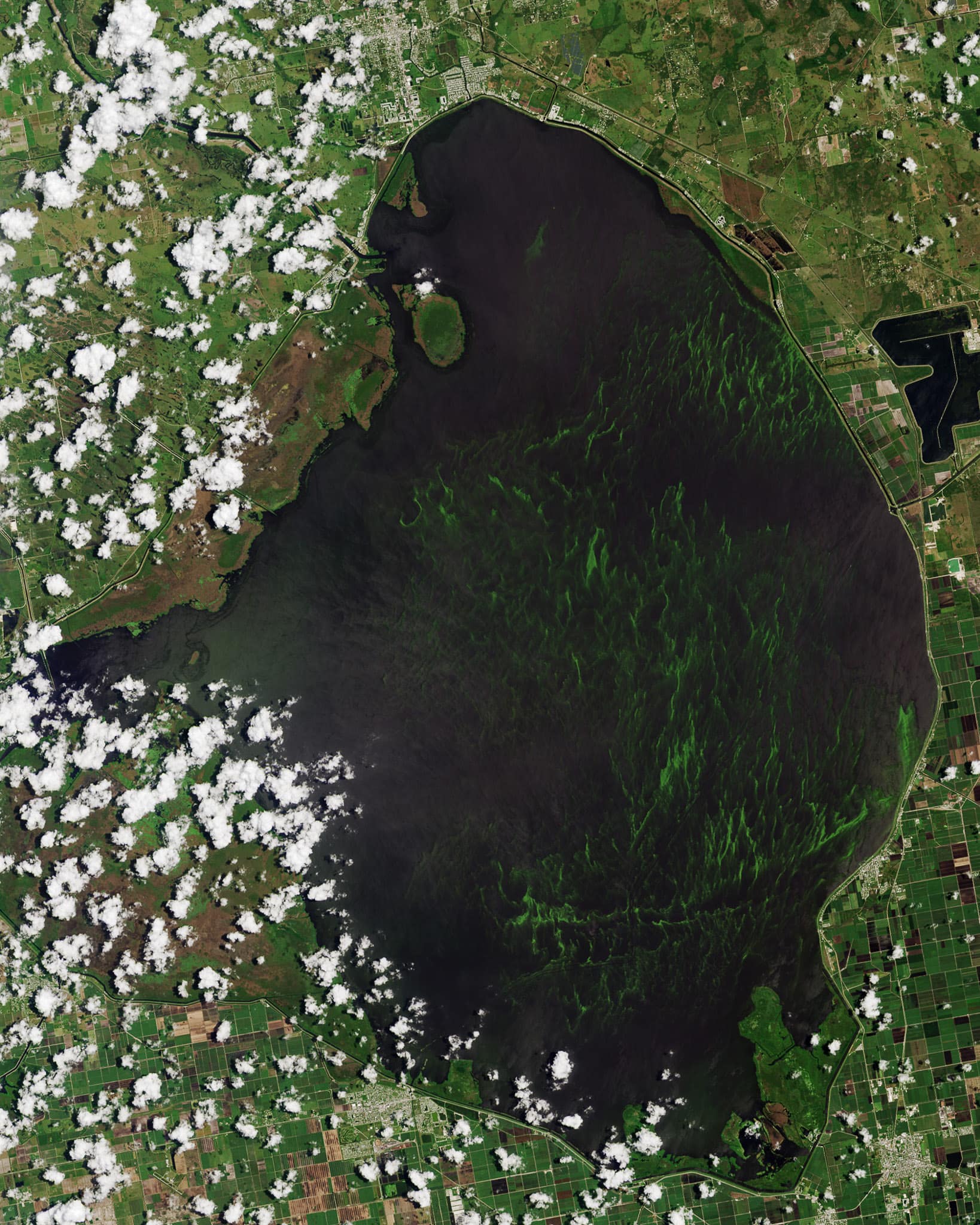
Blue-green algae on Lake Okeechobee can be seen from space. (Image: NASA Earth Observatory/Wanmei Liang)
The project is supported by a $500,000 Environmental Protection Agency grant and is in collaboration with the University of South Florida and the Sanibel-Captiva Conservation Foundation.
Feeding on abundant nutrients, cyanobacteria blooms grow rapidly on Okeechobee and at times have covered as much as 90 percent of its surface. For people living near the lake, the blooms’ annual arrival brings rotting smells. Cyanobacteria produce toxins that can become airborne, irritating the throat and lungs.
The South Florida Water Management District currently operates 32 sampling stations across Okeechobee. During the peak algal bloom season, from May to October, samples are collected twice a month.
“Our goal is to develop a system where a single aircraft can take multiple samples across a broader region,” said Dr. Kevin Adkins, professor of Aeronautical Science and a principal investigator on the project. Adkins also directs Embry-Riddle’s Uncrewed Vehicle and Atmospheric Investigation Lab.
Working with several four- and six-rotor aircraft, the team has prototyped various water collection systems. One challenge is that carrying liquid loads reduces the drones’ battery life, limiting flight time and range.
“Water is inherently heavy, so something we’ve been talking about is building a water sampler to maximize our fieldwork time while also being wary of how much the drone can sustain,” said Kayla Taylor, a Ph.D. student in Electrical Engineering and Computer Science.
The system must also collect samples simultaneously from the lake’s surface and at a depth of 0.5 meter (about 1.6 feet). The team is currently experimenting with a device that holds two sets of syringes, which are opened by small motors.
To study the atmosphere above the algae, the research team is designing what is called an impinging system, a narrow suction tube containing a liquid that captures microorganisms. While impinging devices are available on the market, the team’s design builds on these systems by collecting multiple, discrete samples at various locations and heights.
“These systems are novel, and hopefully will unlock new insights,” Adkins said.
The water and air samples will then be analyzed to determine the levels of cyanobacterial toxins, said Dr. Emel Sen Kilic, a principal investigator on the project.
Nutrients, such as phosphorus and nitrogen, that the cyanobacteria thrive on will also be tested for. Such testing could help clarify the concentrations and combinations of nutrients that trigger a bloom.
“With enough sampling, you can see if there’s a pattern and potentially even predict them,” said Sen Kilic, assistant professor of Aerospace Physiology and co-director of the Space Physiology Antibody and Cellular Engineering Lab.
During peak months, blooms grow so extensive that the mats of blue-green algae are visible from space and can be identified and tracked by satellites. NASA and European Space Agency multispectral satellites in low Earth orbit can measure wavelengths of light indicative of their concentrations.
Similarly, the drones will use thermal infrared, multispectral and hyperspectral sensors, which capture hundreds of spectral bands. Adkins said the existing satellite imagery can be fused with “finer-scale drone imagery” collected more often.
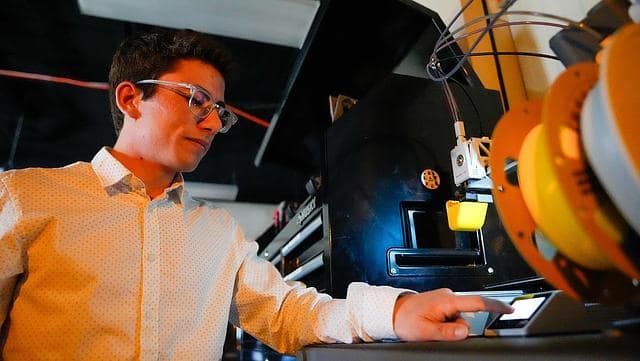
Fratto used 3D printing to prototype components of the water collection system that will be tested on the drones. (Photo: Embry-Riddle/Krystel Knowles)
The higher-resolution imagery will enable the team to understand algae bloom movement and formation that “were previously masked by the lower observation frequency and coarser spatial resolution of satellite sensors,” Adkins said. The imaging can also help monitor the health of aquatic vegetation.
The first drones will be deployed over Lake Okeechobee this summer and fall.
Justin Fratto, a junior Mechanical Engineering student working on the water sampler, said the experience has taught him how to create multiple prototypes and work within the drones’ physical constraints while meeting the scientists’ needs.
“This has been really valuable, to be given a problem, brainstorm something and then build it,” he said.
Taylor, the Ph.D. candidate, said she was drawn to the project because she is from Sarasota, Florida, and has seen firsthand the effects of red tide, a different type of harmful algae.
“Not only do I see myself as a leader of research,” she said. “But I want to be a leader on projects that are in the community.”