
Embry-Riddle Professors Connect With Ukrainian Students Through Virtual Peace Corps Program

 Melanie Stawicki Azam
Melanie Stawicki Azam
/
Melanie Stawicki Azam
Feb 17, 2026, 8:58 AM
Two Embry-Riddle Aeronautical University professors recently found a way to support students in war-torn Ukraine.
Through the Peace Corps’ Virtual Service Pilot program, Dr. Maria Petrescu and Dr. Iuliia Hoban, both faculty at the Worldwide Campus, completed youth development projects with students and faculty at Ukrainian educational institutions.
“It’s been very rewarding in multiple ways to be able to contribute my expertise to something tangible,” said Hoban, an assistant professor in the Department of Emergency, Disaster and Global Security Studies at the Worldwide College of Arts & Sciences and program chair for the master’s in Human Security and Resilience. “They’ve learned from me, and I’ve learned from them.”
Participants in the virtual Peace Corps program donate up to 15 hours a week, collaborating online with their counterparts in more than 50 countries for up to 6 months on projects. The projects are in six sectors, including agriculture, community economic development, education, environment, health and youth development.
Hoban developed a 12-week interactive course, teaching leadership and communications skills to students at Sambir College of Economics and Information Technologies in western Ukraine.
“Despite the challenges they faced following Russia’s full-scale invasion of Ukraine in February 2022, including continuous air raid alerts and problems with electricity, these students remained committed and engaged,” she said.
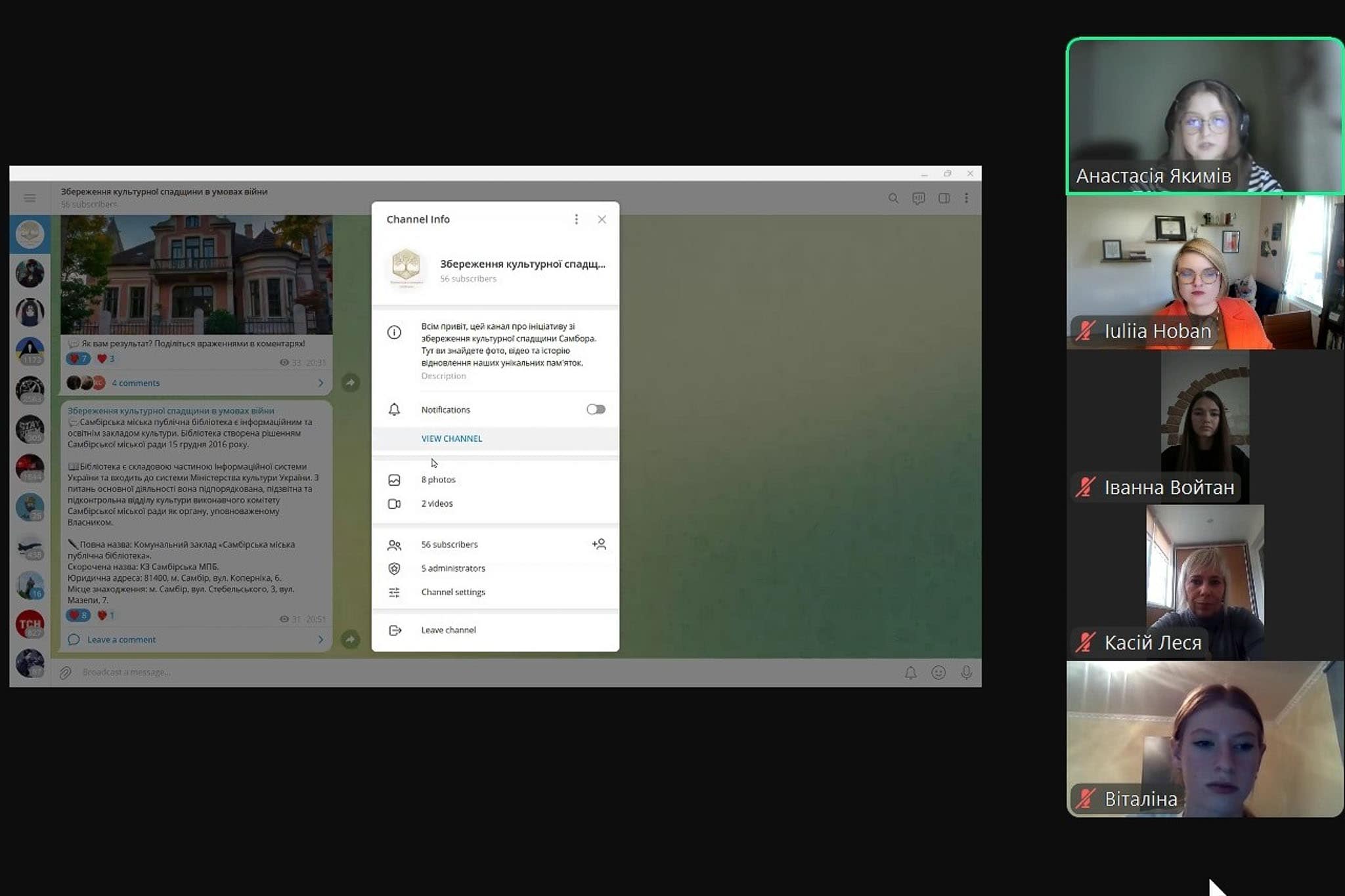
Students from Ukraine’s Sambir College of Economics and Information Technologies present their project on preserving local cultural heritage amid the ongoing Russia-Ukraine War. (Photo: Embry-Riddle/Dr. Iuliia Hoban)
The students, ages 15 to 18, also gained hands-on experience, working in teams to design projects tackling local issues. Topics included mental health; environmental sustainability; youth activism and social change; and cultural heritage preservation amidst the Russia-Ukraine war.
“What impressed me most was how the students collaborated with local stakeholders, from museums and educational institutions to businesses, to ensure these projects would have a tangible impact on their communities,” said Hoban, who is originally from Ukraine. “Additionally, the students used generative artificial intelligence tools to enhance their work — showing just how creative and resourceful they are.”
Petrescu, an associate professor of marketing in the Worldwide College of Business, taught an AI-enhanced digital and hybrid professional communications class virtually to students at National University’s Yuri Kondratyuk Poltava Polytechnic. She met weekly with students to discuss topics such as communication tools and styles, AI in business communication and digital content creation.
“I wanted to help students in a difficult environment and give them some encouragement that things can get better and there are people around the world thinking about them,” said Petrescu, who is originally from Romania. “So that was where I felt I could be the most impactful.”
Like Hoban, Petrescu was impressed by her Ukrainian students’ resilience amidst the Russia-Ukraine war.
“For most of our interactions, they only had electricity for a few hours a day and would use flashlights and mobile power from their phones,” Petrescu said. “Their dedication for our sessions was really amazing.”
Dr. Anna Pavelieva, an associate professor and International Relations coordinator at Yuri Kondratyuk Poltava Polytechnic, described Dr. Petrescu as an exceptional educator.
Her positive impact on our students cannot be overstated,” she said. “Her dedication and generosity left an indelible mark on our students’ academic and personal lives.”
Students said Petrescu’s class taught them practical skills and how to use tools like LinkedIn and Canva in the modern workplace, while fostering a friendly environment to discuss their respective countries.
“I learned so much new and interesting information thanks to this course,” said Oleksandra, one of Petrescu’s students. “Dr. Petrescu was excellent and shared facts about U.S. culture while genuinely expressing interest in Ukrainian culture.”
Petrescu said she equally benefited from the program. Besides learning about Ukrainian culture from her students, she said she was also able to connect and exchange information with faculty from Yuri Kondratyuk Poltava Polytechnic’s marketing department.
“I learned a lot too in this exchange,” said Petrescu. “I encourage anyone who wants to give back to be involved.”