
Across Continents, Embry-Riddle Professor Advances AI Solutions for Business and Logistics

 Melanie Stawicki Azam
Melanie Stawicki Azam
/
Melanie Stawicki Azam
Mar 09, 2026, 8:58 AM
From ports in Bangladesh to aerospace companies in Germany and France, Embry-Riddle Aeronautical University professor Dr. Burak Cankaya is exploring ways to leverage artificial intelligence for business and entrepreneurship applications and share that knowledge with students.
“We’re in the age of AI, and it is going to change how every business operates, from startups to enterprises,” said Cankaya, an associate professor in the Department of Decision Sciences and Analytics at the Worldwide College of Business. “Some students have a lot of anxiety about AI, but I want to mentor them to be comfortable and literate with AI, particularly in the areas of aerospace and aviation subject matter areas.”
Recently selected for a three-year Fulbright Specialist Award, Cankaya got a first-hand look at how AI could positively impact business and logistics globally. He spent a month in Bangladesh, working with three universities in the South Asian country on AI in business development and entrepreneurship for university maritime business and logistics programs.
“Bangladesh is built on a river system, and its ports and naval system are its bloodline,” he said. “Its economy is built on the ports, which have some unique challenges.”
Cankaya, who has prior industry and research experience in the maritime sector, led a four-week initiative in September to integrate AI into port research, planning and operations at Bangladesh Maritime University (BMU).
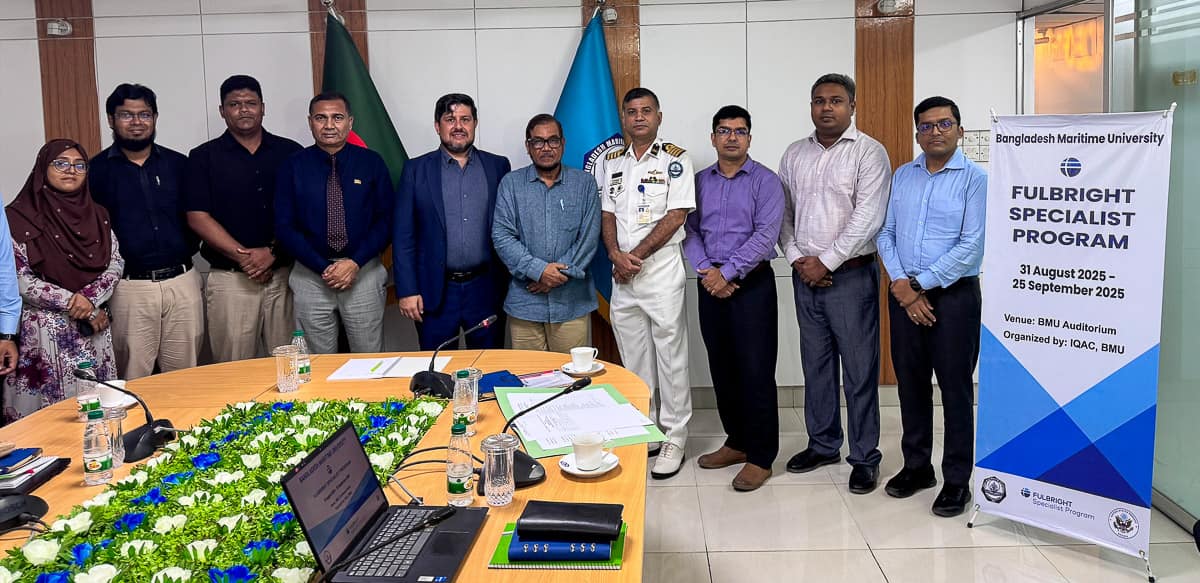
As part of his Fulbright, Cankaya led a four-week initiative in September to integrate AI into port research, planning and operations at Bangladesh Maritime University. (Photo: Dr. Burak Cankaya)
“The program covered a wide range of activities, including modules on AI-driven business development, decision-support systems and idea-pitching simulations,” said Cankaya, who has a background in the aviation, aerospace and maritime sectors. “We also conducted hands-on development of machine learning algorithms to detect vessel movement anomalies, which are strategic skills for the future of the country.”
Additionally, he visited Bangladesh University of Engineering and Technology and Bangladesh Aerospace University to discuss ways AI can be used for aerospace applications, including in avionics, aircraft maintenance and flight safety simulation.
“It was one of the best experiences of my life,” said Cankaya. “I will always cherish the memories of that trip, especially the lifelong friendships and peer relations formed between the institutions in Bangladesh and Embry-Riddle. It’s going to be a lifelong partnership.”
Eager to bring those global AI opportunities to Embry-Riddle students, Cankaya is launching AI Entrepreneurship in Aerospace, a new study abroad program in Germany and France serving students from all Embry-Riddle campuses this summer. In partnership with aerospace companies such as Lufthansa and Airbus, students will take business classes and explore how European aerospace companies and start-ups are using AI. There will also be an entrepreneurial project as part of the program, in which students will design and pitch an AI project.
The program, led by two Daytona Beach Campus faculty members, includes just two weeks of travel, making it more feasible for working students than longer study abroad programs.
“We wanted to offer it as an opportunity to all students, including those who work full-time,” said Cankaya. “It is open to both business and non-business students to launch their AI entrepreneurship ideas and pitch them to international industry leaders.”
At Embry-Riddle, Cankaya is also working to integrate AI solutions into the classes he teaches, particularly for students in his analytics courses. As part of the Worldwide Campus’ Academic Innovation Research Faculty Fellow Program, he is developing tools to support project-based learning with AI.
“As an analyst, you do a lot of troubleshooting,” he said. “So, I developed an AI bot to help students with coding and debugging.”
Cankaya is also involved in several university research projects that use operations research, AI and machine learning to improve crew planning, aviation safety, operations and sustainability.