
Embry-Riddle Team’s Lunar Energy Project Advances to NASA Challenge Finals

 Michaela Jarvis
Michaela Jarvis
/
Michaela Jarvis
Apr 20, 2026, 8:56 AM
A team of students from Embry-Riddle Aeronautical University has designed a system to provide multi-day energy storage on the moon without needing to transport huge battery systems from Earth. Their proposal has advanced to the competition finals of NASA’s Revolutionary Aerospace Systems Concepts – Academic Linkage (RASC-AL) program.
The system would collect solar heat during the lunar day, storing it in the lunar soil, or regolith. During the two-week lunar night, the heat would be converted into electricity.
“In simple terms, we’re using the moon as a battery,” said Naiyar Shaman, team lead and a junior majoring in Engineering.
The Worldwide Campus team is made up of five students based in four states: Florida, Oregon, Colorado and Wisconsin. When they attend the competition finals, it will be the first time they have met each other in person.
Dr. John Watret, chancellor of the Worldwide Campus, said their achievement demonstrates “the ingenuity and collaborative spirit of our students, who are tackling the kinds of complex challenges that define the future of aerospace.”
“Advancing to the NASA RASC-AL finals,” he added, “is an extraordinary accomplishment and a clear reflection of the strength of their ideas and the guidance of our faculty, despite the physical distance between them. We are incredibly proud of this team and excited to see the impact of their work on the next era of space exploration.”
The Embry-Riddle team is one of 14 selected for the final competition, which is designed to connect academia and the aerospace community to encourage innovation, collaboration and the development of the workforce to meet NASA’s exploration goals.
“The innovation and technical depth demonstrated this year are exemplary,” Daniel Mazanek, senior space systems engineer at NASA’s Langley Research Center, said in a press release. “The strongest teams demonstrated not only creativity, but also the disciplined analysis and systems engineering required to develop credible solutions for space exploration challenges,” including those NASA faces in its Artemis program and future human missions to Mars.
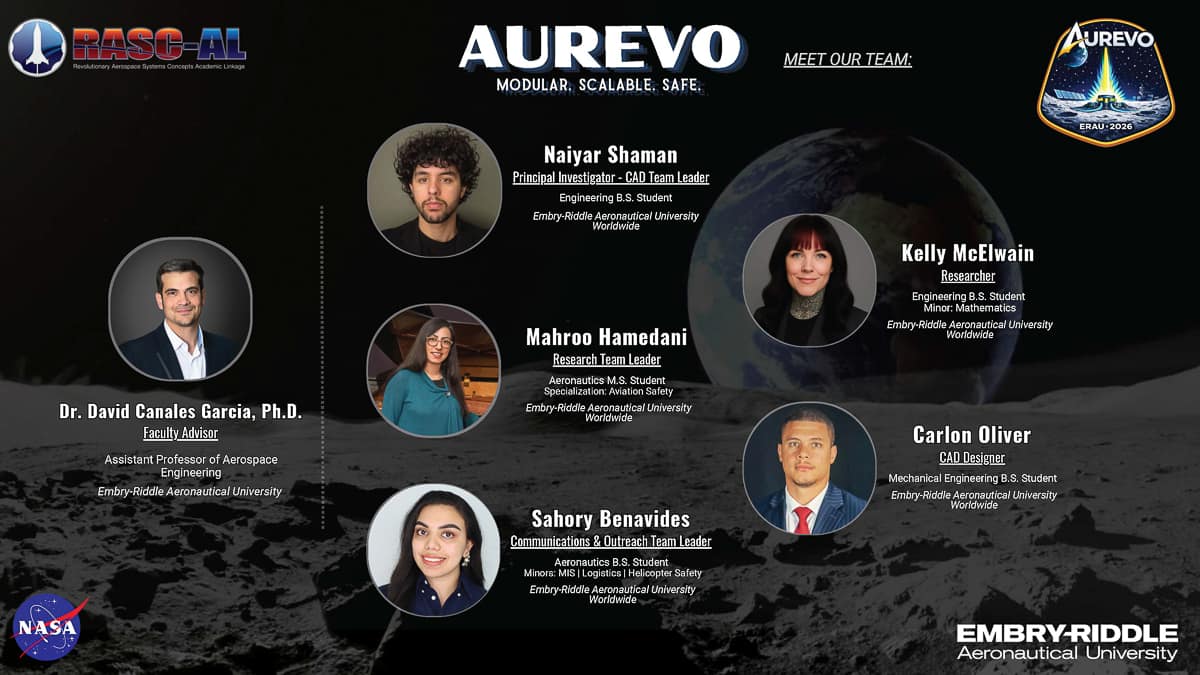
The Worldwide Campus team that made it to the finals of NASA's RASC-AL competition
The teams, awarded $7,000 for travel, will face the last stage of the competition at an in-person showcase on June 2 in Cocoa Beach, Florida, where they will present their work to NASA leaders, industry professionals and other finalists. The team’s project, titled “Advanced Utilization of Resources for Energy & Viability Off-Earth (AUREVO),” also includes a nuclear power system and electrical grid to ensure continued power.
What the student competitors gain from RASC-AL goes well beyond learning about space exploration, said Dr. David Canales Garcia, assistant professor of Aerospace Engineering and the team’s faculty advisor.
“They are actively contributing to problems that are relevant now,” Canales said. “They are working on real problems that NASA and the aerospace community care about, which gives them a sense of purpose and ownership over their work.”
The competition also provides extensive networking possibilities. Shaman, the team lead, said it’s “a unique opportunity to connect our academic work directly with the NASA teams actively shaping future mission architectures.”
Sahory Benavides Villareal, a junior majoring in Aeronautics at Embry-Riddle Worldwide in Fort Lauderdale, Florida, said participating in RASC-AL “has pushed me beyond my comfort zone and given me the opportunity to dedicate my full effort to contribute and deliver at a high level.”
“The strong teamwork, coordination and execution have allowed me to expand my knowledge, strengthen my skills, grow my network, broaden my perspective and open my mind,” she added.
Mahroo Hamedani, who is earning a master’s degree in Aeronautics, said participating in the competition has reinforced her passion for aerospace and inspired her to focus on the skills and experiences to build her career.
“Being a finalist has made me more excited about the direction I'm heading in and more committed to pursuing opportunities in this field,” she said.
Other RASC-AL team members include Carlon Oliver, a junior in Mechanical Engineering, and Kelly McElwain, a sophomore in Engineering. All of the team members plan to attend the finals.
To join next year’s RASC-AL team, students should look for an internal university announcement in late August or early September.