
‘Time Stood Still’: Embry-Riddle Grad Helps Power Artemis II Launch

 Michaela Jarvis
Michaela Jarvis
/
Michaela Jarvis
Apr 10, 2026, 8:20 AM
When the Artemis II rocket was about to lift off the launch pad on April 1, Embry-Riddle graduate Joe Pavicic was right there in Firing Room 1 of the Launch Control Center at Kennedy Space Center.
“It was surreal when we started going to terminal count. It had been such a long road getting there, the last two months — and years — getting to that spot. We were thinking, wow, all this is culminating,” said Pavicic, a NASA operations project engineer on the cryogenic propulsion team. “Those last ten minutes felt like they took two hours. Time stood still.”
It wasn’t until eight and a half minutes after the launch, when the rocket’s main engines were cut off at the end of the initial ascent phase, that Pavicic and his colleagues took a full breath and cheered.
“Once the engines got cut off, the feeling in the room was euphoric,” he said.
For Pavicic, that moment was long in the making but not guaranteed.
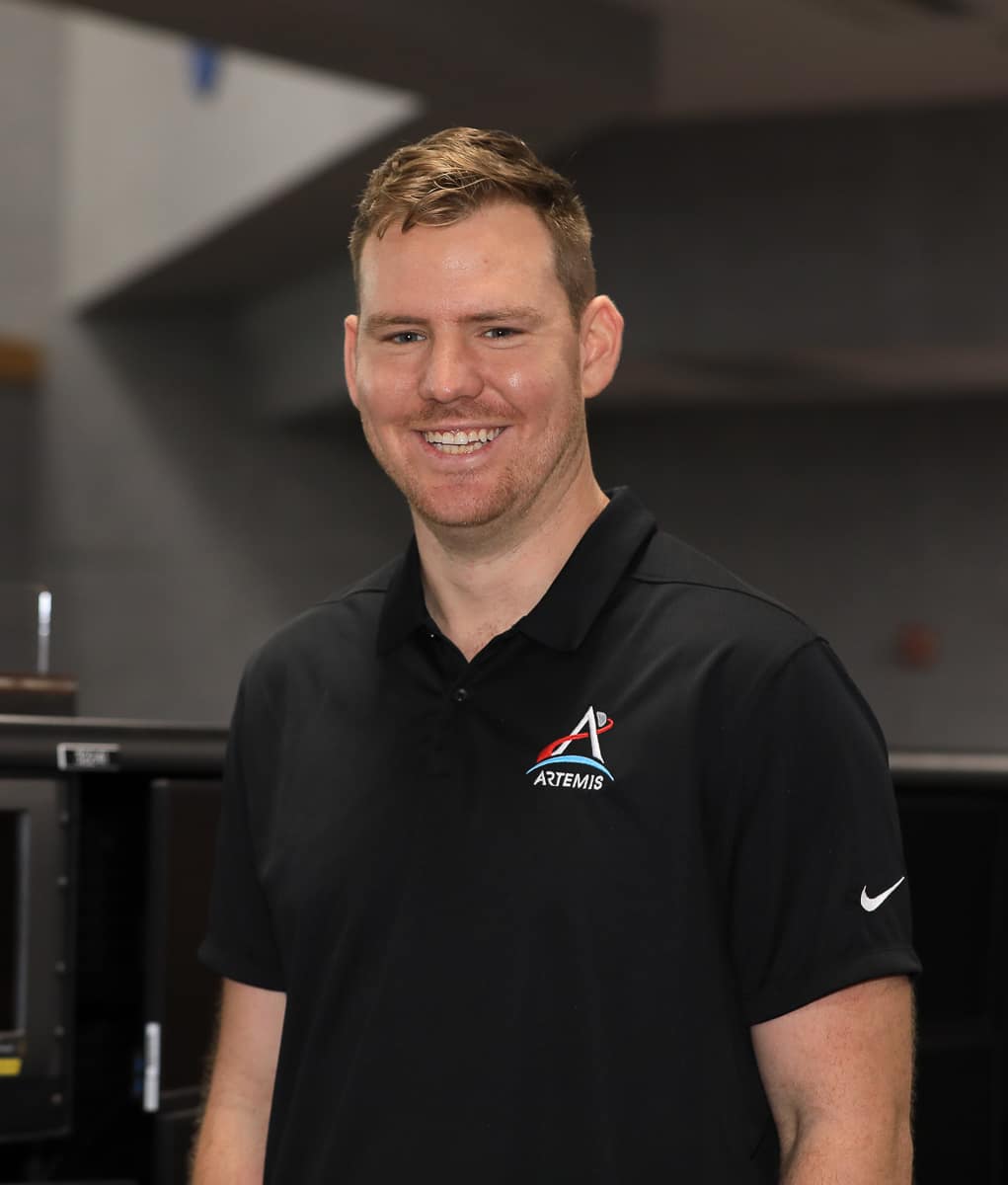
Pavicic earned his bachelor’s degree in Aerospace Engineering at Embry-Riddle (Photo: NASA/Glenn Benson).
In 2015, as he was finishing his bachelor’s degree at Embry-Riddle in Aerospace Engineering, he accepted a job at Jacobs, a leading NASA contractor. Pavicic’s focus as an undergraduate had been on propulsion. He said the job sounded generic, in testing operations, and his attitude was, “That sounds kind of cool.”
When he arrived at the job, it was immediately clear that his role would be much more than he thought.
“I came out here [to Kennedy Space Center], and they were like, ‘Well, you’re the one who has the propulsion background, so you’re going to be the main engine,’” Pavicic said. “That was awesome. I went from being thankful that I got a job after college to it being a full-blown passion, and I can’t believe I’m actually doing this.”
Pavicic transitioned from Jacobs to NASA in 2023.
“I’m grateful that life brought me here,” he said.
Dr. Anouck Girard, professor and chair of Embry-Riddle’s Department of Aerospace Engineering, said “Joe’s participation in the Artemis II launch demonstrates the extraordinary heights our students can reach.”
"When talent, determination and rigorous training come together, our graduates help shape the future of space exploration," he added.
In Pavicic’s work at NASA, he said he draws not only on the education that he received at Embry-Riddle, but also on how the university helped to develop him as a person. Steve Ridder, head coach of Embry-Riddle Athletics, said Pavicic carried “himself with confidence” that showed he would “impact others and do something special in life” after Embry-Riddle.
“He is certainly making a difference and making all of us proud,” Ridder said.
Pavicic was extremely active in student clubs and activities. He said Todd Thomas, who served as the assistant director for student activities and campus events for fraternity and sorority life from 2013 to 2015, was also a mentor.
“Learning to grow, learning to lead, I thought those were things you don’t learn in the classroom,” he said.
In February of this year, Artemis II had a liquid hydrogen leak during a wet dress rehearsal, which was similar to leaks that had delayed Artemis I back in 2022. Pavicic’s team was on the spot to fix it.
“I was helping lead that team, and it was great," he said. It was comprised of people across industry and different companies, different centers. Everyone came together and said, ‘I don’t care who I work for, we’re here to solve this problem.’”
Despite bearing the responsibility of the entire mission and losing sleep over it, Pavicic said, “We had it solved in six days and were ready to go to another test. It was incredible to see how everyone pulled together.”
Pavicic visits Embry-Riddle once or twice a semester “to go hang with the students and advise them,” he said. “I like building those mentorships with them. It’s been a really rewarding experience because I learned so much from my mentors, people who took the time just to help me. I wanted to make sure when I got to where I’m at now, being part of the launch leadership team, that I would give back.”