
Embry-Riddle’s Record Four NSF Graduate Research Fellows Continue to Find Success

 Michaela Jarvis
Michaela Jarvis
/
Michaela Jarvis
Feb 06, 2026, 10:00 AM
Four Embry-Riddle Aeronautical University graduates selected in the last round of the National Science Foundation (NSF) Graduate Research Fellowships are thriving in graduate school and taking advantage of the research freedom offered by their awards.
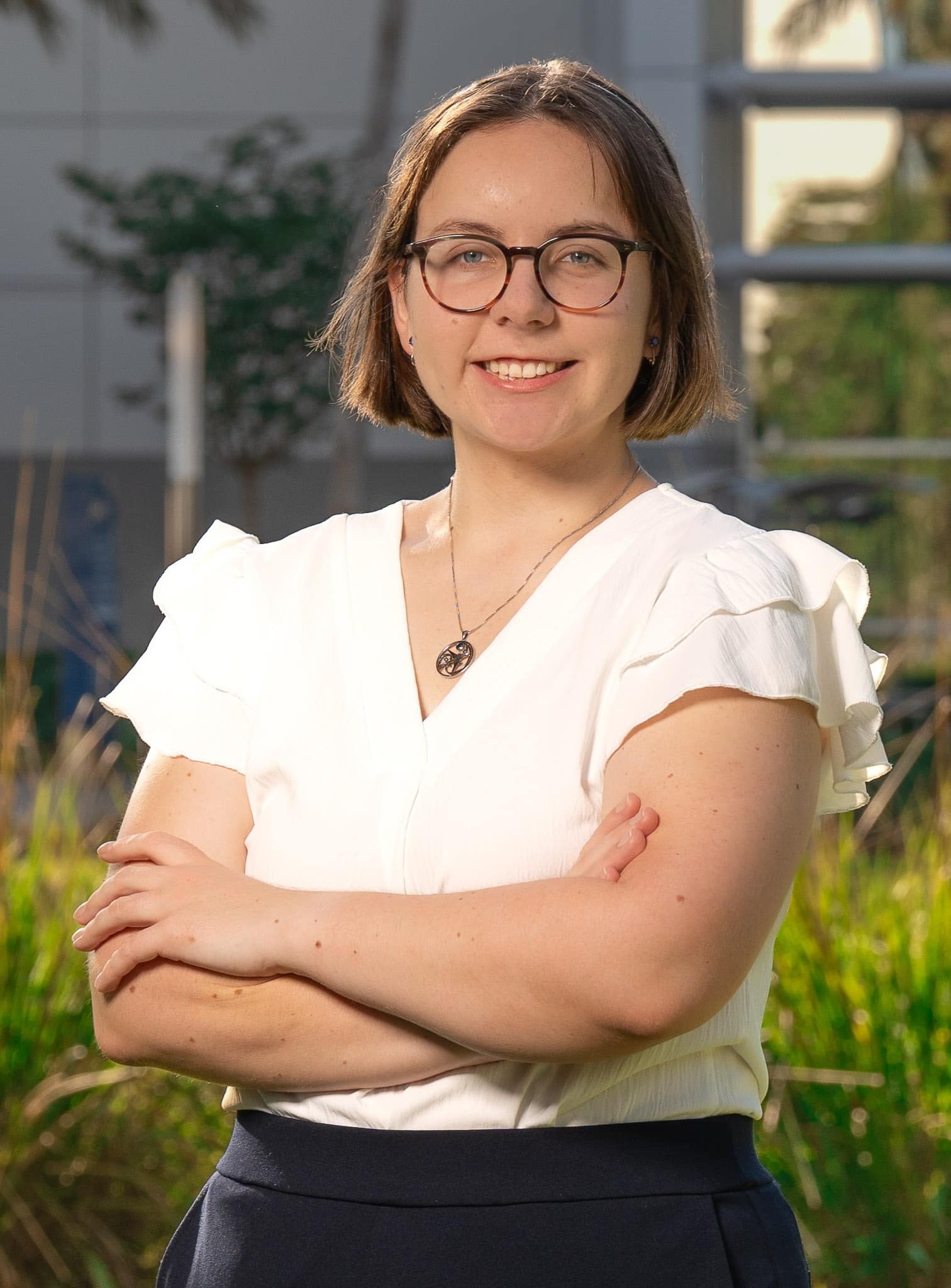
Alexandra Newcomb published three scientific research papers while an undergraduate. (Photo: Embry-Riddle/Bill Fredette-Huffman)
“Because the fellowship funds me as an individual, as opposed to for a specific project, I can pursue the research I find to be most impactful and that aligns with both my interests and background,” said Alexandra Newcomb, who earned a bachelor’s degree in Software Engineering at Embry-Riddle and is continuing at the university to earn her Ph.D. in Electrical Engineering and Computer Science.
In a year when fewer NSF fellowships were awarded — 1,500 were offered in the most recent round, compared with more than 2,000 annually over the past 15 years — Embry-Riddle had the most students selected in a single year in its history. In addition to Newcomb, Embry-Riddle graduates Erin Motherway, Vikas Patel and Hailey Murray were awarded fellowships. Two honorable mentions went to students Christopher Deloach and Alexander Knecht.
Based on the intellectual merit and broader impacts of the awardees’ research, the fellowships provide $37,000 annually for three years of support, plus $16,000 annually to cover tuition and fees.
Newcomb’s mentor, Dr. Omar Ochoa, associate professor of Software Engineering and Computer Science, called Newcomb’s selection “a direct result of her involvement in research as an undergraduate.”
Newcomb said that undergraduate research and strong mentorship by Ochoa influenced her decision to continue studying at Embry-Riddle.
Her research involves automating and increasing the adoption of complex software verification techniques using machine learning and artificial intelligence.
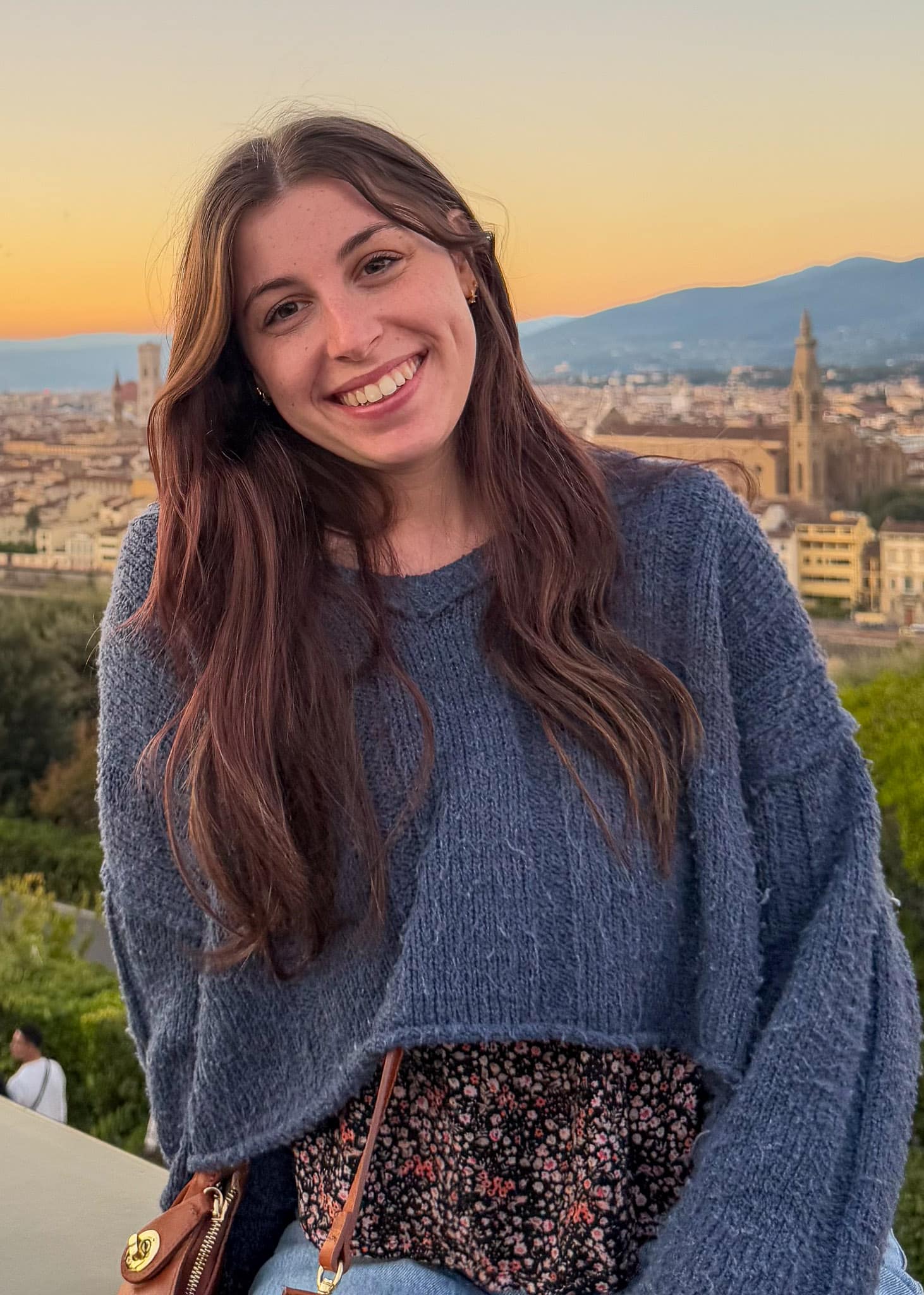
Erin Motherway traveled to Florence, Italy, to attend a workshop on binary stars. (Photo: Erin Motherway)
Erin Motherway, a first-generation student who graduated from Embry-Riddle in 2023 with a bachelor's degree in Astronomy and Astrophysics, was awarded an NSF Graduate Research Fellowship to continue her doctoral program in astronomy at the University of Wisconsin-Madison.
Motherway studies the evolution of binary stars and their gravitationally bound companion stars, star systems that can evolve into supernovae and gravitational wave sources. She focuses on blue straggler stars, which gain mass through interaction with their companions. Because they are bluer and brighter than stars their age should be, these stars challenge common perceptions of how stars evolve.
Motherway said being able to get hands-on experience with the 1-meter telescope at Embry-Riddle was crucial to her development, giving her “valuable experience and intuition with observational astronomy that I otherwise would not have.”
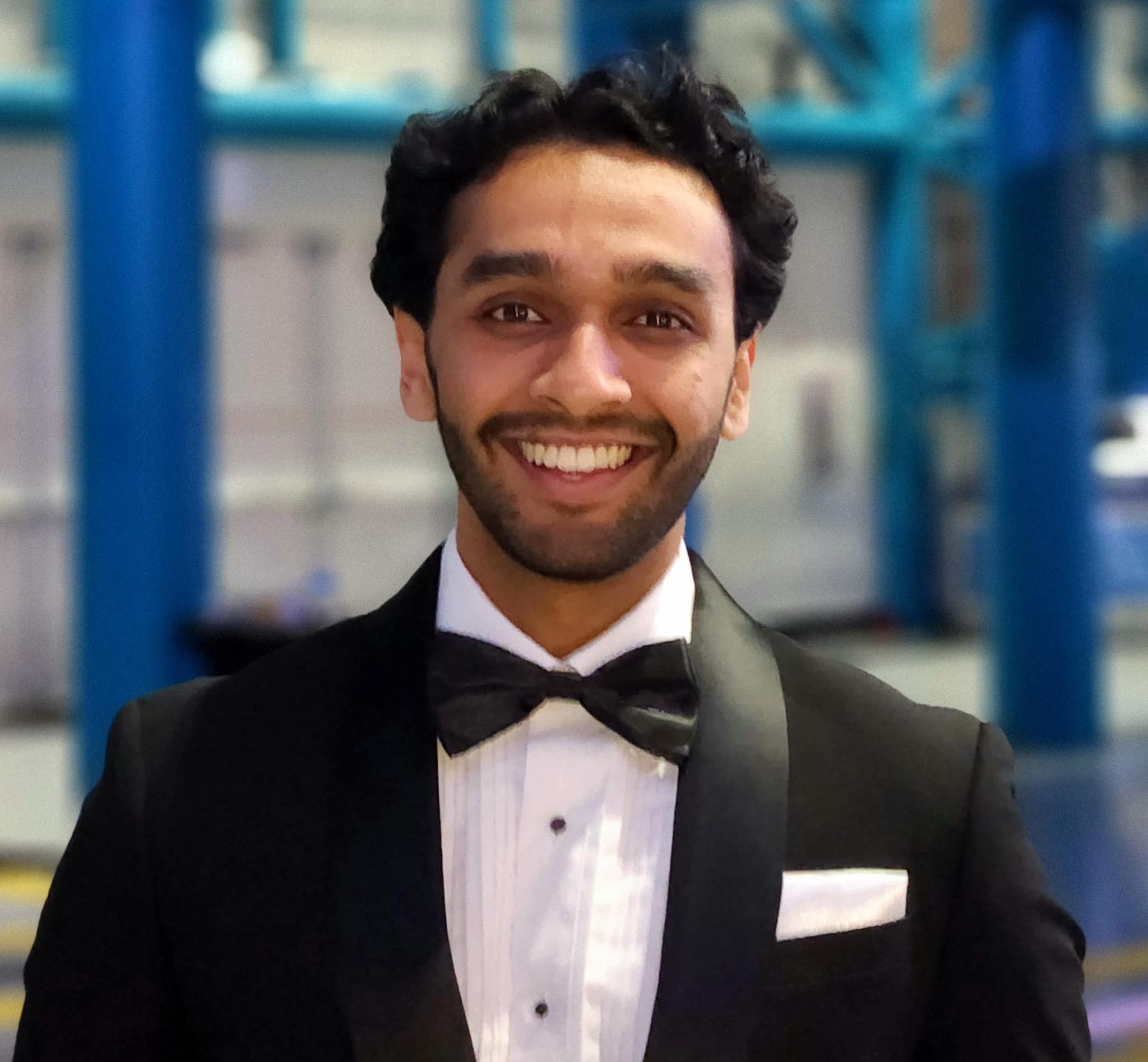
Vikas Patel attended the U.S Astronaut Hall of Fame Induction Ceremony in May. (Photo: Vikas Patel)
Like Newcomb, Motherway said the NSF fellowship has given her the freedom “to choose which scientific threads I follow. It allows me to take intellectual risks rather than always following the safe path. I think that this freedom is essential for scientific progress, as it creates space for discovery that might otherwise remain unexplored.”
Vikas Patel, who is earning a master’s degree at Stanford, said his NSF Graduate Research Fellowship not only allowed him to pursue graduate study at the California university, but it also made it easier to match with a research lab, “since it helps circumvent the largest hurdle of graduate education and research — funding.”
Patel has joined the Stanford Intelligent Systems Laboratory, where he has been leading research on landing site selection methods for applications in extraterrestrial landers and urban air mobility.
“I could not imagine going to a better place than Embry-Riddle for my undergraduate studies,” he said. Patel, who earned his bachelor's degree in Aerospace Engineering, added that hands-on projects — such as working with the Design/Build/Fly team to create and test remote-control aircraft, as well as designing and building space payloads — provided “the best foundation for my current stage of education.”
Hailey Murray, the fourth NSF Graduate Research Fellowship recipient, earned a bachelor’s degree in Space Physics at Embry-Riddle in May. She is now in the Applied Physics Ph.D. program at Cornell in New York, where she is conducting research in quantum information theory.
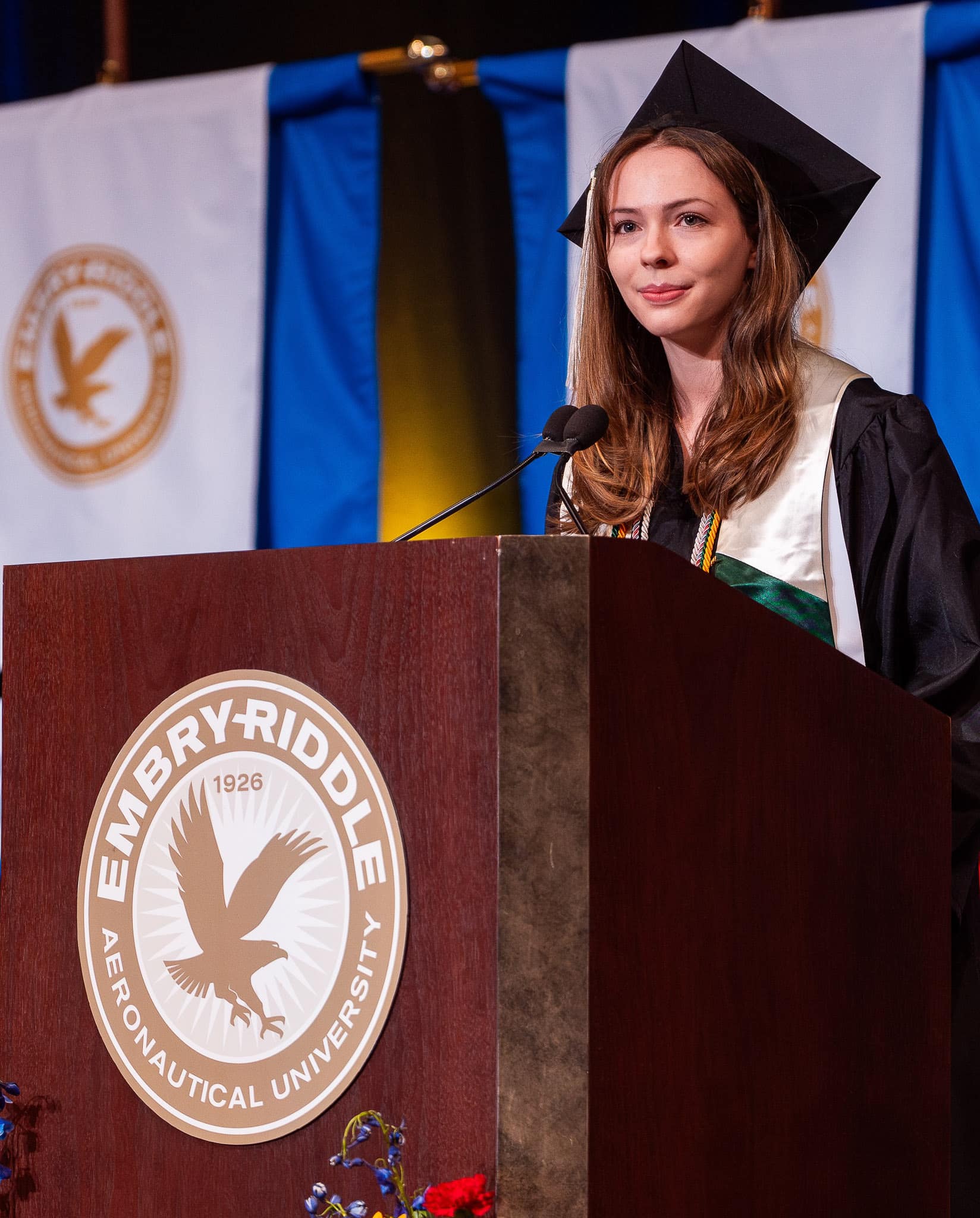
Hailey Murray was the featured speaker at her 2025 graduation. (Photo: Embry Riddle/Wilson Van Ness)
Active in undergraduate research, she was a co-author on a published paper that demonstrated a possible alternative to Einstein’s general theory of relativity as it relates to black holes, joining physicists who look to question the classical theory. The project she proposed for the NSF fellowship focused on quantum cryptography. Murray said she would like to pursue a position in academia after graduate school.
The letter sent to all of the recipients stated that the NSF Graduate Research Fellowship “is a significant national accomplishment that highlights your potential to make significant contributions to STEM” and to pass the baton by teaching others.
Motherway, who tutored non-physics majors at Embry-Riddle who had little experience in science and math, said that “the most fulfilling aspect of this experience was being able to help students who initially doubted their ability to succeed in physics realize they could not only understand the concepts and successfully solve problems, but could also find enjoyment in their new knowledge and skill set.”
She added that she hopes to "achieve a career and life full of meaningful research and impactful teaching.”