
Embry-Riddle Asia Launches Professional Space Operations Course in Singapore Amid Regional Space Boom

 Michaela Jarvis
Michaela Jarvis
/
Michaela Jarvis
Mar 13, 2026, 8:27 AM
As Singapore works to develop its involvement in the space industry, Embry-Riddle Aeronautical University’s Asia Campus recently offered a professional space operations course led by Dr. Andrew Aldrin, associate professor and executive director of space programs at Embry-Riddle Worldwide.
“The most exciting thing about this course was the level of enthusiasm and the opportunity for helping develop the future leaders of Singapore’s space programs,” Aldrin said. “I think we can develop Singapore as a space education hub for the Asia-Pacific region.”
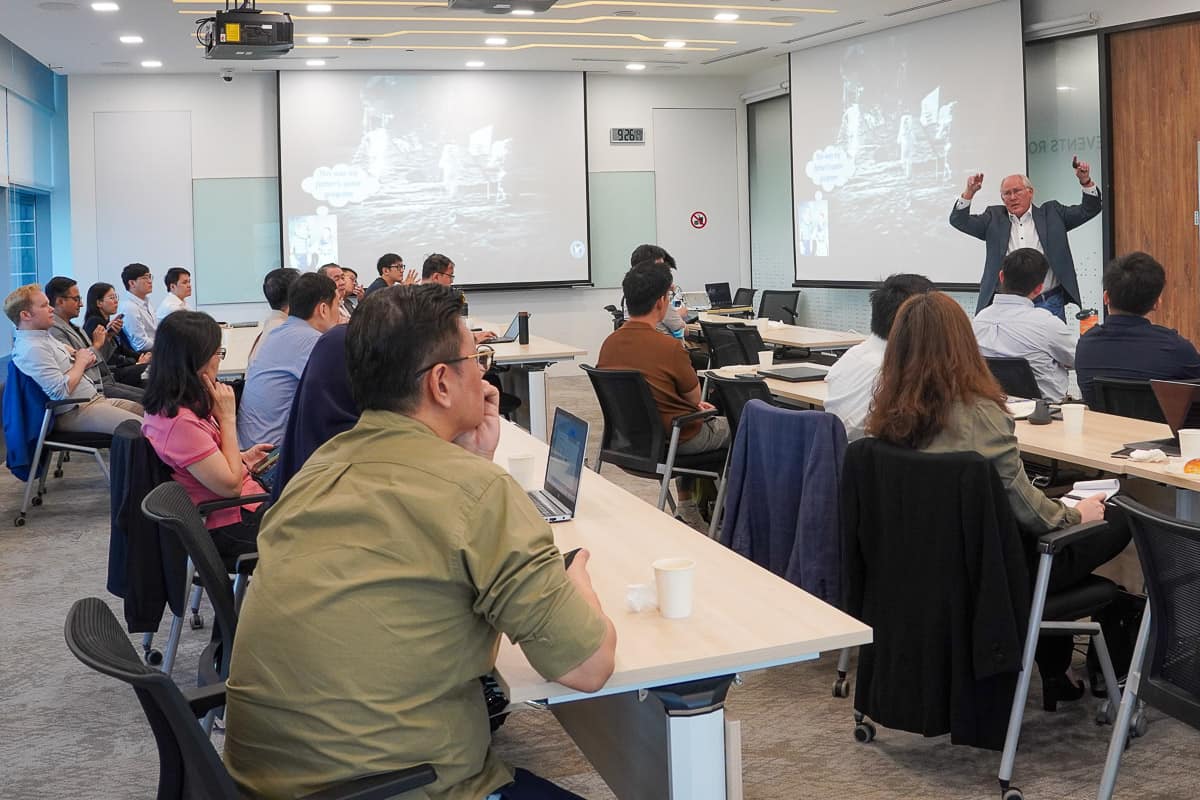
Aldrin, associate professor and executive director of space programs at Embry-Riddle Worldwide, led the new space operations course. (Photo: Space Faculty)
The three-day, in-person course attracted professionals from academia, industry and government in Singapore, Thailand, the Philippines, Australia and Brunei. As private companies become more dominant in space operations, the course sought to provide executives and policymakers with much-needed interdisciplinary knowledge.
“Aviation professionals looking to step into the space sector for the first time may have a STEM-related background, but some would have an entrepreneurial or business background,” said Jack Patel, academic officer and associate professor at Embry-Riddle Asia.
The course was delivered in partnership with Space Faculty, a Singapore-based company focused on education, talent development and innovation in the space and deep-tech sectors. Students explored the commercialization of space and public-private partnerships, associated risk and projected growth of the $570 billion global space economy.
“The space domain is one of the most dynamic and consequential sectors emerging on both the national and international stage,” said Aldrin. “The pace of development across Asia is extraordinary, and Singapore — with its particular economic, educational and governmental ecosystem — is uniquely positioned to play a leadership role in the evolving space economy.”
Lynette Tan, CEO of Space Faculty, said the course represents an enduring partnership with Embry-Riddle and the space community in Asia.
“By anchoring this partnership locally, we combined Embry-Riddle’s world-class pedagogical heritage with the hard-won regional insights necessary to navigate the Asian space ecosystem,” said Tan. “This collaboration is a testament to our shared commitment to making space truly accessible through the kind of strategic, boots-on-the-ground partnerships that define success in our part of the world.”
Beatrice Toring, a university administrator who traveled from the Philippines to attend the course, said the course helped her to understand how “policy decisions, economic models, regulatory frameworks, education systems and international cooperation all shape the direction of space development.”
“The course reframed space not as a distant frontier, but as a dynamic practical domain that directly affects life on Earth,” she added.
Toring said Aldrin emphasized the importance of recognizing that space operations can benefit communications, disaster management, navigation, climate monitoring and economic growth.
“That made me reflect on my responsibility as an educator, that educating students about space is about equipping them with knowledge that can help prevent risks, reduce disaster impacts and build a more resilient nation,” Toring said.
On returning to the Philippines, she started working with her university on a “Space on Earth” program.
“This initiative is a direct reflection of the course’s impact and embodies the idea of being purposeful in ensuring that space education becomes a practical tool for empowering communities,” she said.
Singapore has positioned itself as a regional hub for space exploration. The country will launch its first national space agency on April 1, according to an announcement made in early February. Organizers have said the agency will focus on research and development, space industry growth, global partnerships, national capability in space and legislation for safety and sustainability in space.
Matthew Flaherty, vice chancellor and head of Embry-Riddle Asia, said Embry-Riddle’s Singapore Campus has recently added a Space Studies minor to its undergraduate offerings and is exploring opportunities to offer a space-related master’s degree program in an in-person format, thereby “further strengthening the region’s space talent pipeline.”
Aldrin said Embry-Riddle has a “very solid” reputation in Singapore’s aviation industry, and “we want to extend that recognition into space.” At the same time, Singapore has a strong reputation in the U.S. and European space communities.
“Everyone I have spoken with is excited about the potential for collaboration with Singapore,” Aldrin said.