
Eagle Team Advances to NASA Blue Skies Finals, Builds Valuable Skills

 Michaela Jarvis
Michaela Jarvis
/
Michaela Jarvis
Apr 15, 2026, 12:28 PM
A team of student researchers from Embry-Riddle Aeronautical University has advanced to the finals of NASA’s Gateways to Blue Skies Competition for the second year in a row, becoming one of eight teams chosen to vie for positions as interns with NASA’s Aeronautics Research Mission Directorate in the prestigious contest.
While the team faces the final stage of the competition on May 18-19 at NASA’s Langley Research Center in Virginia, its six members have already earned skills and confidence that will serve them well in their careers.
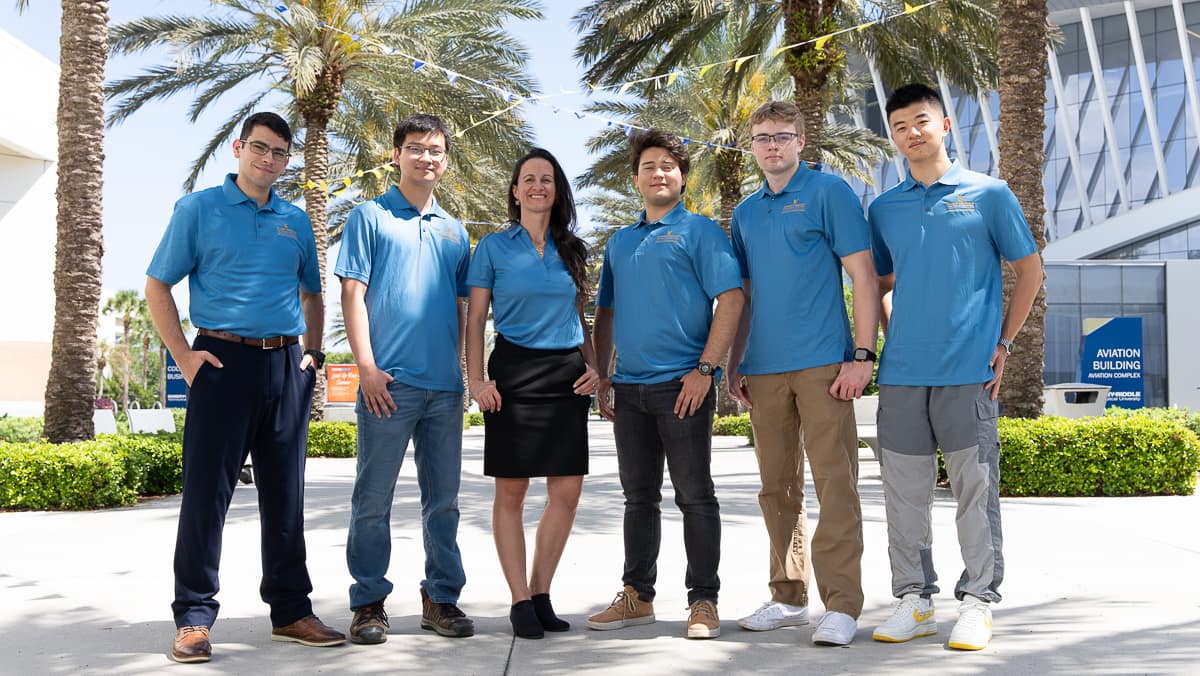 The team will present to NASA and industry experts at a May 18-19 forum at NASA’s Langley Research Center in Virginia. From left are students Diego Cordero-Rios, Ruipeng Zhao, Ilan Soler, Ryan Mercer, Zimo Yang and their faculty mentor Dr. Claudia Ehringer Lucas (center). (Photo: Embry-Riddle/David Massey)
“Three of the team members – Diego Cordero-Rios, Ilan Soler and Ryan Mercer – were once students in my Introduction to Engineering course,” said Claudia Ehringer Lucas, associate professor of Engineering Fundamentals and the team’s faculty advisor. Observing their studies and participation in Blue Skies, she said, “It has been a privilege over the past three years to watch them grow into peer mentors in my course and into confident leaders as they embrace their roles as emerging researchers.”
The other three team members are a sophomore, Addison Groce, and two freshmen, Ruipeng Zhao and Zimo Yang. The three “distinguished themselves early on,” Ehringer Lucas said, and were invited to join the team.
“Their selection reinforces a core philosophy: providing students with meaningful opportunities as early as possible,” she said. “With the right support and challenge, students can achieve far beyond expectations.”
The team’s competition entry addresses the increasing complexity of commercial aircraft maintenance with “Smart Mechanic Glasses.” The device integrates augmented reality, inspection with drones and advanced imaging for hands-free diagnostics in real time.
As finalists, the team was awarded $9,000. The finalist team that wins the competition will earn internships with NASA. Two of the Embry-Riddle participants, Ruipeng and Zimo, are international students who are not eligible for internships at NASA but still chose to take part in the competition.
Cordero-Rios, student lead of the team, said he has been able to use knowledge acquired in his Human Factors courses in the competition. At the same time, he said, he developed skills such as “logistics, coordination, team building, purposely celebrating team success and encouraging members through hard tasks.”
Mercer said participating in the competition “has given us the opportunity to tackle real challenges in the aviation industry.”
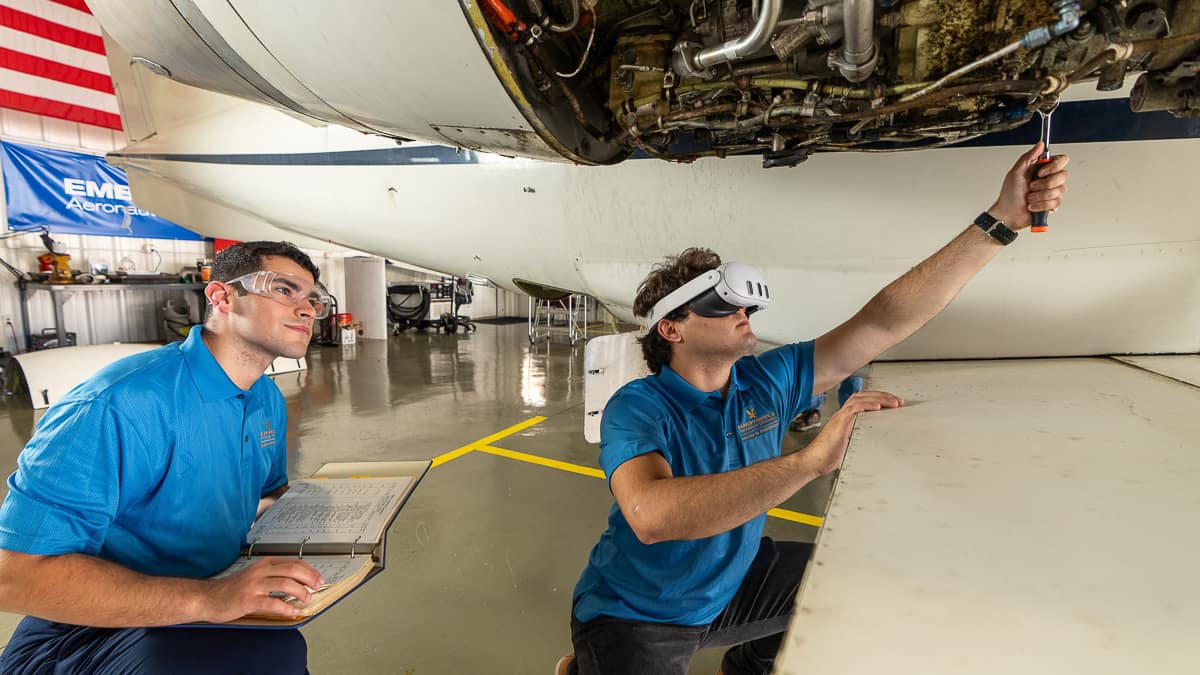
Cordero-Rios and Soler show how Smart Mechanic Glasses could be used to inspect a jet engine. (Photo: Embry-Riddle/David Massey)
Zhao, who has three years of aircraft maintenance experience, said that he was able to apply that experience in the competition and that “it has been exciting to contribute to a project focused on improving the future of aircraft maintenance and aviation safety.”
The competition is helping to shape the future STEM workforce, Ehringer Lucas said.
“By engaging students early in hands-on research and leadership, they develop both the technical skills and confidence needed for careers in aerospace and beyond,” she said. “These experiences create a powerful pipeline in which students evolve from learners to mentors to researchers, prepared to lead in their fields.”
The team’s participation is being partially funded by an Undergraduate Research Scholarship of $900. The College of Engineering and Engineering Fundamentals will be supporting the team’s travel. Addison Groce transferred to Cecil College in Maryland this semester, and that institution is also being named in the finalist distinction.