
Beet Juice and Breath Training: Embry-Riddle Researchers Investigate Ways to Improve Breathing Efficiency in Patients, Pilots
 Michaela Jarvis
Michaela Jarvis
/
Michaela Jarvis
Dec 01, 2025, 8:55 AM
Embry-Riddle researchers are conducting a clinical trial on two promising non-invasive methods to improve the exercise capacity of people with impaired breathing due to disease or because, like pilots, they perform in low-oxygen environments.
The trial is being funded by a $538,000 grant from the National Heart, Lung, and Blood Institute of the National Institutes of Health.
One of the promising methods is specialized breath training, in which study subjects breathe against resistance using special equipment, gradually increasing the strength of the muscles, specifically the diaphragm. The other method, which has also shown potential in various studies, is consuming shots of beet juice.
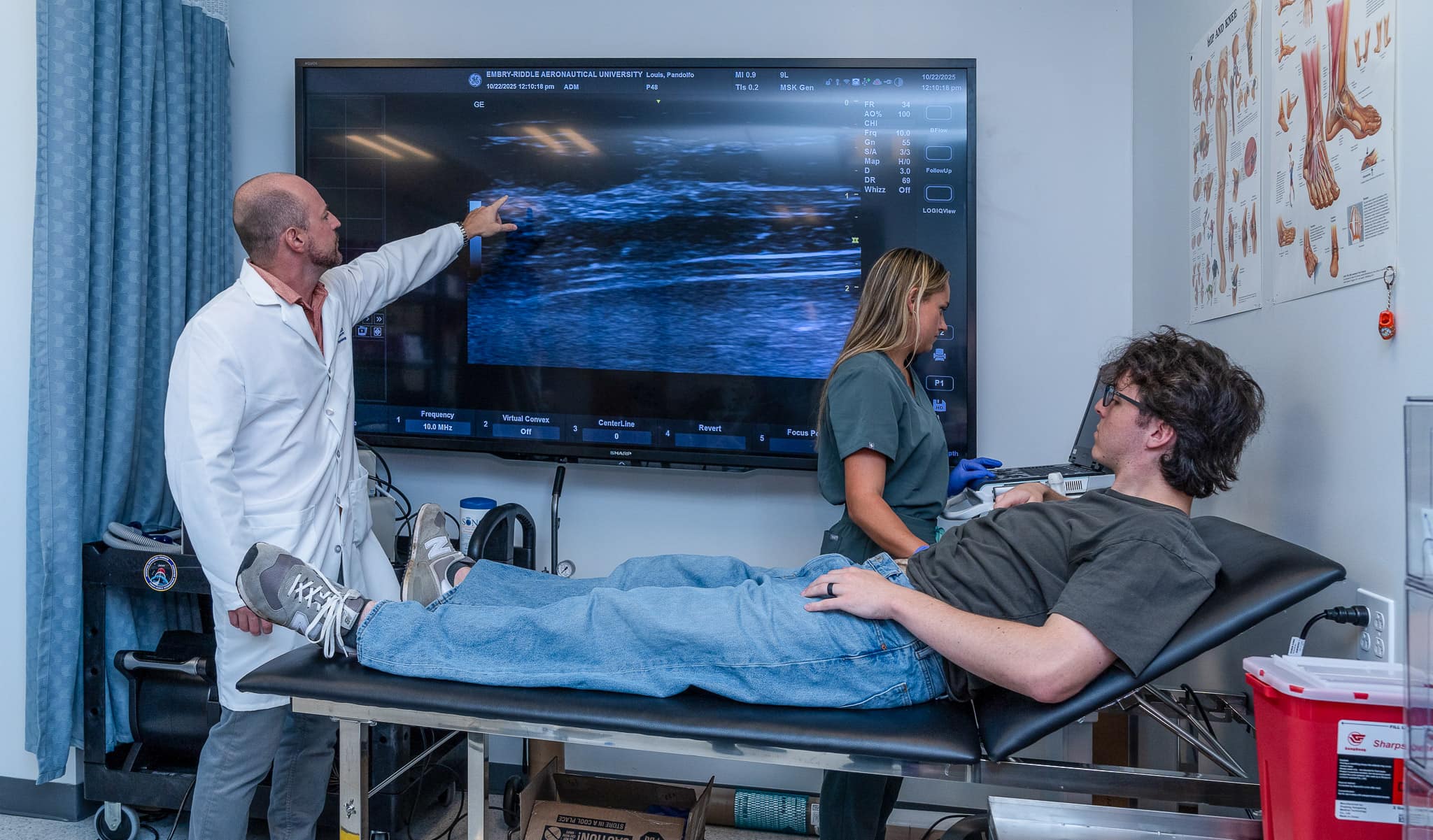
Dr. Scott Ferguson and Ph.D. candidate Sabrina Ehrenfort check the diaphragm thickness of a participant using Doppler ultrasound. The thickness of the diaphragm changes as the muscle strengthens through training. (Photo: Embry-Riddle/Daryl LaBello)“Two key groups that could benefit are patients requiring invasive mechanical ventilation and those with cardiopulmonary conditions, as well as pilots, divers, high-altitude workers and soldiers,” said Dr. Scott Ferguson, project principal investigator and assistant professor of Human Factors and Behavioral Neurobiology and director of the Integrative Aerospace and Exercise Physiology Laboratory.
The research will be performed at sea level and at simulated altitudes of about 4,000 meters, created in Embry-Riddle’s High-Altitude Normobaric Lab’s low-oxygen chamber. That altitude is just below the 12,500-foot threshold at which pilots are required to use supplemental oxygen in non-pressurized cabins to ward off the dangerous loss of performance that can occur with insufficient oxygen. Ferguson said higher altitudes may be simulated in follow-on studies, depending on the results of this study and safety considerations.
According to the grant proposal, previous research performed by Ferguson has demonstrated that both interventions may improve exercise performance. The breath training, known as respiratory muscle training because it trains the diaphragm, has been shown to improve exercise performance at high altitudes and also in patients with chronic heart failure, in which insufficient pumping of the heart contributes to shortness of breath and inability to perform everyday activities. The beet juice, which like spinach and many other vegetables provides nitrate, has in Ferguson’s laboratory studies and others been shown to reduce blood flow to the diaphragm of rats during exercise, leaving more blood to support the muscles.
“Nitrate has been recently hailed as an unrecognized nutrient, and I have spent the last 15 years studying its effect on cardiovascular control during exercise and human performance,” Ferguson said. “As with any supplement, there are populations where caution is warranted, but we are using established, safe doses that are easily obtained in a well-balanced diet.”
Sabrina Ehrenfort, a Ph.D. candidate in Embry-Riddle’s Human Factors program, presented some of the results from the preliminary research at the 2025 American Physiological Society meeting in April. Other students involved in that research included Erica Bryant, Toni Butler, Riley Dienna, Hannah Lyons, Christopher MacDuffee and Danielle Norris.
Ehrenfort is currently monitoring study participants, collecting and analyzing physiological and performance data and making sure the study is being conducted according to research standards. She said she was “drawn to the opportunity to investigate interventions that could have clinical, aeromedical and athletic applications.”
“Optimizing crew performance is also essential as we continue to explore the limits of human performance in extreme environments like outer space,” Ehrenfort added.
The study will be conducted largely by undergraduate students, providing them with hands-on experience in clinical research techniques. It will also involve undergraduates among the 80 or so study subjects, who are currently being recruited.
The specific type of NIH grant that is funding the study, known as an Academic Research Enhancement Award, is intended to increase research capacity at institutions like Embry-Riddle, where undergraduates make up the majority of enrollment, Ferguson said.
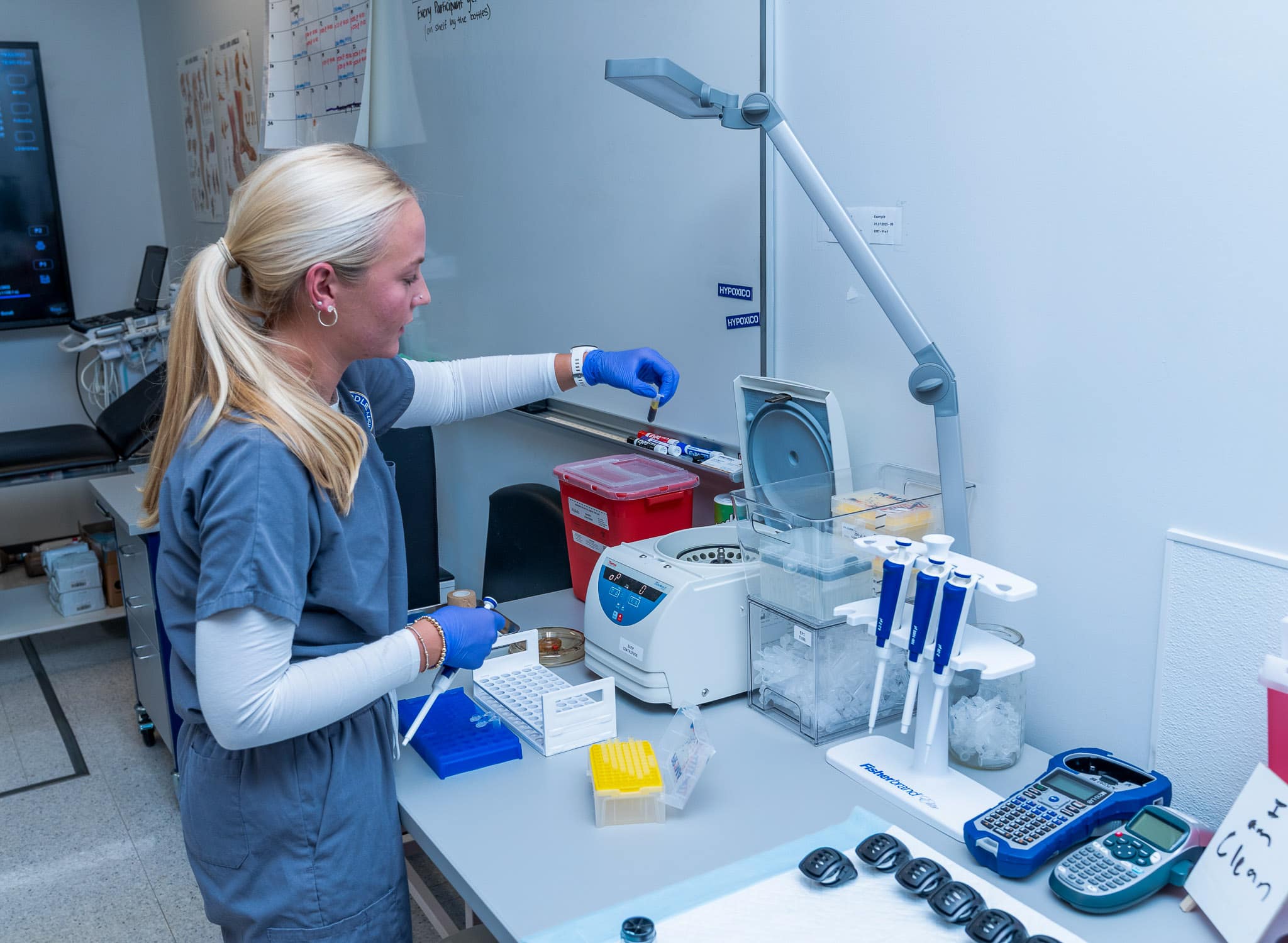
Erica Bryant, a senior in Aerospace Physiology, removes a blood sample from the centrifuge and prepares to separate blood plasma from the rest of the cells. She will be measuring the concentration of nitrate and nitrite in the blood to assess if the nitrate supplement (beet juice) increased those values as anticipated. (Photo: Embry-Riddle/Daryl LaBello)Bryant, a senior majoring in Aerospace Physiology with minors in Chemistry, Psychology and Human Factors, has been involved in the research since 2022. She is directly involved in testing, data collection and lab management assistance related to the study.
Bryant has a number of deep connections to the research. Her father was an Air Force pilot, and her sister and brother-in-law are Air Force pilots as well. She is planning a career as a healthcare provider, first as a nurse and later perhaps as a researcher. She is also an endurance athlete and is interested in educating others about the benefits of exercise and evidence-based supplementation to improve health and performance.
“This research is profoundly meaningful to me,” she said.
The study is designed to explore the effects of respiratory muscle training and nitrate supplementation on muscle oxygenation, vascular function and exercise tolerance in young, healthy adults.
One of its objectives is to help develop interventions to enhance the physical capacity of critically ill patients recovering from having been put on a ventilator. During the COVID-19 pandemic, many patients required such invasive mechanical ventilation, which can result in diaphragm dysfunction and serious effects on a patient’s health and quality of life. In general, ventilators are required for millions of patients each year, because of medical events or surgical procedures.
“Dr. Ferguson and his research team of graduate and undergraduate students epitomize the research mission of Embry-Riddle,” said Dr. Scott Shappell, chair and professor of Human Factors and Behavioral Neurobiology.
“Their innovative research to improve exercise tolerance will improve both aviation and space travel in low-oxygen environments. His successes as a mentor and scientist are exactly why we worked so hard to get him to Embry-Riddle. We couldn’t be more proud.”