
Aviation Week Op-Ed: AI Enhances Pilot Training With Supercharged Debriefings, Embry-Riddle President Writes

In his latest Aviation Week essay, Embry‑Riddle Aeronautical University President P. Barry Butler, Ph.D., writes about how artificial intelligence holds the promise of providing students with personalized debriefings that supplement lessons taught by instructors during training flights. Through the Hunt Library, the Eagle community can log into ERNIE to freely access the op-ed. Alternatively, subscribers to Aviation Week can log into the publication's website to access the essay, which is also provided below.
By P. Barry Butler
On any training flight, student pilots are experiencing the complexities of flying, navigating the skies while responding to a steady stream of radio communications under the guidance of an instructor. It’s the tried-and-true path to building essential flight skills, but in a stressful environment, it’s a lot to absorb. Even an immediate debrief from the flight instructor can be hard to retain.
What if the experience could be supplemented by a more personalized debrief, where student pilots could revisit every aspect of their performance? Artificial intelligence holds the promise to do just that, translating cockpit audio recordings and avionics data from training flights into actionable insights.
At Embry-Riddle Aeronautical University, we have partnered with Navi AI, an aviation technology company, to develop a tool that delivers tailored, timely AI-generated feedback to reinforce flight instructors' lessons. The tool, which is also being tested by other flight programs and the U.S. Air Force, is designed to help instructors deliver a greater learning impact.
The purpose-built AI is trained on databases that comprise FAA materials, company-specific publications, standard operating procedures, institutional resources and other vetted sources. It integrates recorded flight deck audio between the student pilot and instructor, as well as air traffic control communications. The system also incorporates recorded flight data, which includes everything from altitude, heading and pitch to engine temperature.
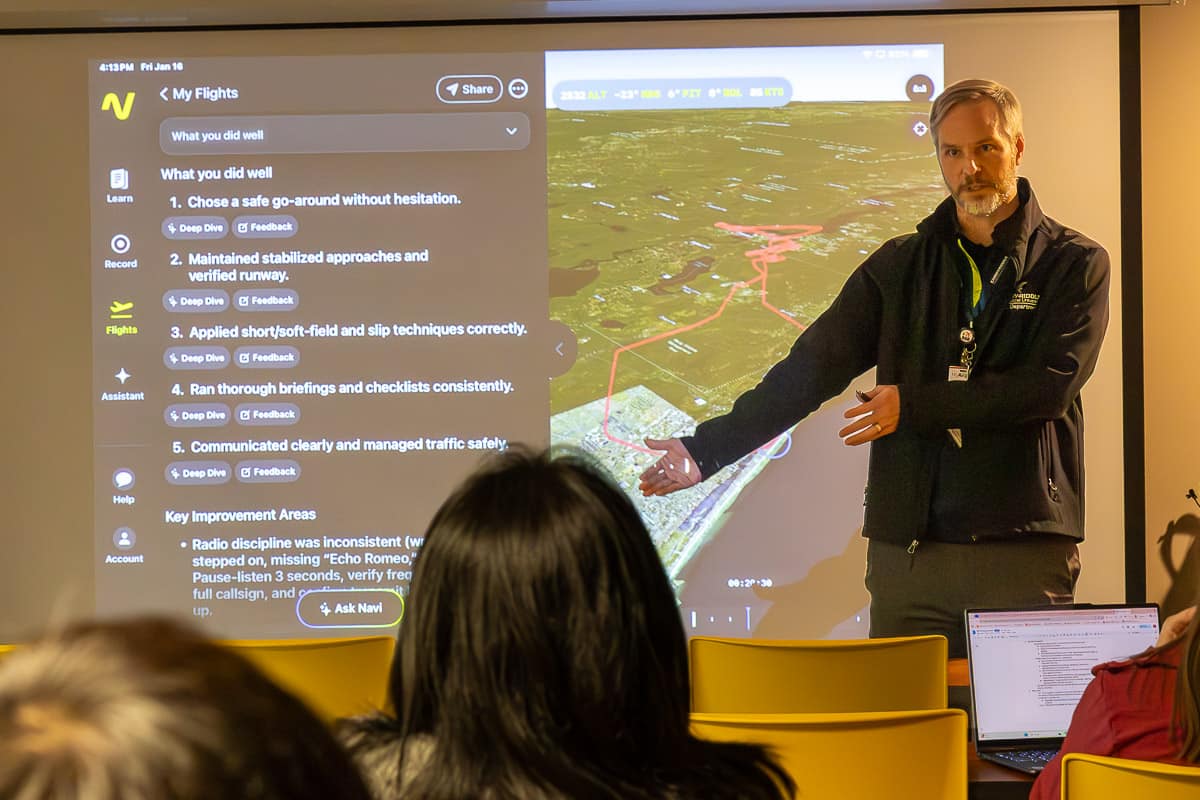
Embry-Riddle Research Coordinator Andrew Schneider discusses NAVI with senior instructors in the Flight Standards Department. (Photo: Embry-Riddle/Seth Robbins)
According to Embry-Riddle Research Coordinator Andrew Schneider, who has collaborated with Navi AI, all this information is processed using large language models and machine learning algorithms. The result is an AI-powered application that presents the student’s performance in the form of text, maps, graphs, data, audio and animations. The system can also interact with users in multiple languages.
Each AI debriefing begins with an overall summary of the flight, followed by bulleted items on what the student did well and key areas for improvement. Aspects of takeoff technique, landing execution and go-around procedures, among many other areas, are explored. Students can go into greater depth on any item, ask questions in a ChatGPT-style interface and pinpoint supportive citations and relevant tutorials. They can also review an analysis of their radio calls and learn why certain communications were substandard.
A separate visualization function reviews maneuver proficiency. The combination of avionics data and flight deck audio allows the AI to determine the level of instructor support given during each maneuver — from heavy or light assistance to full independence.
“Previous technologies could not identify who was controlling the aircraft,” Schneider says. “Now a student can see their specific performance to know if they are on track.”
AI also holds exciting promise for providing insights into student performance on a macro level. Embry-Riddle catalogs about 200,000 hours of student flight data per year. The AI techniques incorporated into the Navi AI system can analyze that data to detect trends and improve overall efficiency.
Flight training is all about scaffolding skills. Using this data, flight departments may be able to pinpoint whether a high percentage of students are struggling with the same advanced maneuvers, potentially revealing gaps in more foundational training.
There are also reasons for caution in adopting this technology. A primary concern is the risk of AI hallucinations.
To counter this, Navi AI co-founder Nikola Kostic says the company has focused on building an aviation-specific AI that is “fine-tuned” to carefully selected sources and data.
Privacy is another concern, particularly with the recording and use of flight deck audio. To protect student and instructor privacy, Embry-Riddle restricts access to this data and removes personal identifiers, ensuring that it meets the same security standards as other flight safety data.
Embry-Riddle is also taking a phased approach to the technology, with senior instructors in the flight standards department now testing Navi AI. This includes evaluating postflight debriefings and tracking their experiences. Next steps include gathering student feedback and conducting research on whether the system improves performance.
The effectiveness of these AI systems must be validated over the long term as we learn how best to apply them in the training process. The goal of employing AI in flight education should not only be to raise our students' success rates, but ultimately to make them safer pilots.